



By Eric Forga -
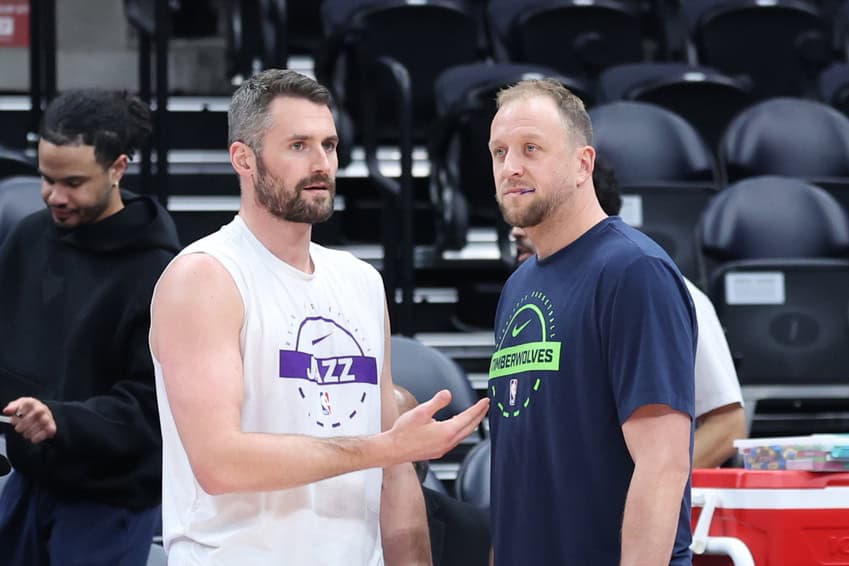
A Kevin Love reunion with the Minnesota Timberwolves would be as much sentimental as it is complicated. The franchise has changed dramatically since Love last donned a Wolves uniform, and he is no longer the 26-point, 12-rebound force who carried Minnesota through much of the early 2010s. Still, there is a legitimate basketball argument for bringing him back, if the price, role, and roster situation make sense.
For a Timberwolves team built around Anthony Edwards and a win-now core, Love could offer something that cannot be measured entirely in box score production: experience, spacing, rebounding instincts, and a meaningful connection to a franchise that has spent years trying to establish a lasting winning culture.
Love was the face of the Timberwolves before the franchise’s current era. During his Minnesota tenure, he became one of the NBA’s most dominant power forwards, pairing elite rebounding with rare offensive versatility. He could score in the post, initiate breaks with outlet passes, hit threes, and clean the defensive glass at an elite level.
https://www.youtube.com/watch?v=nJa0j-lJzio
The Timberwolves don’t need him to recreate that version of himself. They would need him to embrace a narrower, more realistic role. At this point, Love’s potential value would come from his ability to stretch the floor as a reserve big, move the ball quickly, and provide reliable rebounding in limited minutes.
Minnesota’s offense is at its best when Edwards has driving lanes and when its big man can complement, rather than crowd, him. A frontcourt player capable of pulling an opposing big away from the rim still has tangible value.
Love has also spent years on contending teams and has experience in the pressure-filled environment Minnesota is trying to navigate. He has played alongside high-usage stars, accepted shifting responsibilities, and understands the sacrifices role players make on teams with championship aspirations.
https://www.youtube.com/watch?v=4HA1ft_QHws
That veteran perspective could be useful in a locker room led by Anthony Edwards, Jaden McDaniels, and the rest of Minnesota’s core. Love would not arrive to take shots away from Minnesota’s stars. Ideally, he would arrive to help make their jobs easier.
The biggest issue is that a reunion would have to be based on fit, not nostalgia. Minnesota’s identity has been rooted in athleticism, defensive versatility, rim protection, and physicality. Love is a smart positional defender. However, he’s not the switchable, high-mobility frontcourt defender teams typically want to deploy against elite modern offenses.
The Timberwolves can’t rely on him for heavy minutes against fast, small lineups or opponents that force bigs to defend far from the basket. That means his role would need careful management.
Love makes more sense as a situational rotation player than as a nightly starter. He could help against teams that play traditional centers, especially when Minnesota needs more rebounding or shooting from its second unit. In the right matchup, his outlet passing could also help the Wolves generate transition opportunities before a defense is set.
https://www.youtube.com/watch?v=z4ipgckuzOM
There’s also a straightforward offensive case: Love remains the type of big man opponents cannot casually ignore beyond the arc. Pairing a credible shooter with a more interior-oriented center or forward can create cleaner space for Edwards to attack. But Minnesota would need to avoid treating Love as a solution to every frontcourt question. He would be a complementary piece, not a foundational player.
Even if Love and the Timberwolves had mutual interest, getting him to Minnesota might not be easy. Minnesota’s financial flexibility is limited, especially with the Kuminga signing. A veteran with playoff experience may also have multiple suitors, especially if he is available through trade, buyout, or free agency. Contending teams are always looking for shooting, rebounding, and frontcourt depth, so Minnesota would not be alone in its pursuit.
A trade would be particularly challenging if it required meaningful salary matching or draft compensation. The Timberwolves should not sacrifice an important young player, a valuable rotation contributor, or future flexibility to create a feel-good reunion. The ideal scenario would be acquiring Love at a modest cost, with a clearly defined bench role and no expectation that he must carry the franchise’s emotional identity. That’s the only version of the move that makes sense.
Love returning to Minnesota would create an emotional storyline, and there is nothing wrong with that. He remains one of the most talented players in Timberwolves history, even though his first stint ended without the playoff success both sides wanted. But the best reunions happen when sentiment and strategy align.
If Love can still provide shooting, rebounding, passing, and steady veteran leadership, the Wolves should at least explore the possibility. He may be difficult to obtain, and Minnesota should not overpay to bring back a familiar name. Still, if the opportunity emerges on favorable terms, a Kevin Love reunion could be a low-risk move with a potentially meaningful payoff for a team trying to turn sustained success into something even bigger.
Think you could write a story like this? Hockey Wilderness wants you to develop your voice, find an audience, and we'll pay you to do it. Just fill out this form.

Recommended Comments
There are no comments to display.