


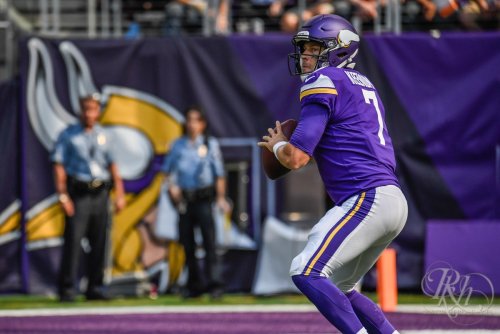
The miracle season that seems to be Case Keenum’s 2017 could form the basis for the Vikings’ strong performances this year. Ranking seventh in passer rating, eighth in adjusted net yards per attempt and second in ESPN’s QBR, Keenum seems like the major driver to success for an offense that ranks ninth in points per drive this year.
With a top-10 offense and a top-two defense, the Vikings are poised to cause damage in the postseason and possibly be the first team to play the Super Bowl in their home stadium. Historically, it’s not absolutely necessary to carry a top-tier quarterback to win a Super Bowl, but it’s the strongest indicator of success.
Unfortunately for the Vikings, their quarterback may be a paper tiger. There are a lot of signs that his play may not be sustainable and as of late, relies on luck and one-dimensional tactics that can be exploited in the playoffs.
On one hand, it may seem absurd that a quarterback can go an entire season — over 400 passing attempts — with a consistent level of statistical performance and still be fluky. After all, they have to go through a gamut of opponents in a variety of situations, and 400 passes certainly seems like a large enough sample size to iron out any kinks.
Generally, that’s pretty true. Quarterbacks who perform well in the regular season tend to perform well in the postseason and in following years.
But that’s not always the case, and there are signs that Keenum may be another example of a fluke year from a quarterback.
Quarterback Comparison
By its very nature, there aren’t a large number of examples of fluke quarterback years to compare Keenum to, but we do have some comparisons to either draw parallels or point out key distinctions that distinguish Keenum from other flukes.
Many of those flukes were referenced in a piece a month ago about Keenum’s potential contract and those can serve as a starting point for comparison. To simplify things, it will be important to look at players who have been in the NFL for a few years without posting a great season before suddenly arriving on the scene.
Players who have a storied career before dropping off for a few years can go off and have big years, and that’s not a great comparison to someone like Keenum, who doesn’t have the resume to give him the benefit of the doubt.
At the same time, a quarterback with years of mediocrity before firing off an elite season has a significantly larger burden of proof with reasonable suspicion about their sustainability going forward — much more so than Keenum.
Keenum had 777 attempts and 826 dropbacks before signing with the Vikings and therefore has a solid backlog against which to compare this year’s surprising showing.
There are some quarterbacks who can match that -- both good and bad. The chart below lists those quarterbacks as well as how many passing attempts they had before their peak and for how many years. It also lists what their adjusted net yards per attempt was for those years and what they achieved at that peak year. The final column looks at whether or not they’ve sustained their new, higher level of play for more than a few years.
| Quarterback | Attempts Before Peak | Years Before Peak | Age at Peak | ANYA before Peak | Peak ANYA | Sustained? |
| Matt Hasselbeck | 350 | 3 | 27 | 4.43 | 6.25 | No? |
| Mark Brunell | 373 | 2 | 26 | 4.82 | 6.77 | No? |
| Matt Schaub | 450 | 4 | 27 | 5.70 | 6.81 | No? |
| Matthew Stafford | 473 | 2 | 23 | 4.06 | 6.98 | Yes |
| Jake Delhomme | 535 | 3 | 29 | 5.56 | 6.43 | No |
| David Garrard | 539 | 5 | 29 | 5.31 | 6.97 | No |
| Drew Brees | 909 | 3 | 25 | 4.63 | 7.78 | Yes |
| Vince Young | 1034 | 4 | 26 | 4.92 | 7.34 | No |
| Josh McCown | 1113 | 11 | 34 | 4.14 | 7.63 | No |
| Ryan Fitzpatrick | 1175 | 6 | 29 | 4.40 | 5.29 | No |
| Alex Smith | 1514 | 6 | 27 | 4.42 | 6.13 | Yes? |
| Eli Manning | 1805 | 4 | 27 | 4.94 | 6.00 | Yes |
| Mark Sanchez | 1867 | 5 | 28 | 4.78 | 6.18 | No |
| Joe Flacco | 1958 | 4 | 27 | 5.89 | 6.34 | No |
| Andy Dalton | 2111 | 4 | 28 | 5.86 | 8.17 | No? |
| Case Keenum | 777 | 5 | 29 | 5.35 | 7.07 | ??? |
One cautionary tale worth reading into is not on the chart (no rookie-only cases are): the case of Nick Foles. After a poor 265-attempt rookie season where he led the league in TD:INT ratio, passer rating and adjusted net yards per attempt, he dropped off precipitously and is now regarded as a serious liability for the Philadelphia Eagles as they enter the playoffs.
Of course, not all surprise sophomore seasons mean unsustainability.
We’ve seen players like Donovan McNabb and Carson Palmer immediately produce as second-year players after poor rookie showings and turn in fine careers. While only time will tell whether or not the same will be true of Jared Goff -- and by some measures, Carson Wentz and Derek Carr -- it’s clear that only doing poorly as a rookie isn’t enough to provide a reasonable basis for comparison, for good or ill.
This should also allow us to dismiss Matthew Stafford, who only had three games in his second year before an injury ended his season.
From that group of 14 comparable quarterbacks, that leaves us with about three quarterbacks who look to have had sustainable success following their jump in production, aged 25, 27 and 27. There are some reasonable question marks about successes like Alex Smith, as he’s had some volatility in Kansas City and “failures” like Mark Brunell (who earned two Pro Bowls and a Super Bowl appearance after his peak), Andy Dalton (who will certainly get more chances to redeem himself) and Matt Schaub (who earned another Pro Bowl appearance with two other good seasons aside from that).
Still, excluding all edge cases gives us a hit rate of 22 percent — similar to when including edge cases.
Also worrisome is the fact that each success was relatively young, though Manning and Smith had more than twice as many attempts as Keenum did before turning out. In fact, each success had more passing attempts than Keenum did before hitting a sustainably high level of performance.
If we take it as a fact that Keenum’s 777 attempts prior to the season give us more information than his 450 this season, we should also acknowledge that that information is not always superior — though history suggests that it often is. For about a fifth of quarterbacks, the prior information was less useful than the new information — but it also means that the majority of quarterbacks revealed who they were before they peaked.
There is a second-order sample size issue. We have an admittedly low number of quarterbacks to really draw comparisons from; 14 quarterbacks can hardly provide us with clear data to draw from, but it’s also unlikely that a reasonable sample would overturn our conclusions too much either — it would take 13 successful quarterbacks of the next 16 surprise performers to turn the hit rate from low to 50/50.
So, knowing that there’s a decent chance that Keenum could be more of a Garrard than a Brees, what are the clues in his recent performances telling us?
Statistical Clues
There aren’t a lot of things surface-level statistics will tell us about Keenum’s season that gives us real insight into sustainability. The best indicators of sustainability, like ESPN’s QBR and net yards per attempt (which counts sacks as attempts and sack yardage as negative passing yardage) both like him — in QBR’s case, quite a bit.
But over the final stretch of the season, he’s been playing in a way that should raise eyebrows when digging into deeper statistics.
Excluding the Bears game, his final stretch (since Week 12) has him relying on receivers an inordinate amount for yardage, with 45.5 percent of his yards coming after the catch — 26th of 30 qualifying quarterbacks.
He’s been somewhat reticent to pass the ball deep (ranking 19th in deep passing percentage, per Pro Football Focus) and has been inaccurate when doing so, only hitting his intended target 29.4 percent of the time (ranking 20th).
For reference, Bridgewater – who has long been criticized for his mediocre ability to throw the ball deep — was accurate on 37.5 percent of deep passes in 2015 and hit 40.6 percent of his deep passes in 2014. Keenum’s recent stretch of play includes deep passing that has been worse than what many consider to be the biggest weakness of his backup.
Those two statistics line up with the change in his average depth of target, which has dropped to well below league average. He averaged 7.37 intended air yards since Week 12 (per PFF) while the league average is 8.45 and ranks about 37th of 40 quarterbacks.
Not only that, Keenum’s performance under pressure has dropped, and he ranks 20th in net yards per attempt when under pressure — he had ranked second in the NFL prior to Week 12.
A number of these changes in performance are likely due to regression to the mean, particularly when it comes to performance under pressure. Keenum was leading the league in sack avoidance, with only 4.2 percent of dropbacks under pressure resulting in a sack — twice as good as second place (Philip Rivers) and three times as good as third place (Blake Bortles).
But over the final stretch, he’s fallen below average, ranking 23rd in sack avoidance in snaps under pressure. While it’s true that he has been getting pressured more often, it’s not by an enormous amount; he ranked sixth in pressure rate before Week 12 and second after Week 12. The increase in sacks is largely due to that pressure finally converting, something that was very likely to drop off.
He’s also struggled to throw the ball in the intermediate range. For passes intended to go between 10-19 yards downfield, he’s been averaging 6.08 yards per attempt compared to a league-wide average of 9.86 —a huge dropoff.
Without the ability to complete passes deep or generate yards on intermediate throws, he’s been overly reliant on short passing and after-catch work from stellar receivers in order to get things done.
A YAC-heavy offense isn’t necessarily doom-and-gloom for a team heading to the playoffs. While the three most YAC-dependent offenses lost in the first round of the playoffs last year, the fourth-most YAC-dependent team won the Super Bowl.
Instead, the reliance on after-catch performance is more important because it tells us that the Vikings are no longer relying on Keenum to make explosive plays. The Vikings have had 52 passing plays gain 20-plus yards this year.
Before Week 12, half of the explosive passing plays the Vikings made were on passes traveling 20 yards or more through the air. Only 19.4 percent came on short throws turned into big gains from yards-after-the-catch.
After Week 12, only 25 percent of explosive passing plays came from deep passes — and the other 75 percent came exclusively on short passes that receivers turned into big gains after catching the ball. Unlike in the beginning of the year, there were no intermediate passes that turned into big plays.
Put another way, the Vikings used to rely on deep passes to get big yards. Now, they rely on short passes and after-catch work to get the same yards.
Historically, successful teams that worked with YAC-dependent offenses still were willing to throw it deep. New England ranked 16th in deep passing percentage heading into last year’s playoffs, and threw it deep 15.6 percent of the time once they entered the postseason, a mark that would have ranked second over the regular season, more often than Cam Newton’s Panthers or Palmer’s Cardinals. Their ability to produce yards-after-the-catch wasn’t a singular method of producing yards in their offense.
The Vikings may have reverted to a one-dimensional offense in response to the decreasing effectiveness of a deep passing game that looks to have been built on unsustainable luck and corrections from receivers that won’t always be able to bail out bad throws.
Just as Keenum’s lead in sack avoidance was probably a result of both luck and genuine skill at avoiding sacks, the Vikings receivers’ capabilities of winning contested catches are likely overrepresented by their current sample, even if they’re typically good at winning the ball in tight passing windows.
[caption id=attachment_24063" align="aligncenter" width="766]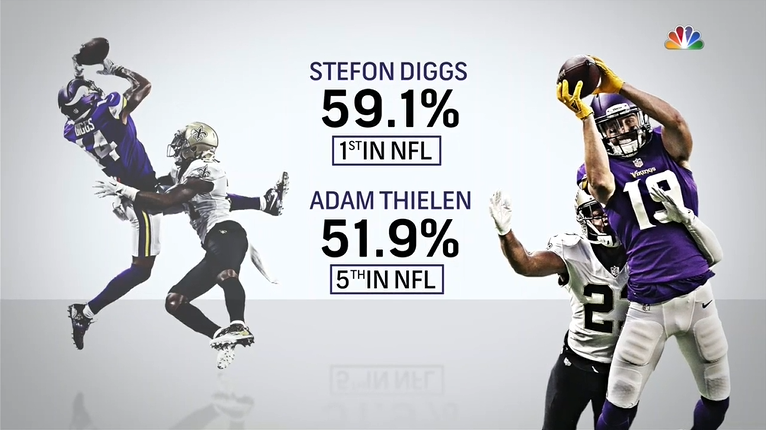 Screenshot Courtesy NBC Sports[/caption]
With 60 contested-catch opportunities between them, Diggs and Thielen have been essential to Keenum’s success.
It does happen to be the case that Keenum has been the victim of some infuriating receiver drops, but he's benefited more from sure-handed receivers than he has suffered from drops.
Since Week 12, which includes a Panthers game with five drops, Keenum has had 5.5 percent of his accurate passes dropped by receivers, according to Pro Football Focus. That's far better than league average — the sixth-most favorable situation over that span.
With an increasing reliance on yards-after-the-catch, decreasing performance under pressure and consistent dependence on winning contested catches instead of creating real estate for receivers, there’s a lot to worry about with Keenum, both in the playoffs and as a long-term option for the team.
Film Clues
All of that might not matter if Keenum has genuinely sustained his level of improvement when asked to do more — if he demonstrates repeatable, positive traits in those scenarios, these worries could fall away.
Unfortunately, film analysis highlights additional problems more than it assuages any fears.
Keenum has been the benefactor of a number of throws that should have been picked this season that he avoided, particularly in the second half of the year. While his interception rate has increased marginally — from 1.1 percent from Weeks 1-7 to 1.9 percent for Weeks 8-16 — his rate of throws that should have ended in a turnover has dramatically increased.
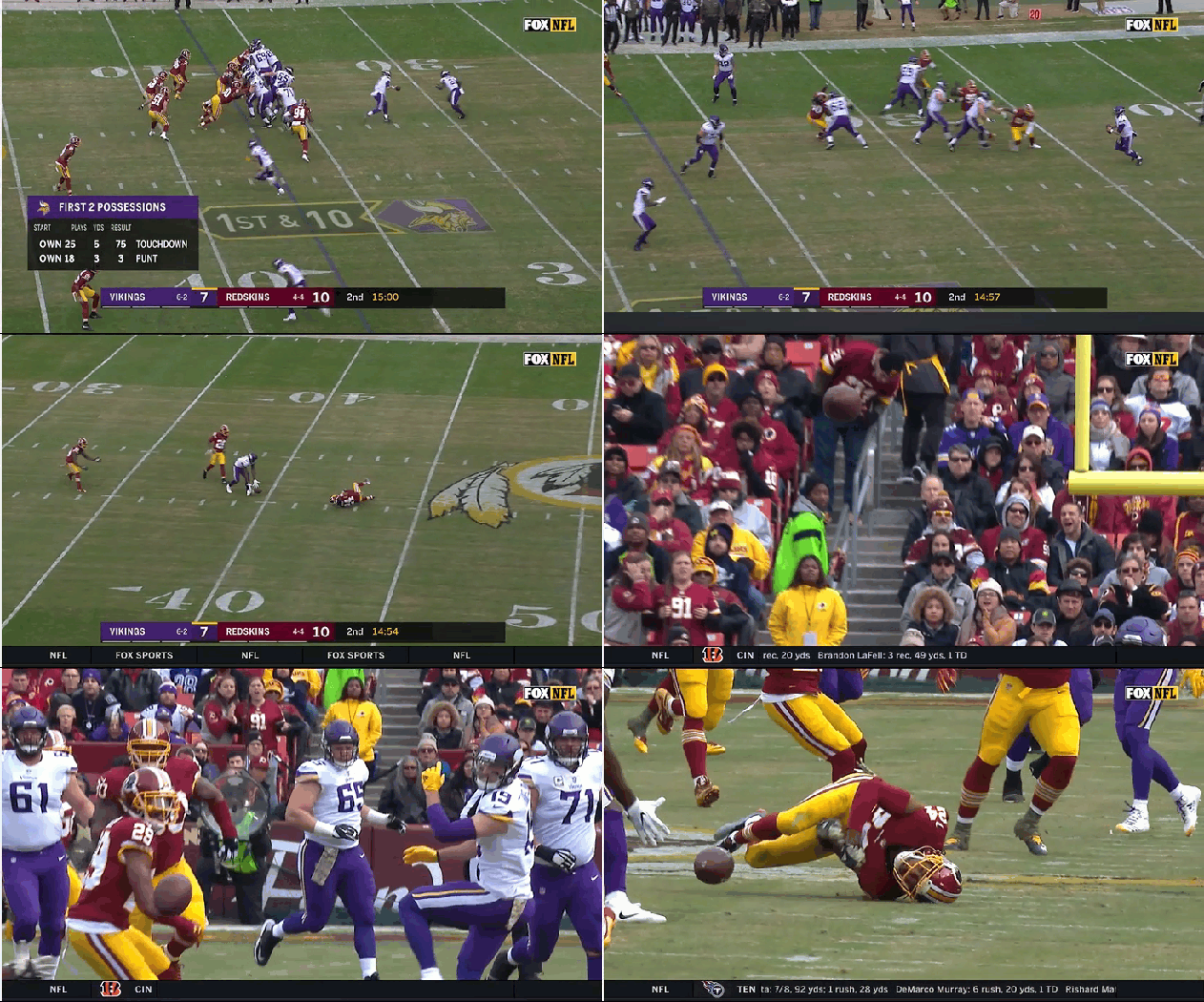
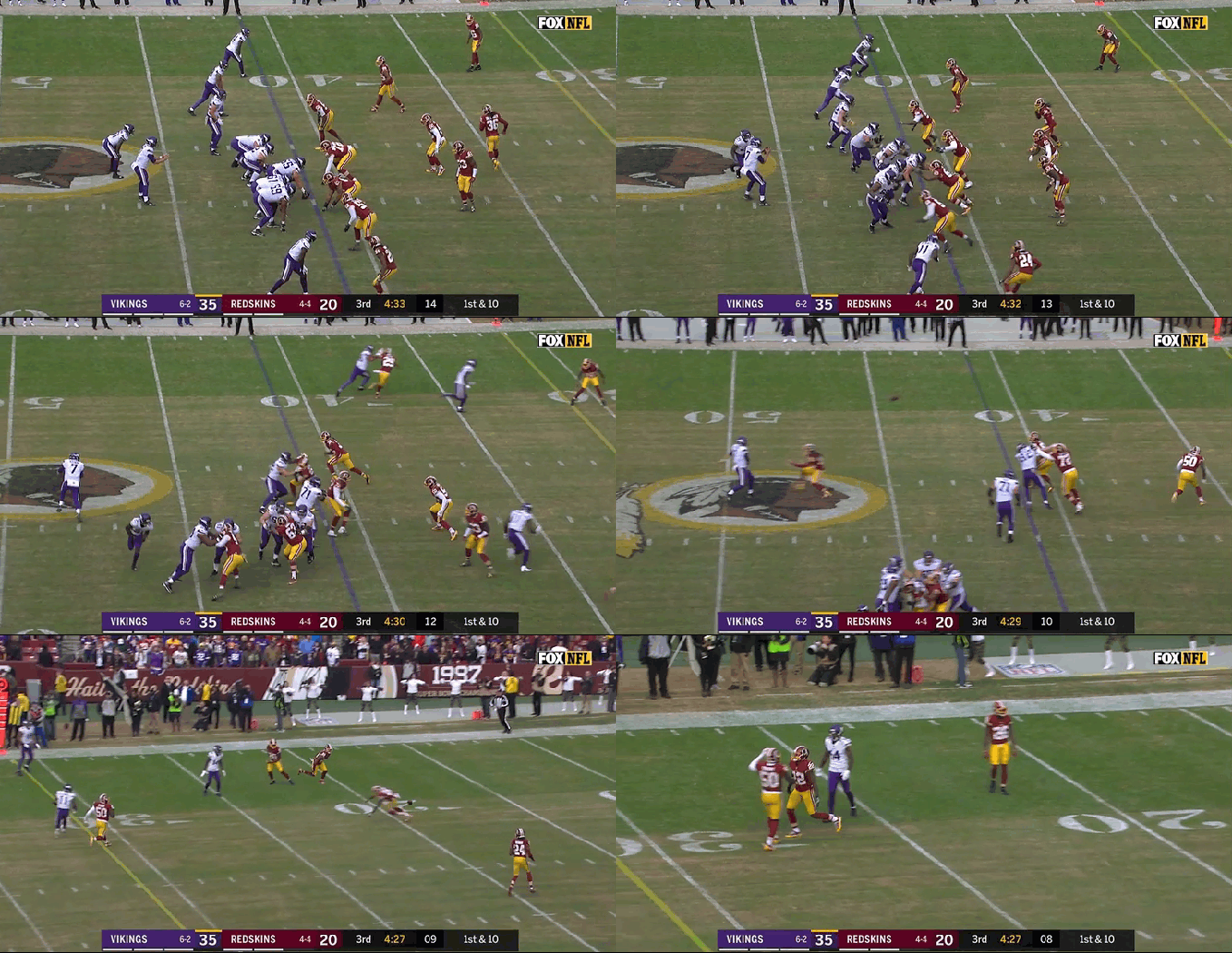


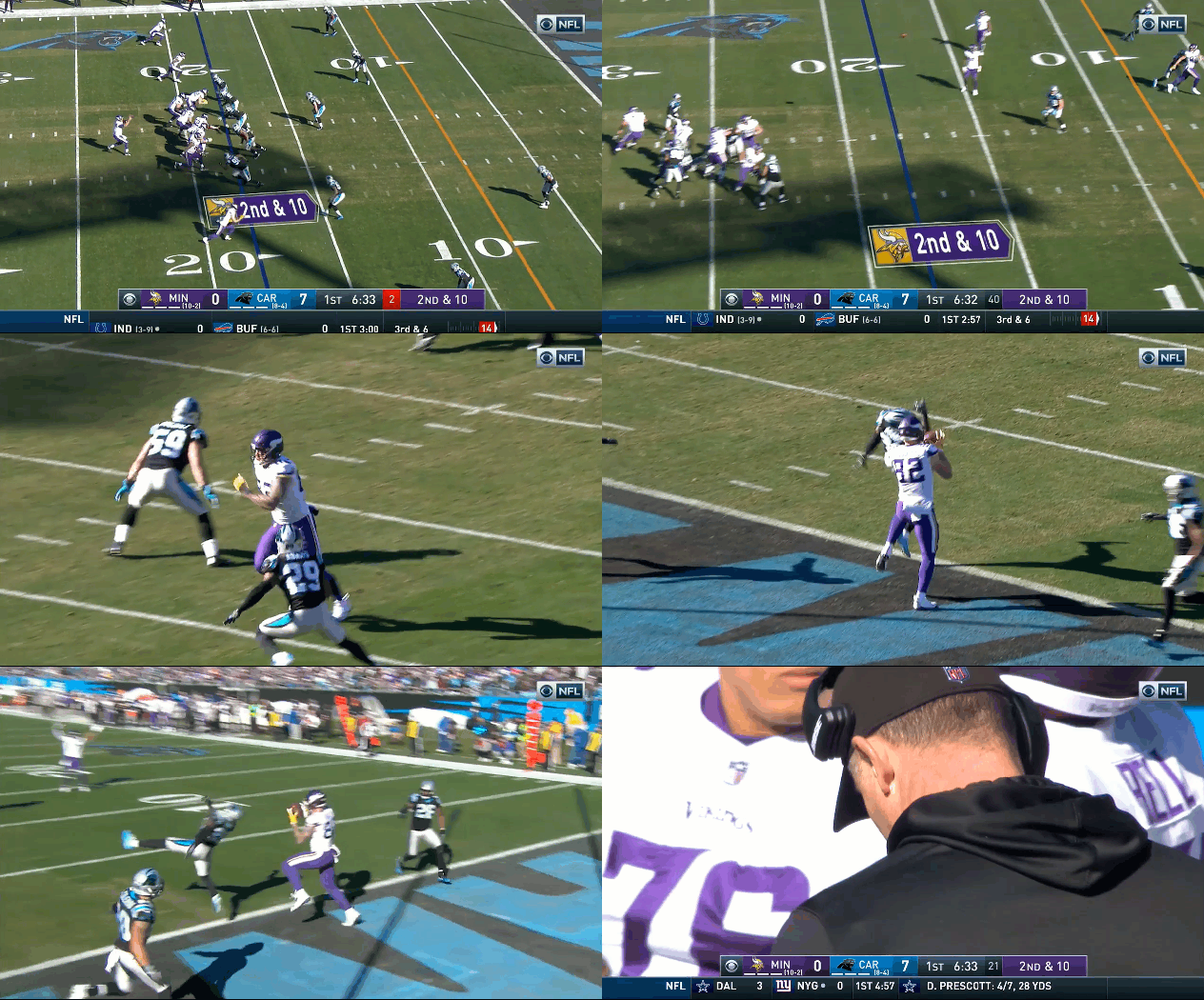
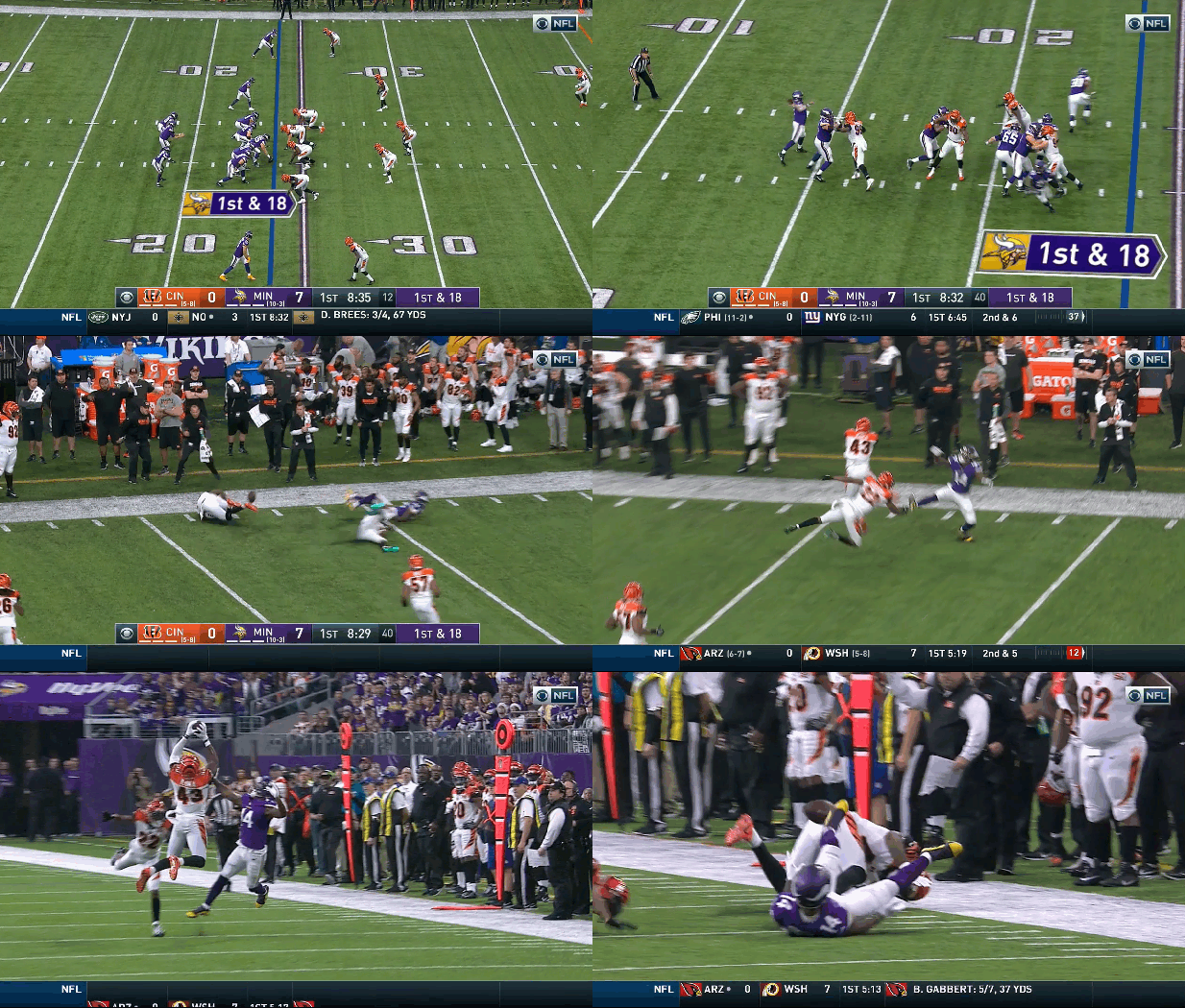
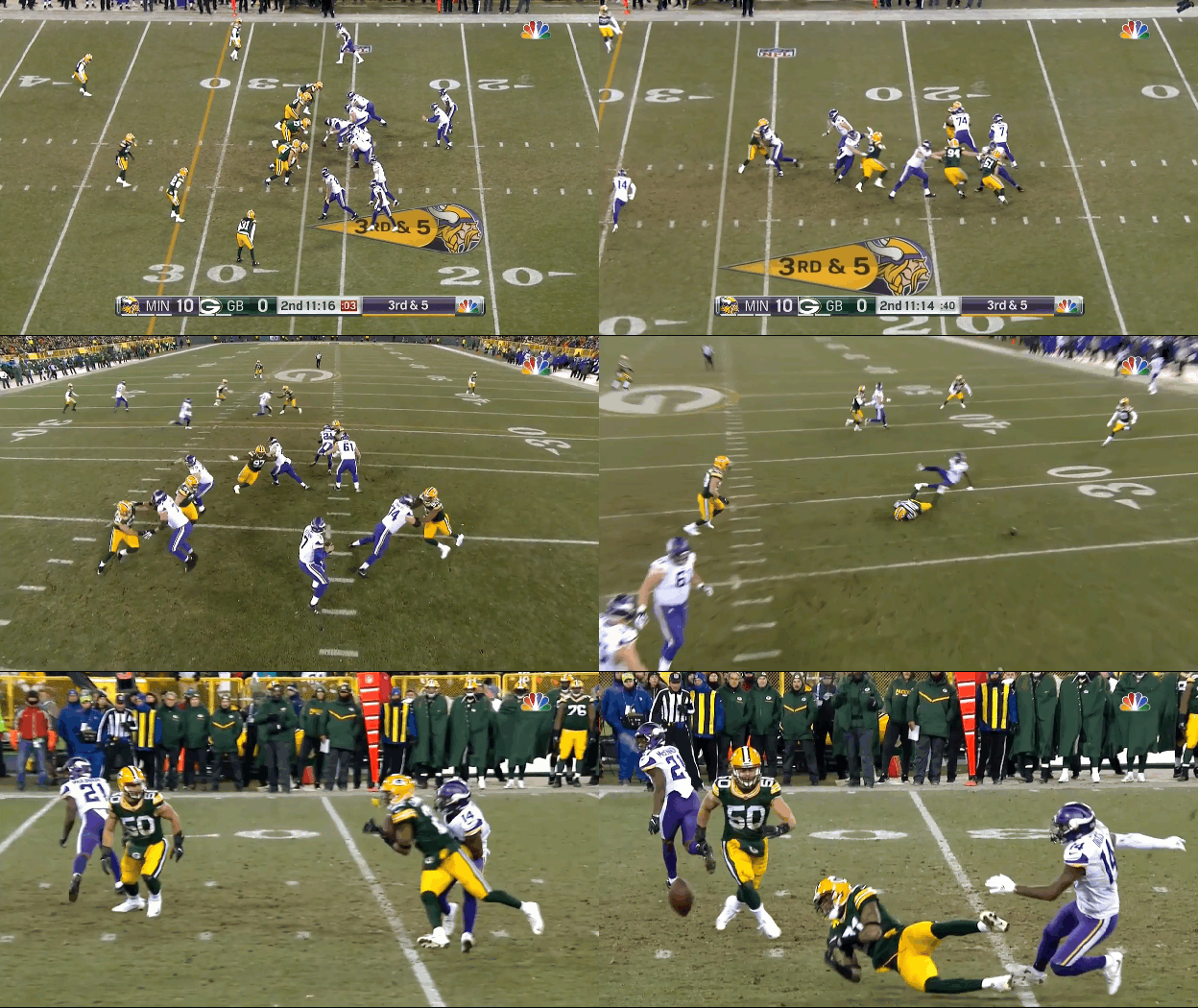
There are other passes that could have been picked as well, including two underthrown balls against Chicago that turned into pass interference penalties instead of turnovers.
This sort of thing matters — picking on passes that could have been interceptions doesn't mean that Keenum secretly threw more picks than he did; it's a demonstration that play might not be sustainable and that interceptions would catch up.
The same thing happened to Christian Ponder to begin the 2012 season. He didn't throw an interception for four games but nearly threw several picks. He then proceeded to throw six picks over the next three games and eight picks over the next five. The same is true of Foles as he entered the 2014 season.
Analyst Cian Fahey argued that Foles was not just due to come back down to earth but that he was actually a poor quarterback. His argument rested on the fact that Foles also threw a high number of passes that "should" have been intercepted. In 2014, they were.
https://twitter.com/Cianaf/status/564826534754910209
That "true" interception rate (6.0 percent) would have been the highest in the NFL in 2013. Instead, Foles had the second-lowest. The following year, he had the third-most interceptions in the NFL before getting benched in Week 9.
All quarterbacks benefit from interception luck at some point, and all of them have had to deal with the converse — interceptions created that had nothing to do with the quarterback's play. But the rate at which Keenum is avoiding those passes is much higher than usual for quarterbacks.
It's not just interceptions that are concerning. Keenum has also been likely to miss opportunities for big gains.
 Above, Keenum misses a wheel route for Jerick McKinnon where he breaks wide open.
 In this play, Keenum targets Jarius Wright and doesn't convert. This route combination is very similar to a "dagger" route combination where the vertical route is meant primarily to clear out space for the underneath route. In this case, that doesn't happen but the vertical route is wide open in part because of the coverage the Panthers decided upon. That coverage should have dictated a deep shot.
 Above, Keenum misses Thielen again. He scrambles for a big gain and largely it's a positive play, but Thielen was open immediately, and Keenum could have avoided the pressure in the first place by reading the coverage correctly.
These issues have plagued him throughout the final weeks of the season.
While it's true that one can find examples of quarterbacks "missing plays" on a somewhat consistent basis regardless of the passer, the issue isn't that another receiver happened to run free — QBs will throw their first read if the first read is open regardless of what other receivers do.
The issue is that Keenum very often will misdiagnose who is open -- throwing to receivers well covered instead of open players -- or misdiagnose who his first read should be. Very often, he will throw to a route designed to beat man coverage when the defense shows zone — even though the other side of the field has routes meant to beat that coverage. That's the precise problem with his near-interception against the Bengals up above as well as the final Green Bay example.
There are a number of very good defenses in the NFC playoffs, and four of the Vikings' five potential opponents are top eight in Football Outsiders' defensive DVOA. These defenses are unlikely to make the kinds of mistakes that allow quarterbacks to get away with missing finite opportunities or turnover-worthy throws.
The Vikings have a better defense than any of those opponents, so they might be able to weather the storm even if Keenum does have a bad day. Not only that, Keenum is a genuinely better quarterback than his price tag — currently a $1.9 million cap hit — and looks to be a better investment than Foles, who has had to take over for Wentz in Philadelphia.
None of this means the Vikings will fail in the postseason, it just means the path could be more difficult than the surface numbers imply.
Catch Arif every week on The Andy Luke & Arif Football Machine

Think you could write a story like this? Hockey Wilderness wants you to develop your voice, find an audience, and we'll pay you to do it. Just fill out this form.
Recommended Comments