


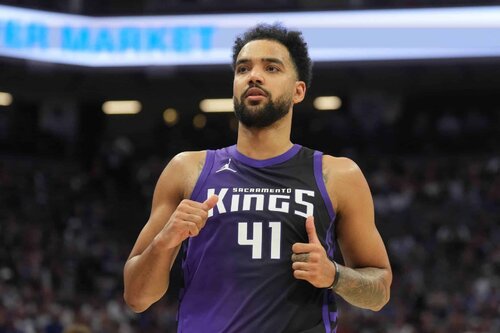
The Minnesota Timberwolves’ decision to sign Trey Lyles feels less like a solution and more like a patch job, one that underscores a lingering issue in the forward rotation rather than resolving it.
At its core, this move reflects a familiar front office dilemma: Trying to stabilize a meaningful role with a player best suited for the margins. Trey Lyles is a capable veteran with stretch-floor utility, and he brings professionalism and some offensive versatility. But asking him to meaningfully shore up a rotation spot, particularly for a team that aspires to contend, highlights a gap between intent and execution.
Trey Lyles has carved out a respectable NBA career by doing a little bit of everything. He can space the floor, attack closeouts, and provide secondary scoring off the bench. Last season, he showed flashes of efficiency as a spot-up shooter and occasional play-finisher.
https://www.youtube.com/watch?v=g8eWwzmNZvU
In isolation, those traits are valuable. In context, however, they raise a larger question. Are the Wolves addressing a need, or simply filling a body into a role that demands more impact?
Minnesota’s forward rotation has been a quiet but persistent concern. Behind the established core that Jaden McDaniels now anchors, the depth chart becomes far less certain. Any Injuries, inconsistency, or matchup limitations could expose how thin the team feels at the forward spots.
Ideally, that’s where a signing like this would bring clarity. Instead, it introduces more ambiguity. Lyles isn’t a defensive anchor, nor is he a high-level rebounder for his position. He doesn’t drastically shift lineups or offer the kind of two-way reliability that stabilizes rotations in high-leverage moments. However, Lyles provides competence, a steady but limited skill set that can survive in short bursts. That’s useful, but it’s not transformational.
That’s where the “backup player in a starting role, problem” dynamic comes into focus. The Wolves aren’t necessarily asking Lyles to start games. However, they are implicitly depending on him to absorb minutes that matter.
Whether it’s spelling McDaniels, filling in during injury stretches, or complementing smaller lineups, those minutes carry weight. And relying on a player whose value is rooted in low-usage efficiency creates a ceiling on what those lineups can achieve.
There’s also a stylistic consideration. Minnesota’s identity under Chris Finch has leaned on versatility, defensive length, and lineup adaptability. Lyles fits only part of that equation. Offensively, he can keep the ball moving and knock down open shots. Teams can target him defensively. That will become an issue against stronger Western Conference opponents, especially teams with dynamic forwards and switch-heavy schemes.
To be clear, this isn’t an indictment of Lyles as a player. In the right role, he’s a positive contributor. On a deep roster, he’s the eighth or ninth man who keeps things functional during bench stretches.
The issue is less about who he is and more about what the Wolves need him to be. If Minnesota is serious about contending, the forward rotation requires more than survivability. It needs a player who can tilt matchups, defend multiple positions at a high level, and provide consistent production without being schemed out of games. Lyles doesn’t check enough of those boxes to elevate the group in that way.
Ultimately, this signing feels like a hedge, a low-risk move that preserves flexibility but doesn’t meaningfully solve a problem. It’s the basketball equivalent of using a reserve part to fix a structural issue: It might hold for a while, but it’s unlikely to withstand real pressure. For a team with ambitions beyond just making the playoffs, that distinction matters.
The Wolves don’t just need bodies in the rotation; they need answers. And right now, this move looks more like a placeholder than a solution.
Think you could write a story like this? Hockey Wilderness wants you to develop your voice, find an audience, and we'll pay you to do it. Just fill out this form.
Recommended Comments
There are no comments to display.