

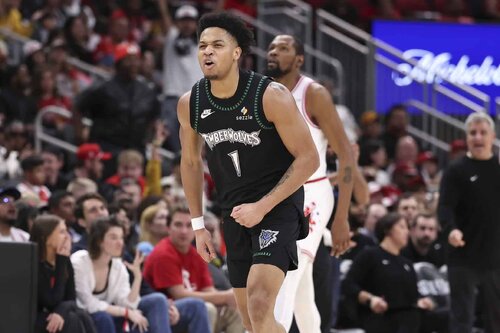
After Terrence Shannon Jr. scored 24 points in the Minnesota Timberwolves’ 110-98 series-clinching Game 6 win over the Denver Nuggets in April, Chris Finch highlighted a mistake he made.
“We’ve learned with TJ that he’s got to have the ball in his hands,” Finch said. “Silly me, we played him out of the corner most of the season, but he is way better with the ball in his hands at the top of the floor.”
After injuries to Anthony Edwards and Donte DiVincenzo in the playoffs, Terrence Shannon stepped into an on-ball role that unlocked a version of himself who single-handedly created a future for himself in Minnesota. Coming out of Illinois in 2024, Shannon has always been at his best with the ball in his hands, using his speed, length, and size to attack the rim.
Finch should have realized that sooner than he apparently did. And he can’t forget that lesson heading into this season.
Against the Nuggets, Shannon played like the player he has always been — the type of player the Timberwolves should continue to deploy this season, even if that means keeping him in a similarly sized role.
https://twitter.com/NBA/status/2050045385226199396?s=20
In early June, Chris Finch told KFAN’s Paul Allen that he saw Terrence Shannon as part of the solution in patching Minnesota’s need for a point guard. Leveraging him that way would have given him on-ball opportunities. But for a team that struggled to generate consistently open offense for and around Anthony Edwards, leaning too hard on Shannon — who has only recorded more than three assists six times in his career — to play like a true point guard would have been a mistake.
Less than a month later, Tim Connelly put any idea of patching together the point guard position internally to rest. He acquired LaMelo Ball, one of the few remaining true point guards in the NBA who blends dynamic scoring with an always-present knack for keeping the ball moving and hitting open teammates out of nowhere.
Ball is the type of offensive point guard Minnesota has long wanted to play alongside Edwards. But by obtaining him, Connelly shipped out Julius Randle and Naz Reid, his only two rotation-level power forwards from last season. Connelly created a power forward-sized hole to patch the point-guard-sized one. And now, the Wolves are hard-pressed to find someone who could fill that new weakness.
Connelly must fill one more roster spot before the season begins. Outside of Rudy Gobert (7’1”), Joan Beringer (6’11”), and Jaden McDaniels (6”10”), Minnesota’s size drops off. The Wolves don’t have a legitimate power forward on their roster aside from Trey Lyles and rookie Trey Kaufman-Renn. Lyles spent last season playing in Spain, and Kaufman-Renn didn’t look NBA-ready during the Las Vegas Summer League.
Complicating things further, Connelly has limited tradable contracts and only $3.9 million in cap space below the second apron — which he can not go above — to fill that final roster spot.
Therefore, in July, Connelly said on KFAN that the Wolves have some internal options that could be perceived as “left-fieldish” to replace the collective size of Randle and Reid.
At 6’6”, 220 lbs., Shannon has the physical tools to fill that hole. He also has the strength and versatile defense — should he carry that over from the playoffs — that Finch could use in his starting lineup. Finch has said that he doesn’t see McDaniels as his starting power forward, so Shannon’s size could allow Finch to keep McDaniels at small forward.
However, starting Shannon would indicate that Finch has forgotten the lesson he learned during the playoffs.
To accentuate Ball, Edwards, McDaniels, and Rudy Gobert offensively, Finch would be best served by prioritizing an off-ball shooter to play alongside them – the type of player who would be unproblematic offensively.
They don’t need — or want — the ball in their hands to be effective and can drain open threes when presented with them. Maybe that player is Ayo Dosunmu, who shot 43% on catch-and-shoot threes last season. Or maybe it’s Josh Green, who has said he’s willing to play power forward and has shot near or over 40% on spot-up threes in each of the last four seasons.
That player is probably not Shannon, though. While he shot 40.8% from deep last season, he shot 18 of 53 (34%) on catch-and-shoot attempts and 13 of 23 (56.5%) on pull-up threes.
Most of Shannon’s offensive output, should he play most of his minutes alongside Ball, Edwards, and McDaniels, would be off the ball. He was a willing cutter last season and went into the summer knowing he could improve his off-ball offense. For as long as Shannon is a role player in the NBA, he will need to continue to improve that part of his game.
At the same time, Shannon has shown too much of his on-ball scoring abilities for the Wolves — who will be searching for ways to make up for Reid’s scoring punch off the bench — to go away from that.
By keeping Shannon off the bench and deploying him in lineups without Ball or Edwards, Finch will enable him to operate more with the ball in his hands at his preferred fast-paced style alongside like-minded players such as Bones Hyland, Jaylen Clark, and Joan Beringer. And if Green starts, then we can add Dosunmu to that group as well.
While Terrence Shannon has proven he’s probably a starting-caliber player in certain systems and has the physical tools necessary to start for Minnesota, Finch must recall the lesson he learned after Shannon’s 24-point game in the playoffs. He is at his best with the freedom to operate with the ball in his hands. And Shannon would lose that freedom should he be a starter this season.
Think you could write a story like this? Hockey Wilderness wants you to develop your voice, find an audience, and we'll pay you to do it. Just fill out this form.
Recommended Comments
There are no comments to display.