

Now that the dust has settled on the LeBron James free agency frenzy, we can finally get to the NBA offseason. Feel free to unsubscribe from Shams Charania’s tweets for three months. You can put down the Summer League tape for now. And the second apron can’t hurt you in August.
Whenever you finish reading this, you can check out, go on vacation, and check back in after the Minnesota Vikings have an early-season meltdown in September when they realize too late that neither J.J. McCarthy nor Kyler Murray was the answer. But the Vikings are a problem for another day.
As the Minnesota Timberwolves head into the depths of the offseason, Chris Finch should be left with a few existential questions to ponder while enjoying a beer or two at his favorite local taverns. Who the hell is going to start at power forward? Can LaMelo drive in the snow? Is Joan Beringer really the French Giannis? And how does rookie Isaiah Evans fit into all of this?
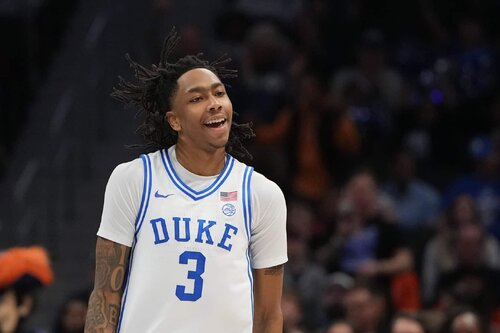
After a series of trades, the Wolves acquired Evans with the 33rd overall pick in the 2026 NBA Draft. The 6’6” guard out of Duke enters a Wolves team in flux after jettisoning Naz Reid and Julius Randle after running out of gas in the second round against the San Antonio Spurs. Evans has traits that should translate well to the NBA. But he has one thing strongly working against him.
Chris Finch is entering his sixth full season as the head coach of the Minnesota Timberwolves. He’s the best coach in franchise history, leading the way through the golden age of Timberwolves basketball. But like Flip Saunders before him, part of Finch’s aura is his win-now-at-all-costs coaching style, which means he tends to pay little attention to the rookies on his roster.
Finch took over the Timberwolves in February 2021 after Ryan Saunders led the young squad to an abysmal 7-24 record. Finch inherited rookies Anthony Edwards and Jaden McDaniels, who were already key contributors on the lottery-bound team. Edwards averaged 14.3 points in 28.5 minutes per game under Saunders and came off the bench until late January.
After the Wolves hired Finch, he drastically increased Ant’s playing time as a rookie to 34.9 minutes per game during the second half of the season, and Edwards responded in kind by showing his future star potential and averaging 23.2 points per game under Finch. But that is what you can expect when you’re the first overall pick in the draft. Any coach would have played Anthony Edwards mega minutes on a team that ended up winning 23 games that season.
Jaden McDaniels played 19.3 minutes per game under Saunders and 27.1 under Finch as a rookie. Some of that can be attributed to the Wolves already being out of the playoff race and giving their youngsters the run of the team with no consequences down the stretch. Naz Reid’s playing time actually decreased from 21.2 minutes per game with Saunders to 17.9 with Finch in his second season. But Finch played a large role in shaping him into the Sixth Man of the Year that he became.
After the 2020-21 season, opportunities for rookies to contribute for the Wolves dried up quickly as Minnesota started to win. Leandro Bolmaro and McKinley Wright hardly touched the court in 2021-22. Josh Minott and Wendell Moore Jr. were nothing more than end-of-bench seat fillers during their rookie season. Leonard Miller never found a role in Chris Finch’s rotation in 2023-24. Rob Dillingham was a 160-pound mess. Terrence Shannon Jr. and Jaylen Clark showed flashes, but Finch buried them on the bench. And last season, Joan Beringer wasn’t quite ready for primetime after showing his upside during summer league and preseason ball.
Now with Anthony Edwards, LaMelo Ball, Jaden McDaniels, Rudy Gobert, Ayo Dosunmu, Joan Beringer, Bones Hyland, TSJ, and Jaylen Clark on the roster, and Donte DiVincenzo recovering from a torn Achilles, Finch might be in dire need of bench support to fill out the remaining spot to get this to a ten-man rotation. Isaiah Evans should be able to fit the mold of a malleable young wing who can back up Ant and Ayo at shooting guard and offer some depth behind McDaniels and Shannon Jr. at small forward.
His first showing in a Timberwolves jersey at summer league was a disappointment. Evans shot 2-15 in his first action in Las Vegas and failed to look comfortable at all against future NBA competition. Finch has plenty of other options to turn to if Evans isn’t ready to go on a team that traded frontcourt depth for backcourt depth this season. Evans could be anywhere from fourth to ninth in Finch’s backcourt rotation at the start of the 2026-27 season.
If Finch’s precedent is a clear marker of the future, Evans will need to be patient and prove himself in the G League, and the stay-in-shape runs during his first season or two before he can gain the head coach’s trust. Finch has overseen some of the best player development stories in the NBA during his tenure. Still, outside of Edwards, McDaniels, and Naz Reid, the homegrown talent pipeline has been clogged.
Think you could write a story like this? Hockey Wilderness wants you to develop your voice, find an audience, and we'll pay you to do it. Just fill out this form.
Recommended Comments
There are no comments to display.