


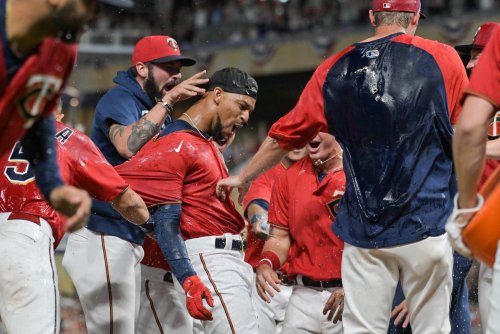
Who doesn’t love a guy that knows when to come up big in a crucial spot?
Whether it’s for one postseason like David Freese and the St. Louis Cardinals in 2011 or David Ortiz delivering in crucial moments for the Boston Red Sox in 2004 and 2013, being clutch at the right time can cement legacies. For the Minnesota Twins, Kirby Puckett’s heroics in the 1991 World Series made him many fans’ favorite player.
Everyone wants to see their team produce when it matters most, even during a regular-season game in the middle of the season.
Minnesota’s offense has been inconsistent so far this season. There are moments where they can rattle off 10-plus runs. However, they may only have three hits the next day. How can a team that ranks fourth in the American League in runs scored and fifth in home runs be concerned about lack of run production? One possible reason could be how clutch they are with runners in scoring position.
On Monday night, the Twins hung four runs in the 10th inning to beat the White Sox in Chicago. But on Saturday, the team went 1-7 with RISP. Of course, that one hit was a game-winner. Still, if the Twins produce in an earlier situation, the game likely doesn’t even get to the bottom of the ninth. There are times this season where getting runners in scoring positions with no one out has been more stressful than exciting to watch because the lineup has squandered those opportunities.
Those cases are anecdotal evidence. But how have the Twins been doing overall with RISP this season? Surprisingly, they’ve been one of the league’s better teams in that department. The team’s .265 average with RISP is sixth-best in all of baseball. Luis Arraez is leading the way with a .396 average with RISP.
However, things get a little more interesting despite their high ranking. The Twins place 19th in runs scored when you isolate runs scored from runners in scoring position. Even Byron Buxton, who’s considered a clutch player this year, only has a .189 average with RISP.
So what does that mean? Generally, it means that Twins aren’t terrible with runners on, individually, but struggle to drive in runs in those situations. Not every high-leverage situation comes in the late innings, though. Some of the most significant spots can come from innings 1-6 rather than 7-9.
Win probability added for each team measures leverage throughout a game. A rating of 6 is the high end, while -3 is league-worst. 1 is league average. The Twins have a 2.42 WPA rating as a team, placing them seventh in baseball. However, there is a 1.5-plus win gap between them and the top six teams.
Diving into the Twins roster, it’s the usual suspects at the top of the WPA list. Arraez (2.20 WPA) and Buxton (1.97) have been the most impactful Twins players in this regard. That won’t come as a shock to those who watched Monday night’s game in Chicago. The least successful Twins players in terms of WPA? Jose Miranda (-0.54 WPA) and Carlos Correa (-0.16). Gary Sanchez leads the team with 27 RBIs with RISP but only accumulates a -0.50 WPA mark.
Another way to look at this would be through Fangraphs' “Clutch” statistic, which scores a player on how well they do in high-leverage spots compared to a more neutral situation. Basically, a clutch rating can be scored anywhere from 2 to minus-2. Zero is league average.
The Twins are towards the bottom two-thirds of the league in clutch rating, with a below-average -0.69 mark. Arraez and Buxton lead the Twins with 0.59 clutch ratings. Correa’s -0.95 rating is the worst on the team. These rankings haven't been kind to Correa. But in fairness to him, he’s seen more clutch scenarios compared to other Twins players, which tends to impact that score. Still, he has yet to find his signature moment at the plate where he takes over a ballgame.
No individual stat fully determines whether or not a player is clutch. But what it does do is help us navigate these situations to give us a better assessment of prior performance. Baseball can be a random game. Sometimes a career .200 hitter can put together more at-bats in the clutch than a .275 hitter.
Sometimes all these stats confirm what we already see with our eyes. Yeah, Arraez seems to be the most “clutch” player on the Twins roster. He always seems to generate positive outcomes in critical spots. Buxton and Polanco are likelier to contribute in the clutch than guys like Miranda or Correa.
All of these guys have provided value to the Twins in one way or another this year. I’m not necessarily saying that a particular group of players is inherently worse than another, generally. But late-inning or high-leverage results will become increasingly crucial in the second half.
Determining whether a player is clutch can feel like a nitpick. After all, the Twins enjoy a multiple-game lead on their divisional rivals heading into the All-Star Break and are the only team in the AL Central with a positive run differential. The number of big-time performances they have might not inhibit them from winning the division. Still, the team needs to have their eyes on larger sights.
A near-20-year playoff drought still looms over this franchise. The Twins have been unable to generate those big hits when it matters most in October. Clutch rating, average with RISP, and WPA don’t predict the future, but they can say plenty about which players are more likely to give you a run-producing hit in the critical moments in those games.
Most of the Twins lineup has found ways to contribute this season, no matter their status. Still, the players who come up in the clutch are the ones the fans usually look at fondly. A handful of Twins have proven their worth in that category. If the team wants to make some noise in the postseason, they will need more from everyone in high-leverage situations to make that happen.
Think you could write a story like this? Hockey Wilderness wants you to develop your voice, find an audience, and we'll pay you to do it. Just fill out this form.
Recommended Comments
There are no comments to display.