


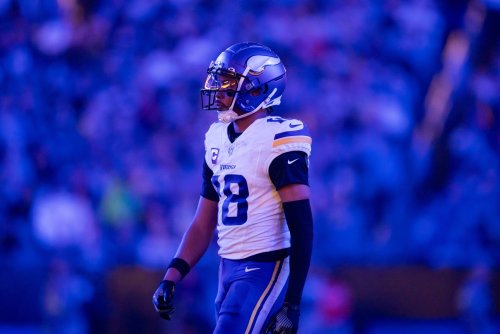
Justin Jefferson came into last season facing uncertainty.
Not of his skills, of course. Those were undeniable. Jefferson cracked 1,000 yards and five touchdowns in a 10-game, injury-shortened season in 2023. But last year, Jefferson was transitioning from the reliable (if not spectacular) Kirk Cousins under center to journeyman Sam Darnold. Even a talented receiver needs a quarterback who can get him the ball.
Turns out, no one needed to worry. Jefferson racked up 1,533 yards and 10 touchdowns, securing his second All-Pro nod. If there was a drop-off from Cousins to the surprisingly effective Darnold, Minnesota Vikings fans couldn't notice it.
But, for the second season in a row, Jefferson is starting with a new quarterback. While Darnold wasn't anyone's idea -- save for Kevin O'Connell -- of a starting NFL quarterback, he was at least a known quantity. Now, Jefferson has the challenge of maintaining his production with a complete unknown in J.J. McCarthy.
Granted, O'Connell was right about Darnold, and he deserves some deference with McCarthy. Even if a meniscus tear kept McCarthy out of action last season, he was at least around the team last year, learning the playbook and putting in work with O'Connell and Josh McCown. But no one -- not even O'Connell -- truly knows what a quarterback is capable of until they play a down in the NFL.
Is that a reason to be nervous about Jefferson's production for next year? On the one hand, that seems like a question that should only concern fantasy players. The only stat that matters is wins and losses. If Minnesota wins with Jefferson getting 1,000 yards instead of 1,500, what Skol-head is gonna care?
On the other hand, Jefferson is the most dominant player on the team, and many of Minnesota's wins come as a direct result of the dominant numbers that he produces. The Vikings are 31-17 in games in which Jefferson breaks 100 yards or scores a touchdown. They're 6-1 in games when Jefferson scores twice. That win-loss record plummets to 13-16 in games in which Jefferson is under 100 yards and is held off the score sheet.
So, yes, while individual stats "don't matter," Jefferson still needs to stay dominant for the Vikings to have a real shot. McCarthy must prove that he can get the ball to Jefferson to keep the team competitive.
Since we don't have a substantial body of work to judge McCarthy on, we'll have to turn to history. How have other elite wide receivers seen their numbers impacted when rolling with a first-year starter? That seems like a simple enough question to ask.
Answering it is probably a touch more complicated.
Putting together a list of players in Jefferson's tier is somewhat nebulous. Suppose we restrict ourselves to receivers with multiple All-Pro seasons, a category to which Jefferson belongs. Then, we have a sample of six (seven, including Jefferson) that excludes notable names like Mike Evans, Stefon Diggs, and Ja'Marr Chase. That doesn't seem right.
So, here's the criteria we'll settle on: A player that 1) Has led the league in a Triple Crown category (receptions, yards, TDs) during the last decade and 2) Has made multiple Pro Bowls.
Improbably, that leaves Cooper Kupp out of the mix. Still, we otherwise get the following group: Davante Adams, Antonio Brown, Doug Baldwin, Ja'Marr Chase, Stefon Diggs, Mike Evans, Larry Fitzgerald, Tyreek Hill, T.Y. Hilton, DeAndre Hopkins, Julio Jones, Jarvis Landry, CeeDee Lamb, Brandon Marshall, and Michael Thomas.
That seems decent enough to work with.
We also need to account for quarterbacks in similar situations to McCarthy. For our purposes, that will be a quarterback who is A) 25 or under, B) was drafted in the first two rounds, and C) is starting eight or more games for the first time in their career. We also want to ensure that our receivers are still in their prime, so the elite wideout can't be more than two years removed from their most recent Pro Bowl nod.
Now that we have that settled, let's dig in.
2015, Mike Evans
First-Year Starter: Jameis Winston
2014 Stats: 68 catches, 1,051 yards, 12 TD
2015 Stats: 74 catches, 1,206 yards, 3 TD
Evans would likely have gotten Offensive Rookie of the Year status in 2014 if not for Odell Beckham Jr.'s ridiculous campaign. Going from Josh McCown (yes, that McCown) to Winston was an upgrade in talent, but obviously, not experience. Winston threw 15 interceptions and 22 touchdowns as a rookie. Still, Evans got his first Pro Bowl nod and built on two of his three numbers in his sophomore season.
Verdict: Neutral. The downgrade from 12 touchdowns to three is steep, but Evans' games with 100 yards/1 TD only dropped from nine in his rookie season to seven in his first year with Winston.
2018, Tyreek Hill
First-Year Starter: Patrick Mahomes
2017 Stats: 75 catches, 1,183 yards, 7 TD
2018 Stats: 87 catches, 1,479 yards, 12 TD
You knew this was coming. The Kansas City Chiefs turned the keys over from the hyper-efficient Alex Smith to the absurdly talented Mahomes. Hill broke out as a deep threat under Smith, but who are we kidding? Mahomes got in, and the rest was history.
Verdict: Step forward. Mahomes will do that.
2018, DeAndre Hopkins
First-Year Starter: Deshaun Watson
2017 Stats: 96 catches, 1,378 yards, 13 TD
2018 Stats: 115 catches, 1,572 yards, 11 TD
While Watson's first full season was in 2018, it may be more instructive to look at the jump between Hopkins' 2016 and 2017 seasons. Hopkins was capable of huge numbers with mediocre quarterback play. The star wideout made his first Pro Bowl in 2015 (111/1,507/11) with Brian Hoyer as his primary signal caller.
Still, in 2016, Brock Osweiler couldn't make it work with Hopkins, despite the team's 9-7 record. Hopkins mustered 78 catches, 954 yards, and four touchdowns. While Watson's rookie season doesn't meet our QB criteria (he started six games, not eight), he represented a big jump from 2016. During his six starts with Watson in 2017, Hopkins averaged 91.8 yards per game and scored six touchdowns, with his catches and yards rising during Watson's first full season.
Verdict: Step forward. It's hard not to consider the 2017 Watson-Hopkins connection in this analysis, even if Hopkins continued to get his numbers with Tom Savage (whoever he is) that season. Even purely going from 2017 to 2018, Hopkins improved in two of the three Triple Crown categories while remaining an elite scoring threat.
2018, Jarvis Landry
First-Year Starter: Baker Mayfield
2017 Stats: 112 catches, 978 yards, 9 TD
2018 Stats: 81 catches, 974 yards, 4 TD
Landry saw not just a change of quarterback, but a shakeup of the entire system, going from Jay Cutler's Miami Dolphins to the woeful Cleveland Browns. Landry got a Pro Bowl nod in both seasons. Still, even with Mayfield throwing for 3,725 yards and 27 touchdowns, it's clear Landry took a step back.
Some of it was self-inflicted, as he struggled with 11 drops (nine after Week 3, when Mayfield first came into action), though Mayfield's inexperience and ball placement could also have been a factor. It's worth noting that he cleaned up the issue in the following two seasons.
Verdict: Step back. Hauling in five or six catches instead of dropping them might have this pushed more toward neutral territory, but it seems like the change of scenery/quarterbacks did Landry a ton of favors.
2018, Larry Fitzgerald
First-Year Starter: Josh Rosen
2017 Stats: 109 catches, 1,156 yards, 6 TD
2018 Stats: 69 catches, 734 yards, 6 TD
We had Mahomes earlier, now meet the Anti-Mahomes. Like the Chiefs that year (and the Vikings this season), the Arizona Cardinals turned from a reliable quarterback in Carson Palmer to a 10th-overall pick. It did not work out with Rosen, and the issue was apparent from the start.
Verdict: Step back. Age is a potential factor in this, as Fitzgerald was 35 years old, but it has to mean something, given the transition from a decent-enough starter in Palmer to the biggest QB bust of the decade. Which means our next and last subject is...
2019, Larry Fitzgerald
First-Year Starter: Kyler Murray
2018 Stats: 69 catches, 734 yards, 6 TD
2019 Stats: 75 catches, 804 yards, 4 TD
Fitzgerald and the Cards got an instant reset at quarterback, and as a result, Fitzgerald got a little bit of a rebound in terms of catches and yards. You'd think that maybe going from an all-time bust to a talented No. 1-overall QB in Murray would have been more impactful, but remember, Fitzgerald was 36 instead of 35. He'd play just one more season after this.
Verdict: Neutral. It'd be more fun to see these two seasons with a Prime Fitzgerald, but alas, that's not in the cards.
Overall, this seems to point only to positive aspects of Jefferson. Of our six subjects, four were able to hold steady or improve, while the two that weren't had mitigating circumstances. Landry changed teams and systems, starting the year under Hue Jackson's leadership. That's gonna hurt. As for Fitzgerald, he was finally slowed down by the great cornerback known as Father Time.
Neither of these applies to the 26-year-old Jefferson, who enters the season with O'Connell and offensive coordinator Wes Phillips for the fourth consecutive year. That's an extraordinary amount of continuity in the NFL. There's a chance that the Vikings might be a touch more conservative this year, perhaps running the ball a bit more, but other than that?
It certainly appears that McCarthy would have to be completely unprepared for prime time to slow Jefferson down.
Think you could write a story like this? Hockey Wilderness wants you to develop your voice, find an audience, and we'll pay you to do it. Just fill out this form.
Recommended Comments
There are no comments to display.