


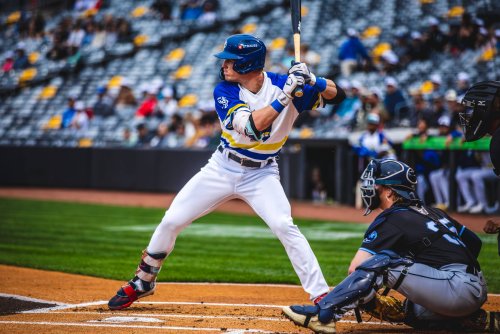
A few days before making his now-historic debut at shortstop for the promising Pittsburgh Pirates, Konnor Griffin reportedly found himself considering a nine-figure contract for a job for which he had yet to begin.
Olney's report draws our attention for several reasons. First, this is a nine-year superstar contract being offered by the Pirates, under the notorious ownership of the Nutting family. The Kansas City Royals may have lost more games in the last 30 years, but no club has squandered more talent than the Pirates. Currently, they boast one of the league’s finest ball yards and the best pitcher baseball has seen in 120 years.
Second, Griffin has not played any games as a major leaguer. In fact, compared to most rookies, he’s barely played in the minor leagues. The Pirates drafted Griffin in 2024, and his ascendancy to the throne of baseball prospects has been well chronicled -- as much as one can chronicle a mere 629 days between draft and debut.
Long-term extension talks aside, his arrival drew a sold-out crowd. It made Pittsburgh’s interleague matchup into appointment viewing for the rest of us during the Twins’ non-metaphorical power outage:
Listen to Pittsburgh. Their sound tells the story of renewal in a sold-out PNC Park, home of the 29th-winningest team in baseball (since 1996). You can hear first the thrill of a 19-year-old’s first plate appearance; then, as the ball leaves the bat, the sound of the unique kind of pastoral hope that baseball was designed to bring to the urbana. It’s in the joyous cadence of play-by-play announcer Greg Brown’s voice: “Do you believe it?”
But the third reason for us to attend to Olney’s tweet, and the one that matters for Twins Territory, is that Konnor Griffin is not the only major-leaguer with next-to-no experience signing massive, nine-figure extensions.
This trend started, understandably, with Corbin Carroll’s eight-year deal with the Arizona Diamondbacks in March 2023, but the Boston Red Sox institutionalized the practice in 2024. I suspect we will hear more of such deals. If this is the way the sport’s business is going -- the signing of players based on promise, rather than performance -- then the Pohlad ownership group has plenty of precedent to follow through on their own promises.
Former Twins great Craig Breslow, now the Boston Red Sox general manager, has spent the last few years preparing for an all-time great Red Sox team to take the field sometime in the early 2030s. Since 2024, he has signed five young players to large contract extensions:
Brayan Bello: six years, $55 million;
Ceddanne Rafaela: eight years, $50 million
Garrett Crochet (after trade): six years, $170 million
Kristian Campbell: eight years, $60 million
Roman Anthony: eight years, $130 million
Breslow’s work will likely continue: Carlos Narvaez and newly acquired Caleb Durbin are also expecting offers for long-term contracts early in their career.
It seems like all the cool kids are doing it.
The Chicago Cubs, in a dizzying week of crafting headlines, signed Pete Crow-Armstrong and Nico Hoerner to six-year deals in the $110 to $115 million range.
20-year-old Colt Emerson, the Seattle Mariners’ top prospect, signed an eight-year, $95 million contract on March 31st, before being optioned to AAA-Tacoma.
Even the Milwaukee Brewers, who traded Caleb Durbin after his stellar rookie season, signed their top shortstop prospect, Cooper Pratt, to an eight-year deal that could be worth as much as $80 million, a companion to the contract signed by Jackson Chourio at the end of 2023.
These numbers are silly, considering what they represent. Stephen Strasburg didn't sign his 9-figure contract with the Washington Nationals until his eighth year of MLB service. The reason for that? The other side of potential’s coin-flip: injury, particularly for pitchers. Strasburg did eventually get his World Series -- just one -- in 2019, but by then he was in his 10th year of MLB service, three years removed from his best season and the signing of his 7-year, $175 million contract.
Most of the players who have signed for nearly as much in the past few years have little Major League experience. Corbin Carroll and Roman Anthony had 85 days’ experience between them; some, like Griffin and Pratt, have zero. They are receiving these contracts despite the potential for injury.
Even stingy organizations like the Pirates and Brewers are in on this surge, signing their most promising players to midmarket deals to clear any potential salary cap. More importantly, these deals give teams marketable young stars to re-fire the fan base when baseball returns after the new labor agreement. The Red Sox are likely going to be really, really good before too long, and they’re willing to pay their players based on the promise they’ve shown in the hopes of fielding a winner in the new era.
Two days ago, Theo Tollefson wrote about the malaise among the Twins’ fan base and its chief cause: the Pohlads’ refusal to act competitively. As the Twins stepped to the plate in the bottom of the sixth on Friday’s home opener, the television broadcast replayed a pregame interview with Executive Chair Tom Pohlad:
I’m speaking for a lot of us here, but Tom? We will.
36,042 hopeful fans showed up on Opening Day, endured an hour’s delay, put their winter wills to the test based on a hope you’ve done very little to prompt. If we will?
All may be lightning in baseball, but hope is the marrow of its very design. It takes a lot to win, but to inspire, you need only to be as good as your word. Even your peers, the Nuttings, are taking that step. Listen to the hope 19-year-old Konnor Griffin inspired with a single at-bat last Friday. They’ve already renamed the left-center field power alley in his honor:
The Twins have two young players to whom the fans are looking to become the Griffins, the Carrolls, Anthonys, and Chourios of Target Field: Walker Jenkins and Kaelen Culpepper. Neither has seen a single day of major-league service. Still, things couldn’t be going much better for Culpepper in St. Paul, and Jenkins last year became a rarity: a player to get Triple-A at-bats before the age of 21.
There’s another brace of outfielders waiting in Emmanuel Rodriguez and Gabriel Gonzalez; there’s 19-year-old Eduardo Tait, already the No. 3 prospect in the pipeline. It’s baseball, so other surprises are coming.
Five years ago, only freespending or insane organizations were offering nine-figure contracts to players who had yet to play a single game in the Show. In 2026, on the cusp of a financial rebirth in Major League Baseball, it seems to be best practice. And while none of these players is a sure thing -- lest we forget we reside within the discourse of baseball -- promise and potential have become the selling points for these young players.
People are looking for a reason to hope at the ball yard. Even Tom Pohlad recognizes it, at least in interviews, and if he’s serious about “winning baseball games,” the blueprint for baseball's winners in 2030 and beyond appears to have taken shape. Jenkins and Culpepper are the Twins’ cornerstones for the next decade; more, they are the foundation of the hope we’re waiting on the Pohlad ownership to cultivate at Target Field.
Think you could write a story like this? Hockey Wilderness wants you to develop your voice, find an audience, and we'll pay you to do it. Just fill out this form.
Recommended Comments
There are no comments to display.