


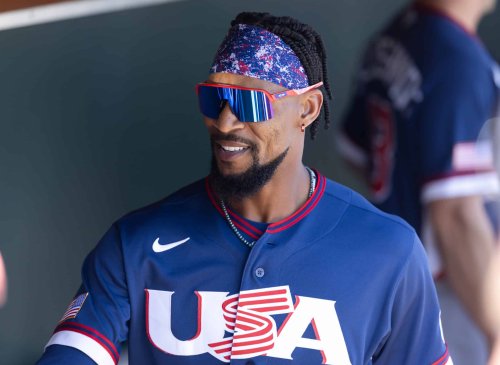
This past weekend featured the opening of the 2026 World Baseball Classic. And while Team USA and Team Puerto Rico — both undefeated as of this writing — have yet to play their third game, the narrative of their wins underscores the WBC's place as a global event and a showcase of baseball’s elite. Meanwhile, the contrasting features of two Minnesota Twins players' first appearances illustrate the variables that make the WBC such a strange and remarkable event.
Every three years, just as Major League Baseball is preparing itself and its fans for the pageantry of Opening Day and the vast regular season to follow, the best players from each represented nation receive invitations to play for their country in a tournament not unlike the team sports that appear in the Olympics. They depart from their teammates and enter the tournament, some for its full duration. Opinions as to the timing, placement, wisdom, and expense of the event vary, and for good reason.
We turn our attention first to Team USA and the player most familiar to Twins fans.
Spectators who may not be familiar with lifelong Twins centerfielder Byron Buxton received a holistic introduction to his style of play in Friday night’s game against Team Brazil: a speedy run down the first base line to beat out a double play and extend an inning; a full-circuit, run-scoring sprint from first base on a double from Brice Turang (who himself drove in nearly a third of Team USA’s 15 runs); and an injury scare.
But in his third at-bat in the sixth inning, Buxton took a 92 mph fastball off his left forearm from Brazil’s Gabriel Barbosa. Buxton dropped his bat and trotted toward the dugout, arm limp, as trainers surged to examine him. The ball appeared to hit bone, and Buxton’s reaction initially suggested a potential injury.
As viewers waited for Team USA manager Mark DeRosa’s decision as to Buxton’s condition for further play, they perhaps questioned the wisdom -- as many have -- of playing the WBC in March, an encroachment upon the province of spring training optimism and the herald of Next Year.
Now, to have an event with the scope of the WBC -- a global showcase of baseball’s finest -- players, owners, and the international community must make certain concessions, in much the same way the NHL adjusted its entire schedule to accommodate professional players in the 2026 Games in Milano Cortino.
But in a sport that boasts a six-month,162-game regular season and another month of playoffs, requiring as many as 13 wins to win a championship, placing an additional two-week tournament for King/Pride/Etc. and Country somewhere on the calendar can only compound extant issues. As Ken Rosenthal reported, many players have been told they may not play in the WBC thanks to insurance underwriting complexities. Some teams, such as Puerto Rico, have even considered withdrawing from the tournament as a result.
Under this framework, the WBC can become yet another strain on the financial plague afflicting baseball, one that they must address to ensure the sport's long-term health.
But closer to home is the immediate threat that Buxton, after a dynamite 2025 season, might not make the Opening Day roster. I’ll grudgingly admit that, as Buxton found himself ringed by training staff and coaches, I drew my breath in pain, muttered “Here we go again,” and mused if another unlucky, prolonged absence by Buxton might open the door to Walker Jenkins or Alan Roden's ascendancy.
Is the loss of a player’s services during a tumultuous regular season worth the risk they take in playing in a deeply competitive tournament less than a month before the start?
Baseball spared my answer, as good news followed. Buxton did not suffer an injury and finished Team USA’s opener against Team Brazil with three plate appearances, an RBI, a run, and a very sore forearm. He was scheduled to start game 3 against Mexico, batting 8th, and playing in center field. Still, on Friday, until Buxton bolted home on Turang’s double, I found myself inclined to agree with the insurance underwriters, as well as those who question the wisdom of a WBC.
Saturday brought a different set of feelings entirely, in Team Puerto Rico’s incredible comeback win against Team Panama.
With Panama leading 2-1 after six innings, Puerto Rico manager Yadier Molina turned to Twins hopeful Luis Quiñones to stall Panama’s surge for insurance runs. It was a crucial moment: before Quiñones took the mound in the top of the seventh, Puerto Rico had only managed one run on five scattered hits.
Quiñones seized his opportunity. As rain clouds threatened the seventh inning, Quiñones shone before his home crowd in San Juan. In two lights-out innings, he struck out five of the six batters he faced. Both ringups in the seventh were called third strikes; in the eighth inning, he struck out the side on just 13 pitches.
“Brilliance,” cried color commentator Tyler Maun, as Quiñones hopped in exultation over the first base foul line.
Three innings later, from the dugout, Quiñones joined the San Juan assembly of over 19,000 home faithful to watch Puerto Rico win their second game of the Classic in legendary fashion. Quiñones, absent an appertaining statistic to prove it, proved instrumental in the result.
Such is the best kind of opportunity afforded by a March-played WBC. On the doorstep of the majors -- he has yet to pitch above AAA -- Quiñones has had to reset his career and rebuild his vector. He’s battled injury, and the league suspended him for using Nandrolone. The Toronto Blue Jays organization released him on Sept. 12, 2025.
He signed with the Twins four days before Christmas and was activated by the Puerto Rican national team on February 5, 2026. A month later, on a rainy night in San Juan, he pitched two dazzling innings for his home country’s side and laid a paver stone for an unforgettable tournament win. Pitching in the WBC afforded him the chance to show great promise as both a pitcher and a competitor, if just for one game against Panama.
The regular season in Major League Baseball is so long, each game its own set of unlikelihoods, that I am convinced that the debate over the WBC’s timing is largely a matter of issues ancillary to the game of baseball (like insurance). Any day spent playing any sport carries the risk of injury and the opportunity costs that follow such a setback.
But the opportunity cost of moving, or dissolving, the WBC is far higher when we consider the stage it provides for players as a far more competitive environment than Spring Training. For players like Quiñones, it grants a chance to compete in a series of games, not for a spot on the roster. Teammates are allies, not opponents, unlike bubble players in March.
With a three-year interval between Classics, baseball also gains a showcase of its biggest stars with another tournament. And while I’m excited to see Buxton back in the lineup tonight, I’m even more excited to see if Luis Quiñones’ sojourn has ended. If, through the confidence he’s found through the WBC, Target Field is the place he can make good on the promise he once carried.
The WBC quarterfinal round begins in Miami and Houston on Friday, March 13.
Think you could write a story like this? Hockey Wilderness wants you to develop your voice, find an audience, and we'll pay you to do it. Just fill out this form.
Recommended Comments
There are no comments to display.