



Pitching today is all about optimization. Pitchers throw breaking balls in two-strike counts hoping for the best possible outcome (a swing-and-miss) is the result. They throw fastballs high for the best chances of returning a whiff. And they increase the spin rate on their curveball to increase the amount of drop on the pitch. Pitchers utilize numerous tools and ideas to squeeze out their best results. Having consistent starts may also be a goal. Limit damage however you can, and do it every start.
Based on last week’s analysis, we know that performing well in some statistics is optimal for having start-to-start consistency. High ground ball rates, low barrel rates, and high chase rates usually predict consistency. Pitchers with the most sporadic outings would give up few ground balls, plenty of barrels, and minimal chases. A barrel, by the way, is a batted ball with an exit velocity of at least 98 mph hit at a launch angle between 26 and 30 degrees. Every mph more velocity the ball is hit, the wider the range in launch angle for it to be considered a barrel.
With this knowledge in mind, another question must be asked: What can pitchers do to conform to those statistics and therefore become more consistent?
Sinkers are well known for their ability to induce ground balls. The namesake of the pitch causes bats to clip the top of the ball, spiking it into the ground. Sinkers with excellent seam-shifted wake, force batters to adjust their swing paths late, further increasing the chances that the quality of contact will be poor. Some sinkers perform better than others in this task.
Using Baseball Savant’s Statcast Custom Leaderboard, we can look at a couple of characteristics of sinkers and their ground ball rates. Most notably, the average vertical break of sinkers naturally has an impact on ground ball rate.

The more vertical break a sinker has, the higher the pitcher’s ground ball rate is.
In general, fastball break paints a bright picture. Below is a graph showing the relation between each pitcher’s average vertical break of their fastball and their ground ball rate. Sinkers, four-seamers, and cutters are all included in this graph, whereas we only looked at sinkers above.

Fastballs that feature more vertical break naturally induce more grounders. For example, Logan Webb and his more than 30 inches of drop on his fastball helps propel him to a 62.2% ground ball rate.
We can confirm this by looking at the following graph:

Pitchers that throw more four-seamers do not have as high of ground ball rates as their sinkerballer peers.
As referenced earlier, four-seamers are the superior whiff pitch. Without even looking at the characteristics of a four-seamer, like the spin rate or vertical break, we can see four-seamers’ effect on whiff rate.
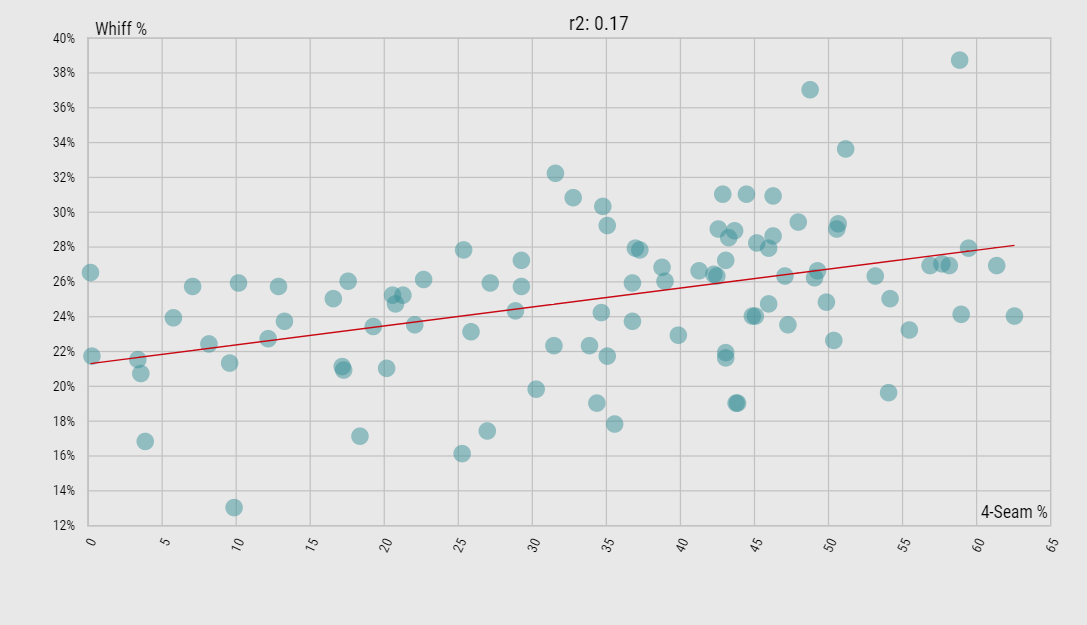
Pitchers that throw more four-seamers also have higher whiff rates. This primarily can be attributed to four-seamers themselves. If a pitcher is a four-seam pitcher rather than a sinkerballer, he’ll get more whiffs by nature of the pitch he throws. Of more importance is how the pitcher uses their four-seamer (throwing it up). Joe Ryan and Pablo López are four-seam pitchers that amass loads of whiffs.
Unfortunately, four-seamers are also far more susceptible to barrels. That’s due to two primary reasons (really just one):
Four-seamers are thrown up in the zone where batters are better able to swing with an optimal launch angle for barrels.
Sinkers are not as susceptible to barrels because they are typically thrown low in the zone.
That can be seen visually in the graphs below:


Pitchers who feature four-seamers increasingly give up barrels more often. The opposite is true for pitchers with sinkers. Pitchers who throw more sinkers give up fewer barrels.
All of this information can be boiled down into a few short sentences. Sinkerballers will naturally induce more ground balls and fewer barrels, leading to more consistent outings. Barrels often become home runs, and home runs lead to bunches of innings being scored. Four-seam pitchers will get more whiffs but fewer ground balls and more barrels, leading to less consistent outings.
The overall talent and ability of a pitcher matter, but this data helps to establish pitcher archetypes. We could already classify sinkerballers and four-seamer pitchers based purely on the pitches they throw, and we know there are differences in how they pitch and what kinds of batted balls they are susceptible to.
By making this connection to the previous analysis about earned run variance, we can somewhat confidently say that sinkerballers are more consistent than four-seamer pitchers. We cannot say that sinkerballers are better because earned run variance does not act in the way ERA does. A pitcher could be consistent in that they give up either nine or 10 earned runs per outing, whereas an inconsistent pitcher could give up between zero and five earned runs but have a lower ERA.
Think you could write a story like this? Hockey Wilderness wants you to develop your voice, find an audience, and we'll pay you to do it. Just fill out this form.
Recommended Comments
There are no comments to display.