

The holidays are a joyous time to spend with family and friends. A time for giving, cheer, and looking forward to new beginnings as the calendar turns over another year.
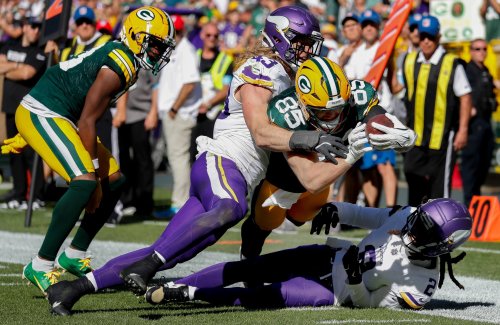
For Minnesota Vikings fans, that cheer has turned to despair in recent years as they've tuned in to watch their favorite team play the Green Bay Packers around this time of year. The Vikings are heading towards another matchup against their most-hated rival on Sunday, but this time, the situation is different.
a history of failure
In the last five seasons, the Vikings have played the Packers four times between December 23 and January 2. All four games had playoff implications, and they've lost all four by a combined score of 134-47. In 2019, they still had a shot to win the NFC North, but they averaged an embarrassing 2.6 yards/attempt on offense as Green Bay slammed the door shut with a 23-10 victory on their way to a first-round bye.
In 2021, Minnesota tried to salvage an up-and-down year by pushing for a playoff berth. Kirk Cousins was ruled out due to COVID-19 in their Week 17 game against the Packers, and they blew out the Sean Mannion-led Vikings 37-10.
The next year, the Vikings were riding high at 12-3, heading into Lambeau to face an 8-8 Packers team that barely had a path to the playoffs. They fell flat on their face. Kirk Cousins threw three picks en route to losing 41-17, which only amplified the fraud narrative surrounding the team.
Finally, last year, the Vikings were clinging to playoff hopes as they hosted the Packers. Both teams were 7-8. The Vikings started rookie Jaren Hall after Nick Mullens had struggled for two consecutive games. Hall had a rough night as Jordan Love threw all over Minnesota's depleted secondary for a 33-10 win on New Year's Eve.
Massive stakes
I don't recount the losses to pick at old scabs but rather to bring context to this week's matchup. The Vikings have entered each game with a great opportunity and left embarrassed.
This week's matchup has similar stakes. A win would set up a Week 18 matchup against the Detroit Lions for the NFC North and also the No. 1 seed in the NFC. Winning out would likely make the Vikings the favorites to win the NFC.
A loss, combined with a loss against the Lions next week and a Packers' win against the Chicago Bears, would relegate the Vikings to the sixth seed. The NFC's sixth seed is slated to travel to SoFi to face the Los Angeles Rams, a team the Vikings have already lost to this year.
Same setup, different results?
The implications of this Packers matchup feel similar to previous years, but the same results are far from guaranteed.
In previous years, the Vikings had significant deficiencies. They were missing their franchise QB in two games. In 2019, Dalvin Cook missed the game, and the Vikings couldn't block Za'Darius Smith or Kenny Clark. The 2022 team was an underdog despite their excellent record.
However, these aren’t the same old Vikings. They're a top-five or -six team pretty much any way you slice it. The Packers are also very good, leading to what should be an excellent matchup. Let's look at how the two teams compare and what we might expect from the game.
quarterbacks... comparable?
In the offseason, the Vikings paid Sam Darnold $10 million to be a bridge QB, with plans to draft a franchise player at the position. Meanwhile, the Packers made Jordan Love the highest-paid QB of all time.
Four months ago, no one would have put Darnold in the same stratosphere as Love in terms of QB play. But if you look at their EPA+CPOE Composite, courtesy of rbsdm.com, their production has been identical so far this year:

Love has a higher EPA (Expected Points Added)/play, but Darnold has been more accurate per CPOE (Completion Percentage Over Expected) and more consistent with a 2% higher success rate. Before this year, Darnold was considered a failed pick for his turnover problems. Darnold and Love have thrown 11 INTs this year, but Love has done so on about 100 fewer passing attempts.
Much has been made of Love's performance over the last month-plus; he's thrown nine TDs and only one INT while the Packers have gone 5-1. There hasn't been the same level of fanfare, but Darnold and the Vikings are 6-0, with Darnold throwing a stellar 15 TDs to just one INT over that timeframe.
Minnesota's passing game is explosive, but it comes at the expense of sacks. Darnold has been sacked about three times a game during the Vikings' eight-game winning streak. He has taken 45 sacks on the year, getting sacked on about 9% of his dropbacks. Love has been sacked just 11 times this season on 3% of his dropbacks, just a third of what Darnold has taken.
To an extent, Darnold's high sack rate has been a sign of some growth. He will often throw the ball away or take sacks in a situation where attempting a pass would put the ball in significant danger. By contrast, Love has a penchant for heaving throws off of his back foot while under pressure to avoid taking sacks.
Love's three interceptions in Week 4 destroyed any opportunity the Packers had to beat the Vikings:
The supporting casts
The Vikings have one of the most potent groups of weapons in the NFL. Justin Jefferson has nearly 1,400 receiving yards. Even when he doesn't produce, his presence changes the numbers for defenses. Jordan Addison has emerged, feasting off of Jefferson's influence, and T.J. Hockenson has regained his role as a critical chain-mover on third downs:
https://bsky.app/profile/friesfootball.bsky.social/post/3ldty4au4z22a
The Packers lack the top-end talent that the Vikings have, but they have a plethora of valid options in the passing game. Four Packers -- Jayden Reed, Christian Watson, Tucker Kraft, and Romeo Doubs -- have over 500 receiving yards, while only Jefferson and Addison have reached that mark for the Vikings. With so many weapons, it's hard to defend Green Bay's passing offense.
In the run game, Aaron Jones has been the engine driving Minnesota's offensive consistency. His carry and TD numbers have lacked the volume his Packers' replacement, Josh Jacobs, has gotten. Still, the efficiency has been similar, with the Vikings having a 39.3% success rate on the ground to Green Bay's 39.9%.
Minnesota's offensive line started off the year playing excellent football, but Christian Darrisaw's injury and lineup changes have taken their toll as the season has gone on. The run blocking is still very good, but pass protection has recently had several mishaps along the interior. In particular, Blake Brandel has struggled with communication.
Green Bay's OL has also been quite good, but is not quite the elite unit they were during the Rodgers era. In Week 4, the Packers' run game had some success early, which is rare against Minnesota's great interior. Still, playing from behind led to only 86 yards on the ground. They also heavily attacked LT Rasheed Walker and the RBs in pass protection. They were pretty successful, pressuring Love on 37.5% of his snaps, higher than his season-long rate of 34.7%, per PFF.
https://bsky.app/profile/friesfootball.bsky.social/post/3le2kindh4c2w
From a play-calling perspective, it feels like an even match. Matt LeFleur has been a well-respected coach since he brought Aaron Rodgers to back-to-back MVPs. Meanwhile, Kevin O'Connell has developed a similar reputation, especially considering his work with Darnold this year.
defensive advantage
The Vikings have a clear advantage on the defensive side of the ball. Green Bay's defense has been improving, but Minnesota’s defense is elite.
During the Packers' current 5-1 hot streak, they've only allowed over 20 points to the Lions. They are coming off a shutout of the New Orleans Saints and have forced nine turnovers in this six-game stretch. The thing is, most of that production has come against backup quarterbacks.
The Packers got three turnovers against the San Francisco 49ers and Brandon Allen, two off the Seattle Seahawks' Sam Howell, and two off the Saints' Spencer Rattler. In that stretch, they also beat the hapless Bears and froze out the Miami Dolphins, who did not seem prepared for the cold.
Green Bay's recent performance reminds me a little of last year's Vikings. They have a new DC and have started to put it together with a great stretch against bad opponents. Remember when the Vikings got to beat up on Taylor Heinicke, Jameis Winston, Broncos Russell Wilson, Justin Fields, and Aidan O'Connell for a five-game stretch last year? However, the lack of talent was exposed once they started playing serious offenses, and Flores' unique scheme struggled to close out the year.
Last year, by the time the Vikings and Packers played, the Vikings were down to just Danielle Hunter as a pass-rush threat. Hunter was great, but teams took him away, and backups like Pat Jones and Andre Carter offered nothing. The Packers are struggling to find consistent threats from their standard front this year. Rashan Gary and Lukas Van Ness barely have above 10% pass-rush win rates, per PFF, and Kenny Clark isn't what he once was as a pass rusher.
Their best success has come from rushing off-ball players, whether it's blitzes or simulated pressures, like Edgerrin Cooper, Quay Walker, and Keisean Nixon. That's great against bad QBs who can't quickly diagnose coverage vacancies. Still, it falls apart when an opponent can punish that with great perimeter weapons and a smart QB. Darnold averaged 10 yards/attempt and has thrown 11 TDs to zero INTs this season against the blitz.
In the secondary, the Packers have put together a strong performance despite injuries to star Jaire Alexander, who Minnesota carved up in Week 4 anyway. Xavier McKinney has been excellent, and All-Pro returner Keisean Nixon has had a breakout season on defense. Evan Williams has been a revelation but is currently dealing with injuries. The Vikings have had a ton of success attacking Eric Stokes in the past, and old friend Eric Wilson is getting a lot of snaps at LB. There will be opportunities for Minnesota to exploit.
Conversely, I've already referenced that this year's Vikings defense is a much more robust version of the paper tigers that went out with a whimper to end 2023. The key is in personnel. Jonathan Greenard is as close to a one-to-one replacement for Danielle Hunter as you can get. Andrew Van Ginkel and Pat Jones have provided great complimentary pass rush, something the defense was missing entirely last year.
On the back end, Blake Cashman has transformed Minnesota's coverages, instinctually removing space that Ivan Pace and Jordan Hicks were allowing last year. That has allowed Pace (and Jamin Davis as an injury replacement) to worry about attacking forward against the run, not dropping back.
Minnesota's safety trio of Harrison Smith, Camryn Bynum, and Josh Metellus is still great. Still, veteran presences in Stephon Gilmore, Shaq Griffin, and Fabian Moreau have given DC Brian Flores the confidence to call a wider variety of coverages that challenge CBs, leading to more confusion. Byron Murphy Jr., who missed the second Packers game last year, has benefitted greatly and is tied for third in the NFL with six INTs so far this year.
Last year, the Vikings basically ran three looks. They would put everyone on the line and run Cover 0 or drop into Tampa 2. Then they would run Cover 3 or Tampa 2 when they didn't threaten blitz, mixing in some three-deep three-under ("zone blitz") or four-deep one-under ("hot quarters") looks.
That confused poorly managed offenses, but teams eventually got a bead on what they were doing and just spammed Tampa 2 beaters like Dagger to have success. This year, they've unlocked a wider variety of coverages and have started playing their base ones better.
Dagger can still get them on occasion, but they've also fought back with interceptions:
I've charted the Vikings coverage over the course of the year. They've become a lot more confident running Man coverage, particularly on third and fourth downs in recent weeks. They play three different coverages, Man, Cover 2 (primarily Tampa 2), or Cover 3, over 20% of the time each.

This increase in variety has propelled Minnesota's secondary to a league-leading 22 INTs. Turnovers are generally a fluky result, but Flores' chaotic scheme breeds them. The Vikings are the only defense to force a turnover in every game this year, and I don't expect that to change against an aggressive, risk-taking QB in Love.
To the Packers' credit, they've also been excellent at taking the ball away this year. They've forced 28 turnovers, two behind the Vikings, and tied for third with the Buffalo Bills and Houston Texans. McKinney has been a complete ball hawk and should probably be an All-Pro. However, their turnover rate has been driven more by fumble recoveries; they have 13 on the season, third in the NFL.
The odds of recovering a fumble depend on the type, but overall, it's roughly a 50/50 proposition. The Packers have recovered 57.1% of fumbles in their games, fifth in the NFL. Minnesota is down at 24th, recovering only 46.9% of fumbles. Given that, when trying to project turnovers moving forward, the Vikings seem likelier to continue their success into the playoffs than the Packers.
what's going to happen?
I'm not exactly in the prognostication business. Vegas currently has the Vikings as slight (-1.5 point) favorites. The Vikings may win this game, they may not. But I don't expect it to be the embarrassment we've grown accustomed to in recent years.
Under Sam Darnold, the Vikings don't have the same crater potential they seemed to under Kirk Cousins. Even in Minnesota's worst offensive performance this year, against the Jacksonville Jaguars, they moved the ball effectively. They got into scoring range on seven of nine drives but could not get the ball into the end zone as Darnold threw three picks.
Even in their two losses, they averaged 5.5 yards per play against the Rams, a respectable mark, and 7.4 yards per play against the Lions, which is excellent offensive efficiency. The Vikings should have an effective passing game that will move the ball against a banged-up secondary. Their defense may allow some yardage, but they will also force mistakes against a turnover-prone QB.
A tense, close game against the Packers may not be what you want to watch during the holidays. But at least it won't be an embarrassment.
Think you could write a story like this? Hockey Wilderness wants you to develop your voice, find an audience, and we'll pay you to do it. Just fill out this form.
Recommended Comments
There are no comments to display.