


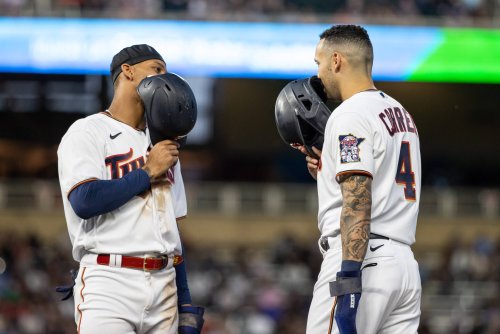
The Minnesota Twins were bleary-eyed and cantankerous when they woke up in Cleveland on Sept. 14, 2019. Still, they were on the verge of snapping out of their doldrums. Years of ill-advised trades and poor player development had turned them into a sleepy organization, but the Bomba Squad had snapped it back to life.
So it’s hard not to blame them for being upset when the Cleveland Guardians pushed for a rainout that Friday, washing Jake Odorizzi’s strong start from history. Still, they woke up on Saturday ready to go. Eighteen innings of baseball in one day? If that’s what it takes to take command of the AL Central.
“The general feel of some of those games does lend itself to just the attitude of you kind of embrace the fatigue,” Rocco Baldelli said that Saturday morning. “You embrace the long day. You embrace the challenge of a very difficult day at the ballpark.”
The Twins were no strangers to long days at the ballpark in 2019. They won a 17-inning game over the Boston Red Sox on June 18, then lost an 18-inning battle with the Tampa Bay Rays on June 27. In doing so, they became the third team in 40 years to play a 17-inning game and a longer game within ten days of each other. On that Saturday, every at-bat where the hitter stepped out of the box to adjust his gloves felt like it took half an hour. Every pitching change felt like an eternity. It was hard not to feel sleep pressure mount in those moments, threatening to drag you from the diamond into the subconscious.
Fortunately, Major League Baseball has taken steps to curtail the length of games. They added a ghost runner on second in extra innings during the 2020 pandemic season and limited the number of pitching changes. This year, they added a pitch clock and limited shifts. Baseball fans love the game, but nobody wants to watch a contest drag on for four-plus hours. Football and hockey games usually last three, basketball two-and-a-half, and soccer two. Playing eight hours of baseball in one day? Or, worse yet, over ten in ten days? That’s taxing. It’s not good for the players, coaches, or fans.
“There are so many different changes that are coming into play at the same time,” Baldelli said at the beginning of spring training this year. “And then the permanent adoption of other rules — you add it all up, I don’t know where it’s going to land.
“The best teams are still going to win. You’re probably going to see the same teams that would have ended up in first place with the old rules with the new rules. That will eventually even out. The growing pains, we’re going to over-discuss and overreact probably to all of them.”
The Twins have already experienced some growing pains. Joey Gallo misunderstood the new shift rule in Minnesota’s first spring training game, and Carlos Correa forgot about the pitch clock. The star shortstop has also had to adjust to the new shift rule that bans infielders from starting an at-bat with their feet touching the outfield grass.
“I like playing deep and using my arm so I can get more range,” Correa said. “Those are the rules, so I’ve got to follow them. I was asking (the second base umpire) a bunch of questions to make sure I understood every single thing that they’re looking at. He told me that my heel can’t be touching the grass at any time and all that. Try to play as back as I can without breaking the rules.”
Baldelli said that spring training came quickly this year. The Twins pursued Correa after he signed with the San Francisco Giants and New York Mets and failed both physicals. They also traded away fan-favorite Luis Arraez for Pablo López and prospects and brought in Christian Vázquez. Plus, they had to adjust to the rule changes. But Baldelli said they were out in front of them. They wanted to play faster anyway.
Derek Falvey suggested that Minnesota’s change in philosophy wasn’t a big lift on his end. Unlike in football and basketball, where managers can quickly overhaul rosters, changes happen glacially in baseball. Players take years to develop, and the league has a lengthy arbitration process. There are blockbuster trades and expensive signings, but the best teams maintain a strong core of players who learn to build off each other. Fortunately for Falvey and the front office, the league has implemented many of these changes in the minor leagues.
But ultimately, MLB has implemented most of these rule changes in the minor leagues. Most players have encountered them before reaching the majors.
Still, Falvey and Co. did enough, because Baldelli feels he has the right mix of players to implement a faster pace.
In 2019, the Twins built a team that crushed the juiced baseball. Four years later, they’ve gotten out ahead of the pitch clock, larger bases, and fewer shifts.
Nelson Cruz, Miguel Sano, and Eddie Rosario headlined the Bomba Squad. They had five players finish the year with 30 or more homers. However, it’s fitting that Byron Buxton and Correa’s team is more oriented around athleticism. Baseball teams adapt or die. The 2019 and 2020 teams adapted with aplomb; the 2021 and 2022 teams died. Adjusting to a faster game is baseball Darwinianism at its finest.
“Games are going to feel very different, and the way we play the game is very different,” said Baldelli. “I vote for two-hour games.”
He flashed a smile as he finished that final sentence. Who can blame him? A lot of great things happened in 2019. But playing a 17-inning game and then an 18-inning one less than 10 days later wasn’t one of them.
Think you could write a story like this? Hockey Wilderness wants you to develop your voice, find an audience, and we'll pay you to do it. Just fill out this form.
Recommended Comments
There are no comments to display.