

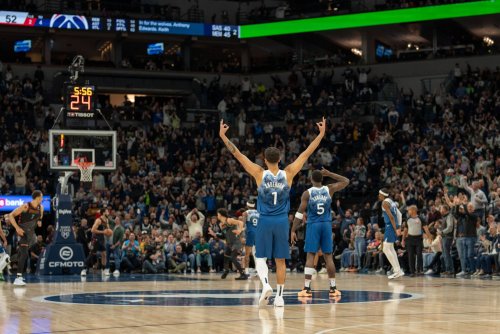
In some ways, it’s hard to imagine it’s been nearly two weeks since the Minnesota Timberwolves last played basketball. The Wolves fell to the Mavericks in five games, and their season officially ended on May 30. With exit interviews completed, it’s time to focus on what changes the Wolves could make this offseason.
Minnesota’s reality is somewhat stark in its ability to make significant changes. Anthony Edwards ($42.3 million), Jaden McDaniels ($23.0 million), and Karl Anthony Towns ($49.3 million) all have exorbitant contracts that are kicking in this offseason. Add that to Rudy Gobert ($43.8 million), Naz Reid ($13.9 million), and Mike Conley ($9.9 Million), who the Wolves have already locked up, and reality sets in quickly.
The Wolves don’t have any space to add impactful players this offseason.
However, the Timberwolves have a couple of draft picks, 27 and 37. Statistically speaking, though, the odds of either of those picks immediately becoming an impact are relatively low. The Wolves also could have the opportunity to trade players to mix up the roster. However, given what Tim Connelly and Chris Finch said in their exit interviews, it appears they would like the team's core to remain intact.
That leaves the Wolves with even fewer options. Outgoing free agents Kyle Anderson, Jordan McLaughlin, Luka Garza, and Monte Morris don’t free up enough cap room for the Wolves to dip under the salary cap line. Therefore, regarding free agency spending, it doesn’t matter if the Wolves let them all walk or re-sign them. Regardless of their decisions with their own free agents, it leaves the Timberwolves with taxpayer’s mid-level exception (MLE) as their only option to sign players. The MLE is only $5.2 million this offseason.
The Wolves are no strangers to the MLE. Last offseason, they split the money up to bring in Troy Brown Jr. and Shake Milton, a couple of players to prove-it deals. Typically with MLE, teams land spot starters or bench players who have shown flashes in the past or have certain skill sets that pop but may have flaws or lack consistency.
However, the Wolves had slightly more money to work with last year because they were not above the taxpayer line. That granted them $10.5 million instead of the $5.4 million teams over the tax got last offseason. However, it’s important to remember that the teams using the MLE are over the salary cap in both instances.
Brown, 24, theoretically was a good three-point shooter (38.1% in 2022-23) who played above-average defense (2.0 defensive win shares in 2022-23). Brown had started 45 games for the Los Angeles Lakers in 2022-23. As a result, the Wolves signed him to a two-year, $8 million deal, primarily to replace outgoing free agent Taurean Prince.
The Wolves also used their MLE to sign Milton. Like Brown, Milton showed flashes of potential last year. He had played 20.6 minutes per game with the Philadelphia 76ers, starting 11 games and shooting 37.8% from three. Milton was a perfect replacement for Jaylen Nowell, whom the Wolves opted not to re-sign. Thus, Minnesota signed Milton to a two-year, $10 million contract.
Unfortunately for the Wolves, Brown struggled to find playing time behind a deep frontcourt and wings. Despite occasionally having good moments, the Timberwolves relocated him to the end of the bench. At the end of his Minnesota run, he only found playing time in blowout wins or due to injuries. As a result, he only played 11.1 minutes per game, down from his 24.5 minutes per game and starting role in Los Angeles.
On the other hand, Minnesota gave Milton the backup point guard minutes, and he struggled to fit in with his new team. His 40% field goal percentage was his worst since 2018-19, and he posted a career-low 26.4% three-point percentage and 8.3 PER (player efficiency rating). Ultimately, Connelly paired Brown and Milton’s salaries to trade for Monte Morris.
The Timberwolves will likely go through a similar process this offseason. The difference again is that the Wolves will only have $5.2 million in cap ammunition to shoot for a free agent. They have likely already started their evaluation process. Minnesota’s team needs are pretty self-evident: a bench player who can control the pace of the game and set up the offense and a player who can create his own shot to help prevent offensive stagnation.
Chris Finch mirrored that thought in his exit interview. In response to a question about where the Wolves could improve, Finch first noted how Edwards' improvement could help the offense, then spoke about relying on Anderson more if they can re-sign him. “Then,” he added, “of course, look to have another ball handler that can play out there alongside anybody.”
Taking Finch’s statement at face value, it’s safe to assume that the Wolves will use the MLE on a multifaceted ball handler. Due to their cap constraints, anyone they bring in will likely have flaws. However, they have a few good options, including Alec Burks, Spencer Dinwiddie, Aaron Holiday, and old friend Kris Dunn. The Wolves don’t have cap space, but the mid-level exception is enough to round out their roster.
Think you could write a story like this? Hockey Wilderness wants you to develop your voice, find an audience, and we'll pay you to do it. Just fill out this form.
Recommended Comments
There are no comments to display.