

Kevin O'Connell is known to be fond of his quarterbacks.
He was a quarterback during his playing days, and that familiarity has translated to the coaching ranks. Since taking over as the Minnesota Vikings head coach in 2022, O’Connell’s teams have finished top six in passing yards and touchdowns each year. In many NFL circles, this consistency has made him a “QB guru.”
When you consider the crop of quarterbacks he’s had to work with, the title makes sense. Outside of Kirk Cousins, every QB that has come through Minnesota’s doors since O’Connell took over has not had much previous success. It’s a testament to his coaching prowess (and to Justin Jefferson) that a rotation of Jaren Hall, Joshua Dobbs, and Nick Mullens put together a relatively reliable passing game just a couple of years ago.
For as much success as the Vikings have had through the air, their ground game has not been as fruitful. They finished 27th in rushing yards in 2022 and 29th in 2023. They moved up to 19th in the category last season but scored just nine rushing touchdowns, fourth-worst in the NFL. The days of Adrian Peterson and a strong power running game are long gone.
Yet, offseason moves lead me to believe a change is coming. Additions to the backfield and offensive line present an opportunity for Minnesota to develop a new identity on offense, and it involves running the football a lot more. After seeing Saquon Barkley lead the Philadelphia Eagles to a Super Bowl, it makes sense why O’Connell said earlier this month that this is the direction he wants to go.
“I want to get back to the truest nature of where the foundation of this offense was,” O’Connell
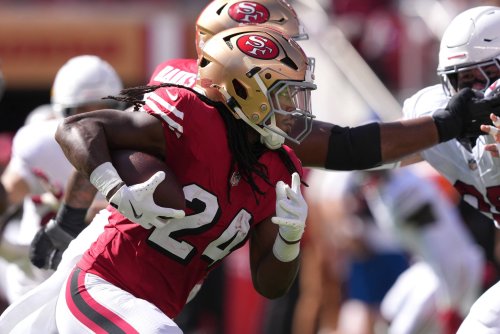
The journey started with acquiring Jordan Mason. The fourth-year back out of Georgia Tech ran for a career high 789 yards in 2024 with the San Francisco 49ers, and the Vikings think he can be a worthy complement to Aaron Jones. The two can foster a 1a-1b relationship, with Mason’s shiftiness mirroring Jones’ consistency.
Despite only having seven games with double-digit carries, Mason was sixth in the NFL with 5.2 yards per carry and 207 yards above expected last season. In games with 20-plus carries, Mason ran for 100 yards or more each time. The Vikings essentially grabbed another starting-caliber running back and only traded away a sixth-round pick.
Minnesota extended Jones for two years and $20 million, and he thrives with another back by his side. His best years in Green Bay were spent splitting carries with Jamaal Williams and AJ Dillon, and the Vikings are hoping they can recapture some of that success by pairing him with Mason. Plus, entering his age-31 season, taking a load off Jones will go a long way to ensuring he’s healthy for a full year.
The tandem of Jones and Mason, plus a potential pickup in the draft, means the Vikings should be able to find success on the ground. They should lean into it to break through their years of mediocrity at the position.
The other key to a good running game is the offensive line, and Minnesota also beefed that up. Guard Will Fries and center Ryan Kelly are coming over from the Indianapolis Colts, where they helped Jonathan Taylor become one of the premier backs in the league.
Taylor led the league in rushing yards and touchdowns in 2021, his last healthy season. Last year, despite missing three games, Taylor finished fourth in the NFL in rushing yards, averaging over 100 per game. Although he picked up much of his yardage without Kelly and Fries while both were nursing injuries, Taylor’s production speaks to the heights Minnesota’s backfield could reach if O’Connell’s scheme lets them shine.
Jones and Mason are not as good as first-team All-Pro Jonathan Taylor, but Fries and Kelly are good enough to be All-Pros themselves. Kelly already has four Pro Bowls and a second-team selection to his name. Fries, 27, has the sixth-best run-blocking grade in the league, according to PFF (84.9).
If the Vikings can build a dominant run game, it also takes some pressure off J.J. McCarthy. Asking a guy who has never thrown a pass in the regular season to replicate what his predecessors did is a tall order, and it’s not a familiar role for McCarthy. His national championship-winning season at Michigan featured a run-first offense and the best defense in the country.
Thus, pairing McCarthy with a run-first scheme will pay dividends and help him develop quickly. It also opens up the offense to allow for more play-action and lets McCarthy unleash his arm on deep balls. That could be scary for opposing defenses with Jefferson and (maybe) Jordan Addison on the outside.
Minnesota will need to run the ball better to build on their successful 2024, and they have the personnel to do it. If O’Connell buys in, which offseason quotes suggest will happen, the Vikings should see the playoffs again in 2025.
Think you could write a story like this? Hockey Wilderness wants you to develop your voice, find an audience, and we'll pay you to do it. Just fill out this form.
Recommended Comments
There are no comments to display.