


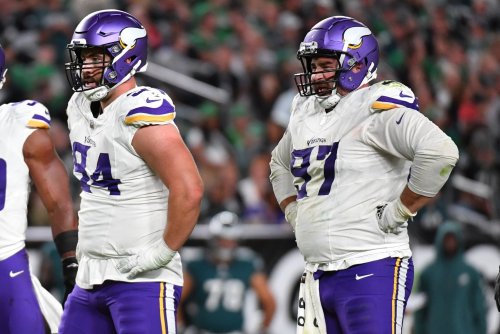
The Minnesota Vikings woke up on Friday with a positive DVOA. The Philadelphia Eagles had just beaten them 34-28, sending the Vikings to 0-2. Since 1990, only 11.5 percent of 0-2 teams have made the playoffs, making that Tampa Bay Buccaneers Week 1 loss particularly devastating. Minnesota’s 13-4 record felt like a lifetime ago. And all those people calling them frauds? Well, the Vikings had a -3 point differential and were 11-1 in one-score games last year.
Still, the underlying numbers indicated that the Vikings aren’t a normal 0-2 team.
Defense-adjusted Value Over Average (DVOA) is an excellent underlying metric that separates the good teams from the lucky ones. DVOA measures a team’s efficiency by comparing success on every play to a league average based on situation and opponent. It’s a helpful tool to explain Minnesota’s performance over the past two seasons.
Last year, they had a -15% DVOA, the fifth-worst in the league, sandwiched between the 5-12 Los Angeles Rams and 4-13 Arizona Cardinals. But the Vikings have a 3.6% DVOA after this weekend’s games, 16th in the NFL. They are ahead of the 1-1 Detroit Lions, who have a negative DVOA, and below the 1-1 Indianapolis Colts. Minnesota is not an elite team by DVOA, but they’re also not among the league’s worst.
DVOA is an imperfect metric. The Vikings weren’t the fifth-worst team in the league last season. But it can help us better understand what’s happening with this year’s team. After Thursday’s loss in Philly, O’Connell pointed out that few teams turn the ball over four times and have a chance to win the game. He also highlighted that they have a -9 point differential. Tampa and Philadelphia didn’t blow them out. However, the Eagles ran all over Minnesota, and both teams tormented Kirk Cousins with pressure.
To what extent the issue is turnovers or the trenches will determine whether the Vikings can buck the trend and make the playoffs. A positive DVOA despite losing as four-point favorites to the Bucs and starting 0-2 indicates they can get right. It starts with beating the Los Angeles Chargers and taking care of business in Carolina to even things out. The Vikings have made every indication that they aren’t giving up after two weeks.
The Vikings signed Dalton Risner to bolster the offensive line and traded for Cam Akers to support a faltering run game. Risner and Akers alone won’t fix an injured offensive line and a league-worst run game. But they can help. They signal that Minnesota is still trying to compete and that they are unlikely to tank for Caleb Williams and Drake Maye.
To reduce turnovers, Kevin O’Connell uses six or seven drills that emphasize different aspects of ball security. In the “see two, split two” drill, he has two zoning defensive players converge on a receiver catching the ball in space. The ball-catcher has to split the defenders with ball security and finish forward. They also use multiple “gauntlet” drills where players use “every piece of equipment you can find on the internet” to try to punch the ball out of their teammate’s hands. “If we didn’t have it before,” O’Connell promised, “we will purchase it.”
He’s also categorized each turnover.
- He only wants players to reach for the pylon on fourth down and two-point plays.
- “Brandon Powell on the punt return phase, that was going to be about the plus 35-yard line after a really well-executed punt return, and he’s really, that happens going to the ground.”
- “Both of Alex Mattison’s fumbles happened going to the ground, which is a unique part to simulate and practice. We do things every day. We’re going to do some things today to incorporate new aspects, to maybe help with some of the things that we’ve seen on tape.”
- “As far as trying to toss the ball on a wide perimeter play and bumping into the guard, I don’t have a drill for that.”
- “And then as far as pocket presence goes, when we got to make sure we keep Kirk clean because he’s been lights out when we’ve been able to protect him in the pocket.”
He also said that Tampa brought an un-scouted look of pressure and that he made a bad play call to start the second half in Philadelphia. The Vikings can improve on ball security in practice. However, they can’t overhaul the offensive and defensive lines. Minnesota’s defense bent but didn’t break against the Bucs, and turnovers hurt them in Philly. Still, it’s hard to look past 259 yards on the ground.
The Vikings were always going to be an offense-first team, though. The defense just had to be league-average. And in a vacuum, the passing offense has looked great in the first two games.
- Cousins was 33 for 44 for 344 yards with two touchdowns and a pick against Tampa and 31 for 44 with four touchdowns in Philadelphia.
- Justin Jefferson had 150 yards in Week 1 and 159 in Week 2.
- Jordan Addison has had a 39-yard and a 62-yard touchdown in the first two weeks.
And Tampa held T.J. Hockenson to 35 yards, but he had 66 in Philly.
Minnesota may be having a Freaky Friday moment. Last year, they weren’t as good as their 13-4 record. But they aren’t a typical 0-2 team this season. They have a chance to win the division if they can get back to 2-2 because there isn’t a dominant team in the NFC North. Ten wins probably takes it; 11 almost certainly does. By DVOA, the Vikings are a better team than they were last year. They’re just going to have to return to the playoffs, having already lost two one-score games.
Think you could write a story like this? Hockey Wilderness wants you to develop your voice, find an audience, and we'll pay you to do it. Just fill out this form.
Recommended Comments
There are no comments to display.