

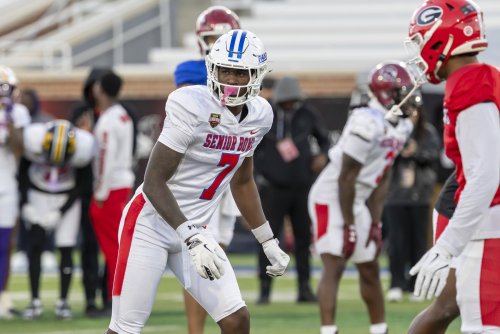
The Minnesota Vikings have a sneaky need at wide receiver that nobody is talking about. While the main headline this past season was J.J. McCarthy struggling to get Justin Jefferson the ball, there was another story slowly developing in the background. Jalen Nailor emerged as a dependable WR3 — so much so that he got scooped up by another team. Fortunately, the Vikings could draft Georgia State’s Ted Hurst to replace him.
After the Las Vegas Raiders signed Nailor in the offseason, the Vikings are now in need of a replacement and will likely look to the draft. Before the season started, the Vikings made an ill-fated trade for Adam Thielen, which turned out to be one of Kwesi Adofo-Mensah’s bad trades.
Despite this, Nalior emerged as one of the few pass catchers who had chemistry with McCarthy. In an offense full of weapons, Nailor carved out his own niche, dominating man coverage, finishing with 236 yards and a contested-catch rate of 70%.
That discrepancy between Thielen and Nailor is yet another reason why the Vikings should look to the draft. While they probably won’t select a receiver in the first round, Hurst could be an interesting Day 3 prospect.
At 6’4”, 206 lbs., Ted Hurst already has the prototypical build for an X or a Z receiver in the NFL. While his size alone is impressive, Hurst pairs it with impressive speed, running a 4.42 40-yard dash and an impressive 1.55-second 10-yard split. Hurst also has insane vertical ability. Coming from a basketball background, Hurst has a vertical of 36 inches. He also has a broad jump in the 99th percentile.
While his combine stats alone are impressive, what Hurst did at Georgia State is even better. He was immediately productive after transferring from a D-2 school, posting 961 yards in his junior year and 1,004 yards as a senior. Hurst averaged 15.5 yards per catch in his two seasons with the Panthers and recorded 15 touchdowns.
However, Hurst had his two worst games against playoff teams this year. He only managed six yards on one catch against Ole Miss and three catches for 60 yards against James Madison.
Still, his speed is evident on tape. As soon as he gets off the line, opposing corners need to honor the threat of a go ball, playing slightly more cautiously than they would against other wideouts. Hurst builds speed as he progresses down the route, getting faster as the play develops.
Ted Hurst has developed the ability to run both breakout and in-breaking routes. Last year, he relied less on explosive plays and leaned on intermediate concepts, leading to his yards per catch dropping from 17.2 to 14.1. Don’t be mistaken, though. He’s still a viable deep-ball target because he can track the ball well and adjust to passes that might not be pitch-perfect.
Hurst has also significantly developed his after-the-catch abilities, more than doubling the number of missed tackles he has forced. It’s an important evolution in Hurst’s game.
Naturally, given his size, Hurst is also a quarterback's dream in the red zone. In college, he had an innate understanding of leverage and when to sit in a zone rather than continue a route. He was also extremely impressive on back-shoulder passes and fades, showing a rare combination of length and body control.
There are still areas he needs to improve on to succeed in the NFL.
First and foremost is drops. Hurst has an incredibly high drop rate of 9%, which he must reduce to get significant playing time. The Vikings would love to have a big-play threat alongside Jordan Addison and Justin Jefferson. Still, they need their WR3 to be secure and consistent with the limited number of targets he will likely see.
Hurst also isn’t much of a run blocker. While most receivers struggle with the motivation to do the dirty work, Hurst doesn’t weigh enough to be an effective blocker. Despite being 6’4”, Hurst needs to add some muscle to his frame at the next level, or other players will dominate him physically.
That also manifests on passing plays when opposing defensive backs can have their way with Hurst by getting their hands on him and rerouting him. It’s a positive that he has good footwork, because most receivers his size would tend to rely on physical skills all the way through. Still, he needs to learn to better use that size to his advantage.
We also see this in his lack of contested catches. Despite almost always having the size advantage, he’s just average. Hurst also exerts a lot of energy and tends to get gassed late in games and during long, sustained drives.
While all of these are issues, they feel like things he can improve on and aren’t uncorrectable flaws. Given how he is likely to be a late Day 2 or early Day 3 pick, the Vikings should bring in Ted Hurst and use him to play on the outside while using Jefferson and Addison in the slot to take advantage of mismatches.
Think you could write a story like this? Hockey Wilderness wants you to develop your voice, find an audience, and we'll pay you to do it. Just fill out this form.
Recommended Comments
There are no comments to display.