


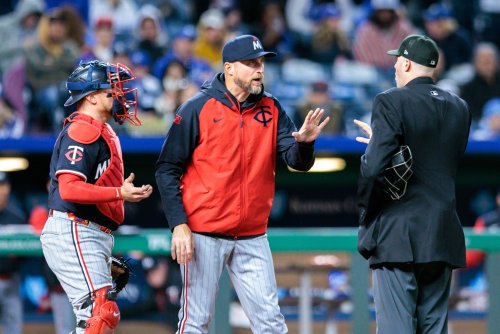
KANSAS CITY, Mo. — How the Minnesota Twins handled events leading to a pitch-clock violation against the Kansas City Royals was like a snapshot of the 3-8 start to their season. Not everything that went wrong was Minnesota's fault, but they also didn't do everything possible to avoid it.
Home plate umpire Nic Lentz dinged right-hander Simeon Woods Richardson with a violation in the bottom of the sixth inning Monday that resulted in an automatic ball and a two-out walk to Jonathan India. The extra baserunner didn't come around to score, but it put extra stress on the bullpen and sparked an outburst from manager Rocco Baldelli, leading to his ejection from the game. It also shed light on a communication breakdown, not just with electronic equipment, but also a more basic one among players and umpires.
As the pitch clock struck seven seconds with the bases empty, Woods Richardson stepped off the rubber and pointed to his head, indicating he couldn't hear signals in his earpiece that catcher Christian Vázquez was sending. The TV broadcast showed Vázquez feverishly working on his end of PitchCom, which was glitching.
Panicking might not be the right word, but Vázquez finally got PitchCom to work and frantically tried to rush Woods Richardson into throwing a pitch. Vázquez was "spamming it," as the pitcher perfectly put it. He re-engaged the rubber and began his delivery with two seconds left. However, Lentz didn't allow him to throw, saying it would have been a quick pitch and unfair to the batter.
Ball four, take your base. It incensed Baldelli, and he burst from the dugout with his finger wagging at 100 mph. During the argument, the broadcast showed him shouting at Lentz: "You [messed] up!" After a few moments, Lentz gave a universally understood umpire signal, using his own finger to tell Baldelli it was time to leave.
It appeared Lentz was being unfair to Woods Richardson. Appeared, anyway. A collective umpires statement, sent after the game through MLB, said Woods Richardson was trying to manipulate the time crunch to his advantage. Not to put too fine of a point on it, but they appeared to be calling Woods Richardson a liar.
Woods Richardson was over it when he gave follow-up thoughts on the call.
"I'm getting ready for Detroit," he said, referencing his next scheduled start.
When pressed, he added: "We all saw it," referring to him pointing at his own head. "I'm 107 pitches into the game. I'm not really trying to manipulate anything at that point. I'm just trying to get my team back in the dugout."
If you are the umpire, why not do what seemed like the right thing and call time out to reset the at-bat? It's a fair stance and question. To the Twins, the ump's process and call left them speechless, other than asking: "What did you want us to do?"
Well, there was something. Woods Richardson seemed to have done his part in stepping off; after all, it's not common to see major league pitchers make a "T" for timeout with their hands like a football or basketball coach might. However, Vázquez failed to take a step that probably would have guaranteed Lentz would have stopped the clock without penalizing the Twins beyond charging them with a mound visit, which they had to spare. "Probably," because with the way the season has gone for the Twins so far, it is safer to assume the worst.
A day later, Vázquez took responsibility for not calling for a mound visit.
"I was thinking about that last night after the game," Vázquez said Tuesday. "'Maybe if this happens again, burn a mound visit.' [The count] was 3-2, not 0-2 when it's not as bad to lose a pitch."
Baldelli changed nothing about what he thought he saw, insisting neither of his players did anything wrong.
"I've reflected on it, but the more I reflect, the more I come back to the fact that I don't think any call probably should have been made there," Baldelli said. "And if there was any issue with a hitter, or the pitcher, or even the umpire being thrown off by what was going on out there, the resolution is, almost always, just to reset the clock and to let the players play and let the pitch be thrown."
Baldelli is right. And not right. Perhaps intuitively, given the context of the moment, Lentz should have assumed not the worst about Woods Richardson's intentions. This is his 10th season as an umpire. Woods Richardson is new, but he also doesn't have an early reputation for attempting subterfuge. And it's not like PitchCom has never glitched before on a freezing night -- or any night. It happens.
Woods Richardson stepped off the rubber, as pitchers do. Did the umpire need a map to be drawn?
But there's also the matter of Vázquez getting flustered and forgetting a step he could have taken to avoid time running out. The Twins have had their share of bad luck, bad hops, and bad play so far through 11 games. Some of it goes beyond their control, but not all. In the case of the pitch-clock violation, they couldn't make the umpire come to a common-sense conclusion in a stressful moment. But they could have taken matters out of his hands and into their own.
In the bigger picture of their brief season, it's a failure that has been all too frequent so far. You can't just point at your head; you also have to use it.
Think you could write a story like this? Hockey Wilderness wants you to develop your voice, find an audience, and we'll pay you to do it. Just fill out this form.
Recommended Comments
There are no comments to display.