


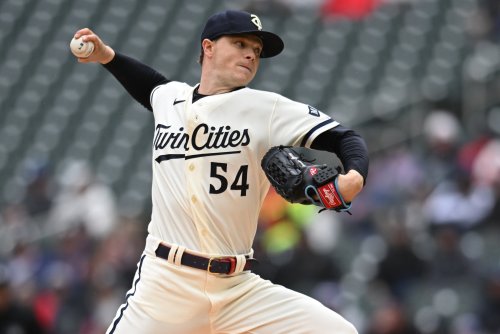
Joe Ryan grew up a Sonny Gray fan. How could he not? Ryan grew up as an Oakland A’s fan in Northern California. He was a junior at Sir Francis Drake high school in San Anselmo, Calif., when Gray debuted with a 2.67 ERA in 2013. Ryan was pitching for Cal State, Northridge when Gray had his first All-Star season in 2015.
Oakland traded Gray to the New York Yankees in 2017, and he struggled for a year and a half in the Bronx. But Gray made the All-Star team in 2019 after the Yankees traded him to the Cincinnati Reds, and Minnesota traded for him before the 2022 season. Gray didn’t have a regular offseason in 2022 because of the strike and was good but hardly an ace last year. Still, he finished the year with a 3.08 ERA (126 ERA+).
But Gray has a sub-1.00 ERA through six starts this year, and Ryan’s loving it.
Rocco Baldelli attributes Gray’s strong first month to having a normal offseason. The Twins traded for Gray on March 13, shortly after the strike ended. Instead of having a typical Spring Training that started in mid-February, he joined the Twins a month before taking the mound. Gray was suddenly pitching to a different set of catchers and had seven new players playing defense behind him.
Gray hasn’t given up a home run this year. He says his success results from being aggressive, attacking hitters, and locating pitches. As an 11-year veteran, Gray knows when to challenge a hitter and not to give in. “It just takes one pitch,” he said after his last start, “one pitch to get soft contact or just to get this or get that.” Gray also knows when to make adjustments to stay ahead of hitters, something that also comes from veteran savvy.
Gray doesn’t sit Minnesota’s young pitchers down and lecture them on how to approach batters. Instead, he leads by example. Gray gets to the clubhouse on time, goes through his weekly routine, and then sets a tone by attacking hitters with his six pitches. He doesn’t give into hitters if he falls behind in the count or has men on base. If one or two pitches aren’t working, Gray ditches them. Oh yeah, and he occasionally goes on epic rants during his starts.
“Sometimes Sonny will just come over and just start ranting to me,” says Ryan. “That hasn't happened too many times this year. He hasn't really needed that, I think. Sometimes, he'll just start talking really fast, and I'm like, 'Yeah. All right.' So [Tyler] Mahle and I had a good one last year with that.”
Mahle says that Gray also went on these rants in Cincinnati. They’re not mean-spirited and occasionally self-critical. Gray won’t rant during other pitchers’ starts, only his own. It feels fitting for the Tennessee-born Gray. He often speaks rapidly in a thick Southern accent and is detailed in his approach to baseball. Baldelli avoids them. “I don't go to the middle of the dugout except for maybe a few times during the game,” he says. “And the far end of the dugout? Not usually, only on rare occasions.” But the young pitchers, like Ryan, can pick something up during them.
Gray has a 2.05 FIP, a statistic that measures a pitcher’s ability to strike out hitters while preventing home runs, walks, and hitting batters. It measures how well a pitcher does, regardless of the defense behind him, and indicates where his ERA is heading. Unsurprisingly, Gray is unlikely to have a sub-1.00 ERA all year. But he can be an ace-caliber pitcher, a complement to Pablo López, and a mentor to Minnesota’s young pitchers. That’s a pretty neat deal, especially if you grew up watching him pitch for your favorite team.
Think you could write a story like this? Hockey Wilderness wants you to develop your voice, find an audience, and we'll pay you to do it. Just fill out this form.
Recommended Comments
There are no comments to display.