


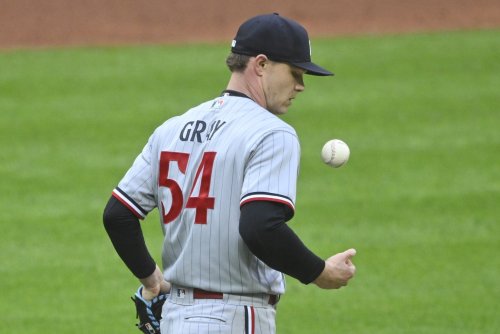
In an interview with Rob Freidman two weeks ago, Sonny Gray
Drafted well before being sub-six-feet-tall was cool (do your thing Woodbury graduate Max Meyer!), Gray’s relatively short 5’10” stature was supposed to be a detriment. His reluctance to throw a changeup, natural fastball cut, and almost nostalgic connection with his two-seamer became issues at times. Gray
His coaches in New York
Compounding that issue was an advised decrease in two-seamer usage. Note my usage of “two-seamer” and not “sinker.” Gray stressed this distinction while talking with Friedman, the Pitching Ninja. His goal with the pitch is to achieve as much run as possible with minimal sink. Because of the way he learned to throw a fastball (he detailed his three-fingered approach as a kid in the interview), two-seamers were innate to him.
Gray’s curveball appears to be the defining factor in his career-low 1.82 ERA. Looking at Pitcherlist’s value statistic (PLV) of the pitch, he’s jumped up from 5.08 just four years ago to 5.52 today. The scale is 0-10, but 5 is average. 5.5 is elite, despite the low number. The jump in PLV means he’s located his curveballs well while throwing them with quality movement and velocity.
It’s long been a favorite pitch of his, and it’s been completely unchanged, unlike the rest of his arsenal. It may not be reasonable to assume he’ll achieve the same results on the pitch forever, but it explains the early success. Ascending to a new level will require something new, or in Gray’s case, something old that he’s planning on using more of.
The two things that will fuel the rest of Gray’s season are his aforementioned cutter-slider combo and two-seamer-changeup combo. These two things are truly just one; pitch tunneling. Gray thrives at the art of pitch tunneling, something he says he consciously works at and enjoys. The associated movement of each pitch plays off one another, helping Gray fool batters into swinging at pitches like these:
Gray’s plethora of pitches create a movement profile almost resembling an upside-down U, with everything playing off of his four-seamer. Two of those pitches are new However, they’re something he’s wanted to integrate in the past. Gray described his cutter as a middle ground between his four-seamer and slider, something I recently discussed when writing about Tyler Mahle. Gray has excessive differences in the induced vertical breaks of those two pitches, which can make it easier on batters to correctly identify which pitch was thrown. Incorporating a middle-ground pitch makes it tougher on batters to identify incoming pitches. Gray’s massively increased cutter usage (from practically nonexistent to ~18%) will help in the same way.
The most exciting of the two keys mentioned is his two-seamer-changeup combo. Gray is already adept at using his two-seamer and cutter as “platoon punishers.” He throws cutters down and away against righties and conversely up and in on lefties. His slider plays off his cutter and is an effective glove-side whiff pitch. The same logic is applied to his two-seamer. Down and away against lefties and up and in on righties. However, an arm-side-breaker that plays off two-seamers would be another deadly weapon. Gray has mentioned he’d like to get more downward break on his changeup, but for now, it’s a work-in-progress way to attack lefties.
Playing his best over a decade into a career filled with adjustments, Gray isn’t done tinkering with his arsenal. Now a pitching sage, he understands his pitches like never before. With his classic curveball and creative tunneling, Gray can still improve.
Think you could write a story like this? Hockey Wilderness wants you to develop your voice, find an audience, and we'll pay you to do it. Just fill out this form.
Recommended Comments
There are no comments to display.