


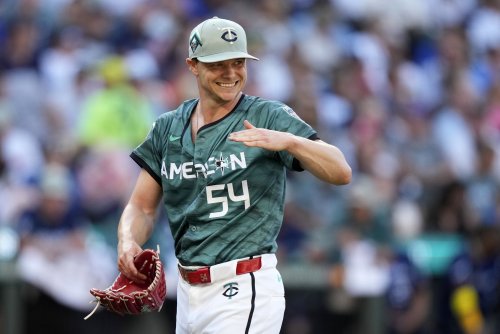
The first thing Minnesota Twins pitching coach Pete Maki noticed when he saw Sonny Gray in Spring Training was that his legs looked stronger. “I remember seeing him first day of Spring Training, I was like, 'Your freaking legs looked pretty strong,’” Maki said, laughing. “It goes back to when no one is talking about or caring about baseball in November and December and January. He was caring about it and preparing to throw a season's worth of innings.”
Gray’s work in the winter months paid off this summer. He finished the regular season with a 2.79 ERA in 184.0 innings pitched and earned a third All-Star nod. Gray’s 2.83 Fielding Independent Pitching (FIP) led the majors. His 183 strikeouts are tied for the second-most in his career. And his 154 ERA+ was his second-highest, only to his All-Star season with the Cincinnati Reds in 2019. Gray was in Oakland the last time he pitched more than 180 innings.
“I guess it started with the expectation,” he said after his penultimate start.
Gray has pitched well since his All-Star season with Cincinnati in 2019. That year, he pitched 175.1 innings, had a 2.87 ERA (162 ERA+), and a career-high 205 strikeouts. But his performance declined in his final two years with the Reds. Gray owned a 4.05 ERA (117 ERA+) in 191.1 innings before the Twins traded for him. Gray pitched last year with a 3.08 ERA (126 ERA+) in 119.2 innings. But he thought he could improve in his age-33 season.
“Going into the offseason and toward the end of last season, it was like, you know what? I know how to go out and throw 130 innings and have an ERA somewhere in the mid- to low-threes or whatever,” said Gray.
Maki’s plan began with rest – less of it. Gray had been relatively healthy, and Maki wanted him ready immediately for his first start. Gray was on board with starting his offseason work early and began preparing for Spring Training in October. Maki has earned his pitchers’ trust because of his background. He pitched at Franklin and Marshall and has a degree in psychology and sociology. Before joining the Twins, Maki coached at two prestigious academic institutions, Columbia and Duke. He has long been invested in balancing how much a pitcher should rest and work.
“It's a topic in which I'm super interested in and always have been,” he says. “Like, how much time should pitchers take off from throwing? I've kind of changed my position over the years on recommended rest periods.
Gray embraced Maki’s plan. He said he had talked to Caleb Thielbar, 36, about offseason preparation last year, and Thielbar said he found a way to enjoy it. Gray also started to embrace the work he was putting in during the winter. He knew he was doing it for a reason but also enjoying it.
“We talked about it, and we came up with a plan, and then it just became fun,” said Gray.
By adding weight, Gray (5’10”, 195 lbs.) was ready to go as soon as Spring Training started. He entered the season in peak form. Gray pitched five shutout innings against the Kansas City Royals in his first start and owned a sub-1.00 ERA in April. The key for Maki was that Gray wasn’t ramping up in Fort Myers. He was ready to go.
“I think just being more in tune with his body to start, right?” Maki asked rhetorically. “Taking less time off in the offseason, right? He's always worked hard when he's here, but that was the framework to come in and be ready to work.
“You remember his first start? His velos were good already. It wasn't like he needed three weeks to get into shape to be ready. I guess that allowed us to start working on things like right away as opposed to three weeks into Spring Training before he was fully ready to go.”
Gray felt he had a good balance throughout the year, beginning in Spring Training. He started Spring Training and the regular season well and knew when to cut back and adjust his pitches. When discussing his expectations, Gray never talked about his ERA or the Cy Young award. He remained focused on the process.
Maki says Gray helps him as a pitching coach because he reinforces the importance of emphasizing process over results with young players. Maki believes Gray could be a great pitching coach one day. But currently, he leads by example as one of Minnesota’s two best pitchers.
“He's a model for what that looks like, actually,” said Maki.
Gray and Pablo López have been Minnesota’s two best pitchers this year, and Gray has done it at a time when other pitchers begin to decline. Gray is no longer the young phenom in Oakland, nor is he in his prime like he was with Cincinnati. But he’s used a combination of guile and spin to keep hitters off-balance. Ultimately, he’s having success because he’s focused on the process. And because he put in the work last winter to lead the Twins into October.
Think you could write a story like this? Hockey Wilderness wants you to develop your voice, find an audience, and we'll pay you to do it. Just fill out this form.
Recommended Comments
There are no comments to display.