


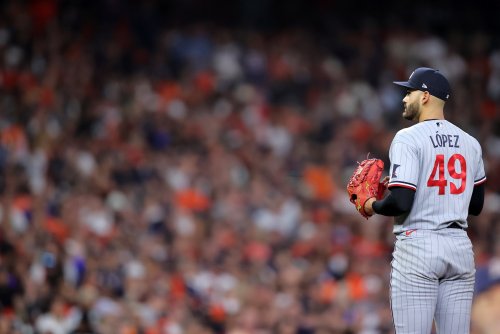
Pablo López had given up two hits and a run through five innings against the Cleveland Guardians in a June 1 game last season. The Minnesota Twins entered that game with a 29-27 record, ahead of the 25-30 Guardians. Still, memories of the 2022* collapse lingered. Minnesota led the AL Central for most of 2022, only to fall victim to injuries in September. Cleveland overtook them in September and never looked back.
The Twins had bolstered their depth last offseason to prevent that from happening again. However, they couldn’t pull away from Cleveland in the middle of the season.
With the Twins leading 3-1 on June 1, Travis Shaw led off the sixth inning with a walk. Steven Kwan singled, and Ahmed Rosario popped out. Then things spiraled on López. Jose Ramírez singled to center, scoring Shaw. Andrés Giménez grounded out to short, scoring Kwan. Then Josh Bell singled, scoring Ramírez to take a 4-3 lead. López allowed two more runs and never recorded a third out. Emilio Pagán entered in relief and got Shaw to ground into a fielder’s choice to end the inning.
Minnesota came back to win the game 7-6. Crisis averted. But López’s ERA reached a season-high 5.54 after that outing. To make matters worse, the Twins had sent Luis Arraez to the Miami Marlins for López and two prospects, a trade that became widely panned in the local media. Arraez had chased .400 for the first month and a half of the season and was hitting .382/.437/.466 on June 1.
However, López’s underlying metrics indicated he would eventually improve. Fielding Independent Pitching is an advanced metric that measures a pitcher’s effectiveness at preventing home runs, walks, and hitting batters while producing strikeouts. In other words, how well is he pitching regardless of the fielding behind him?
López had a 3.76 FIP on June 1, which indicated that his ERA would eventually end up near that number. Cleveland had BABIP’d him in the sixth inning, meaning they had a high batting average on balls in play. A team with good bat-to-ball skills, like the Guardians, can do that to an opposing pitcher. López recognized that and was calm after the game, noting that his cardinal sin was walking Shaw, the leadoff man.
López is naturally smart and a good student. He could have gone to medical school at age 16, and he said he learns better in classroom settings. That’s a rare trait for baseball players, who tend to take instruction one-on-one. A pitcher meets with his catcher or pitching coach to prepare for a start, unlike a football player who meets with his coaches in a classroom setting with his position group. López also likes to use statistics to improve his pitching. Therefore, he knew his FIP and WHIP, or walks and hits per innings pitched, indicated he would improve if he stayed steady throughout the year.
The math eventually evened out. López pitched a complete-game shutout against the Kansas City Royals on July 5, his last outing before the All-Star Break. That effort lowered his ERA to 3.89, the first time it had dropped below 4.00 last season. After his complete-game shutout, a reporter asked about the Arrez trade and whether he was tracking Arraez’s success in Miami. López said that he saw what Arrez was doing but that he wasn’t comparing himself to the second baseman.
López ended the season with a 3.66 ERA (117 ERA+), 3.33 FIP, and a 1.155 WHIP. He had career-highs in innings pitched (194.0) and strikeouts (234), made his first All-Star team, and received Cy Young votes. Arraez finished the year hitting .354/.393/.469, leading the major leagues in batting average and earning his second All-Star nomination and MVP votes. The Twins gave up a great player to get López, but they got the ace-caliber pitcher they needed.
It all culminated in López’s seven-inning Game 2 shutout in Houston. López held the Houston Astros’ powerful lineup at bay and gave the Twins a chance to take the series at home. Minnesota lost the next two games, and the Astros advanced. But López did his part. He focused on his breathing exercises and being present on the mound, only worrying about his next pitch. Between innings, he’d review his performance and try to do what he could to optimize it in the next inning. Ultimately, he delivered when it mattered most, and Derek Falvey took note of that.
López had one of the most memorable outings in Twins postseason history, but he was still the same player he was in June. He knew that if he kept locating his pitches and stayed steady, things would work out in his favor. The balls Houston hit didn’t trickle through the infield like Cleveland’s did in June. López was in command and will enter next season as Minnesota’s ace. He found his rhythm and never strayed from it.
*An earlier version of this post misstated when this collapse happened. We regret the error.
Think you could write a story like this? Hockey Wilderness wants you to develop your voice, find an audience, and we'll pay you to do it. Just fill out this form.
Recommended Comments
There are no comments to display.