

The 2023 season presents a first in quite some time for the Minnesota Vikings. Since 2017, Adam Thielen was locked and loaded as a receiver who would inevitably find himself as a top-two target in Minnesota's passing game. Here's how Thielen's targets broke down over the past six seasons.
2017: 142 targets -- No. 1 on team
2018: 153 targets -- No. 1 on team
2019: 48 targets -- No. 3 on team (missed six games)
2020: 108 targets -- No. 2 on team
2021: 95 targets -- No. 2 on team
2022: 107 targets -- No. 2 on team
With Thielen's release and eventual signing with the Carolina Panthers, the Vikings will be forced to replace his steady reliability in Year 2 of the Kevin O'Connell era. And after Minnesota stood pat at 23rd overall in the 2023 NFL Draft, folks have understandably already assumed that Jordan Addison will immediately step into the WR2 role that Thielen vacated.
While there's little to no doubt that the 2021 Fred Biletnikoff Award winner will enter the fray in 2023 as Justin Jefferson's Robin in the Vikings' wide receiver room, that doesn't necessarily mean that Addison will be the No. 2 in Minnesota's passing game this season.
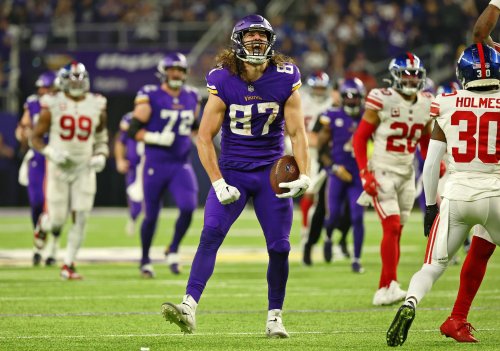
Following his arrival in Week 8 at the NFL's trade deadline, Pro Bowl tight end T.J. Hockenson amassed 97 targets in 11 games, including 11-plus targets in three of Minnesota's final four games last season. If you extrapolate Hockenson's target volume over a 17-game regular season, he's looking at 150 targets.
Is it fair to expect Addison to eat into Hockenson's target share in 2023? Absolutely. However, it's a bit of a stretch to expect Addison to supplant Hockenson as Minnesota's No. 2 option in the passing game. Whether it's right or wrong, many folks still have a difficult time coming to grips with non-wide receivers being near the top of their respective offense's passing game hierarchy. But a quick look around the league from last season will show you that it's fairly common.
Travis Kelce led the Kansas City Chiefs with 152 targets
Austin Ekeler led the Los Angeles Chargers with 127 targets
Mark Andrews led the Baltimore Ravens with 113 targets
Tyler Higbee led the Los Angeles Rams with 103 targets
Saquon Barkley led the New York Giants with 76 targets
Cole Kmet led the Chicago Bears with 69 targets
Pat Freiermuth was second for the Pittsburgh Steelers with 98 targets
Dalton Schultz was second for the Dallas Cowboys with 89 targets
Rhamondre Stevenson was second for the New England Patriots with 88 targets
Tyler Conklin was second for the New York Jets with 87 targets
Alvin Kamara was second for the New Orleans Saints with 77 targets
Aaron Jones was second for the Green Bay Packers with 72 targets
D'Andre Swift was second for the Detroit Lions with 70 targets
Austin Hooper was second for the Tennessee Titans with 60 targets
Last season, 43.75% of NFL teams had a non-wide receiver either lead their offense or be No. 2 in targets. And Hockenson's efficiency with extensive volume from last season can't be forgotten. His 101.2 passer rating when targeted last season was third-highest out of five Vikings who received 50-plus targets. And what's interesting about this is that K.J. Osborn, who Vikings fans still tend to view as nothing more than an afterthought, had the second-best passer rating when targeted last season with 105.8 on 88 targets. For context, Jefferson recorded a 107.9 passer rating across his 185 targets last season.
It's important to consider the first player that Kwesi Adofo-Mensah signed in free agency back in March. With Josh Oliver replacing Irv Smith as Minnesota's TE2, the expectation is that O'Connell's offense will lean into more 12-personnel (one running back, two tight ends, and two wide receivers) on early downs to properly combat the frequent two-high looks that opposing defenses gave Jefferson and the Vikings' offense last season. And with Hockenson's versatility as a player that can line up out of the slot and on the line of scrimmage, that will create opportunities for them to use Hockenson all over the field.
Even if Addison is third in this offense's passing-game hierarchy, that doesn't prevent him from making a serious impact as a rookie. The Vikings had the third-most pass attempts in the NFL last season (672). Even with more frequent 12-personnel on early downs, Minnesota expects to be a top-five passing offense by volume, so there will still be plenty of opportunities to go around aside from Jefferson and Hockenson. And let's not forget, Percy Harvin won the NFL Rookie of the Year award when he was behind Sidney Rice and Bernard Berrian in targets in 2009.
The hype is starting to ratchet up for Minnesota's prized rookie receiver. And for good reason. But it's important to keep expectations in check. And as long as both Justin Jefferson and T.J. Hockenson are on the field, Addison will remain the Vikings' No. 3 option in the passing game. With that being said, it wouldn't come as a shock if Addison surpassed 100 targets while still being that third option.
Think you could write a story like this? Hockey Wilderness wants you to develop your voice, find an audience, and we'll pay you to do it. Just fill out this form.
Recommended Comments
There are no comments to display.