


Tim Connelly’s front office has not shied away from drafting project players in his two years of running the Minnesota Timberwolves. They selected Leonard Miller, Josh Minott, and Jaylen Clark, who were raw but talented. Miller, Minott, and Clark have shown flashes of brilliance, but they would need some time before they could crack the rotation.
There is no better draft class than this year to make another long-term investment in a player who needs more seasoning to their game to maximize their potential.
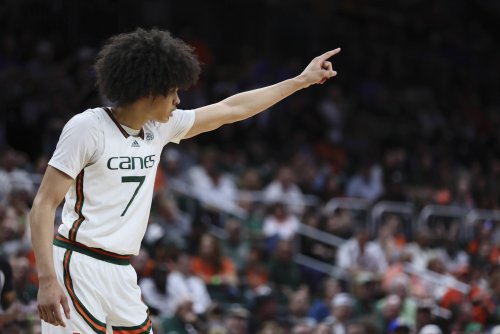
Swiss international and University of Miami freshman Kyshawn George would be the perfect gamble for the Wolves, sitting at the crossroads of Minnesota’s need for shooting and talent upside.
Since arriving in Miami, George has grown significantly on the court and in stature. He is adjusting to his unique pathway and has gone from 5’8” to 6’7” over the last 3 years. Therefore, George was a late riser and is still adjusting to his newfound size.
He started his ascent by playing four seasons of U-21 hoops with Élan Chalon, a French basketball club. While it was a slow start as George was still undersized and young, George averaged 15.2 points on 44/34.4/69.4 splits and 3 assists in 19 games over his final two seasons with the U-21 team. He then spent one season on Élan Chalon’s senior team, playing in 23 games but only averaging 2.9 PTS on 41.8/38.3/50 splits with 2.9 AST.
After his five years in France, Miami coach Jim Larranaga became intrigued with George and extended an offer to whom he would commit. He additionally received interest from Illinois, LSU, Pitt, SMU, Texas, and Xavier.
While it was a rocky season for Miami, losing their final 10 games, George’s gradual improvement in play and overall impact in his lone freshman season remained a bright spot considering his expectations.
George played in 31 games and made 16 starts. Averaging 7.6 PTS on 42.6/40.8/77.8 splits, adding 3.0 REB and 2.2 AST. However, he showed improvements in ACC conference play. Starting 14 of their 19 conference games, averaging 9 PTS on 44/43.2/71.4 shooting splits with 3.4 REB and 2.5 AST. It was still not perfect production for a potential first-round selection, but context will always remain important with George.
Stylistically, everything starts with George’s three-point shooting. He was an absolute flamethrower for the Hurricanes. Holding season totals of 53 of 130 (40.8%) from three, with incredibly intriguing measurements of 6’7” without shoes with a 6’10.5” wingspan at the combine. George was one of four high-major freshmen who attempted more than 100 3P and shot more than 40% from three-point range. The three others being 1st round locks with high chances of landing in the lottery.

George was a lethal threat all across the three-point arc. He easily hit from NBA range, making seven threes from 25+ feet. He rarely showed any sort of shot hesitation. While he was more of a standstill shooter, his smooth shooting mechanics and size carry enough value.
George relied on shooting to make an impact, with 130 of his 190 FGAs coming from beyond the arc. Therefore, this raises the question of how else George can affect the game offensively outside of his shooting.
He only took 38 total shots at the rim all season. While George shot 60.5% on those rim attempts, many were wide-open fastbreak layups. In half-court possessions, it was clear that he did not have the physicality, athleticism, or craft to finish around the rim. At the combine, he only had a 27-inch standing vertical jump and a 32-inch max vertical jump.
George would also only attempt 22 shots from the mid-range, making it clear that he needs to find a secondary scoring niche. NBA teams will gameplan him by playing him tight on the three-point line, forcing him off the line with aggressive closeouts. That can be limiting for shooters who want to take their game to the next level.
However, George offers upside with his on-ball comfortability. Because of his late growth spurt and slower development, he possesses more guard skills than most players his size. While George needs to refine much of this skill set, there is a pathway to success for him to become a competent tertiary ball-handler. He doesn’t have an incredible burst, quick first step, or tightest of handles, but his passing flashes and handle within his projected role offer a lot of upside.
While George will be 21 as a rookie and already is a bit behind the development curve for most players, even as a freshman prospect, his tantalizing three-point shooting and size are worth the gamble. The rest of his game will likely take time and reps in the G-League to work through. However, having an elite trait to work with should make that adjustment much easier because he can focus on where he still needs to improve.
The range of outcomes is still hard to gauge with George, but if he falls toward the mid-20s, the Wolves should do anything within reason to draft him. However, it will take some time for him to reach a playable level, and the Timberwolves seem more in the market for instant impact players. Still, George’s shooting ability and uncertainty of readiness amongst prospects in this range only benefit his draft stock.
We saw the Wolves pounce on Leonard Miller’s falling stock during the last draft. Will they do the same with Kyshawn George?
Think you could write a story like this? Hockey Wilderness wants you to develop your voice, find an audience, and we'll pay you to do it. Just fill out this form.
Recommended Comments
There are no comments to display.