

The Minnesota Vikings' quarterback situation was a mystery in the spring of 2000. Dennis Green MacGuyvered his way through the 1990s by leaning on an infrastructure featuring Robert Smith, Cris Carter, and Randy Moss. Randall Cunningham and Jeff George had reaped the benefits. Still, the Vikings had a raw rookie named Daunte Culpepper ready to take over.
Green was high on Culpepper. He waited eight years to draft a quarterback before choosing the UCF product. Still, the Vikings were in the win-now window with a loss in the 1999 NFC Championship Game (damn) and a 10-6 record with a playoff win in 1999.
Culpepper could be ready to play. But Green didn’t know if he was the best option, so he called the Miami Dolphins to see if Dan Marino was available.
Marino said no. However, 25 years later, the Vikings may have a similar situation. Kevin O’Connell has gotten all he possibly can out of Sam Darnold, who will likely leave in free agency next spring. J.J. McCarthy is the future of the franchise but hasn’t gotten any on-field reps outside of a preseason game where he tore his meniscus.
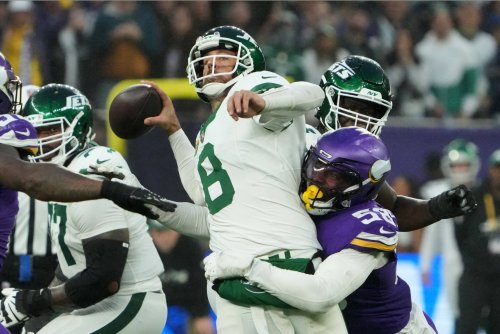
Minnesota could roll with McCarthy. But again, he may not be the best option available. That’s because, far away in Gotham, another future Hall of Famer is on the verge of splitting with his team. People have kicked around the possibility of Aaron Rodgers joining the Vikings since he traded barbs with Green Bay Packers general manager Brian Gutenkunst. Still, it never felt like a real possibility until now when any team can bid for his services next spring.
But before Vikings fans start buying custom jerseys to troll the kind folks of Appleton, Wis., they need to realize that O'Connell doesn't need Rodgers as badly as his predecessors did.
The 2000 Vikings were approaching the end of an era. While the foundation of an offensive juggernaut was within reach, several pieces were at the end of the line. Randall McDaniel had just retired. John Randle was entering his age-32 season, and Cris Carter was 35. Even Robert Smith was at the end of the line, announcing his shocking retirement at the end of that season.
Trusting a rookie and having them learn on the field wasn’t appealing to this group of veterans. Still, it may have been harder to stomach for Green on the sidelines.
The Vikings hovered around .500 early in Green’s career, earning the dreaded good not great label. Minnesota won eight or more games in each of his first six seasons but only won more than 10 twice. When the Vikings entered a 1997 Wild Card game against the New York Giants, a miracle onside kick saved his job and allowed him to draft Moss the following season.
A 15-1 record and a near Super Bowl appearance (again, I’m sorry) saved Green’s job, and getting the Vikings to the divisional round in 1999 heightened expectations even more. Green was the successful coach on a hot seat, and he couldn’t afford Culpepper learning on the job while going 9-7.
That all paved the way for Marino to come to Minnesota. Marino was at the end of his legendary career, but the Dolphins were entering a full rebuild under Dave Wannstedt. The chance to chase a ring had to be enticing, and Marino confirmed in 2022 that the Vikings and the Pittsburgh Steelers were the two teams most interested in bringing him in for a Super Bowl push.
Going back to his hometown of Pittsburgh was intriguing, but not as much as what he would have had in Minnesota. The sight of Marino chucking long bombs to Moss and Carter while also benefitting from Robert Smith in the backfield was enough to envision the Vikings making their first Super Bowl appearance since the 1970s. Plus, it would buy another year for Culpepper to learn the system before Minnesota unleashed him in 2001.
Brett Favre stepped into a similar situation under Brad Childress in 2009. Childress coached the Vikings from a 6-10 record in 2006 to an 8-8 record in 2007, leading Minnesota to a division title in 2008. Like Green, the expectations were rising, but Childress had whiffed on project quarterback Tarvaris Jackson.
Favre was coming off a lackluster season with the New York Jets in 2008, partly due to a torn bicep. The injury convinced Favre to retire temporarily for the second time in his career. However, the Vikings were alluring in more ways than just sticking it to the Packers, who had chosen Rodgers over him in the spring of 2008.
Favre walked into a building that boasted one of the best defenses in the league, led by Jared Allen on the edge and Pat and Kevin Williams (aka The Williams Wall) in the middle. E.J. Henderson and Chad Greenway were Pro Bowl-caliber players, and Antoine Winfield Sr. was one of the most underrated cornerbacks in the league.
Favre also had plenty to work with on the offensive side of the ball. He made Sidney Rice look like a star, and Percy Harvin had an immediate impact, winning the 2009 Associated Press Offensive Rookie of the Year Award. With Adrian Peterson in the backfield, Favre had one of the best seasons of his career and led the Vikings to the NFC Championship game. (Once again, I’m sorry.)
Marino was a pipe dream, but Favre represents concrete evidence that bringing in a veteran quarterback could work. Vikings fans speculated that Matthew Stafford could have helped this team at the trade deadline. If the Jets make Rodgers available, why wouldn’t they at least make the call?
The benefits are right in front of them. Rodgers would be working with a talented cast that already includes Aaron Jones, an old friend from Green Bay. Throwing to Justin Jefferson may be even more appealing than throwing to Moss in the early 2000s, and Rodgers would benefit from one of the league's defenses.
The added troll factor of having Rodgers and Favre play for the Vikings at the end of their careers may be too rich to pass up. But this is a different situation than the Favre/Marino universe due to what the Vikings are building.
In Favre and Marino's cases, the Vikings had a team that could contend for a Super Bowl. While the Vikings are doing that in 2024, they also have several aging players who may not be on the team next season, including Stephon Gillmore and Harrison Smith.
The Vikings also have several flaws they must address. The cornerback room could need as many as three new starters, with Shaquill Griffin and Byron Murphy Jr. set to become free agents. The defensive line needs an impact pass rusher to help out a talented edge group of Andrew Van Ginkel, Jonathan Greenard, and Dallas Turner. And the Vikings could finally use some cap space to answer the question, Can he play guard?
Minnesota has $74.4 million in cap space in 2025. Still, they'll have to use some of that money to solve those issues, especially for a team projected to have only four picks in next year’s draft. It’s nice to think Rodgers would take a pay cut to join the Vikings, but it’s unlikely to be in the same neighborhood as the $10 million Darnold is making next year.
There’s also the matter that Rodgers is under contract with the Jets through 2025, and the most likely avenue for him to leave New York is a trade that will accrue $25.5 million in dead money. Rodgers could re-work his contract as he did for the Jets when he arrived in New York. However, he would have no incentive to do so, considering he already won a Super Bowl with the Packers in 2010.
Sure, the pettiest human in the NFL may want to stick it to Gutenkunst and the Packers like Favre did to Ted Thompson. Still, we must consider that O’Connell doesn’t need Rodgers.
With a 28-16 record, O’Connell has the highest winning percentage (.636) in Vikings history, ahead of Bud Grant (.621). He's a virtual lock to sign a contract extension next spring. With much of the infrastructure in place, O'Connell can guide McCarthy like Green guided Culpepper in 2000 when his Marino plans fell through.
It might not stop the Vikings from investing in a contingency plan next offseason. Still, it doesn’t have to be the mercenary Favre was, Marino could have been, and Rodgers would have been.
Add it up, and it doesn’t make sense for Rodgers to find his way to Minnesota because O'Connell doesn't need him as badly as his predecessors did.
Think you could write a story like this? Hockey Wilderness wants you to develop your voice, find an audience, and we'll pay you to do it. Just fill out this form.
Recommended Comments
There are no comments to display.