


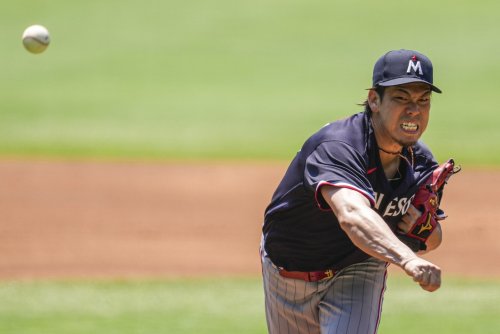
As odd as it may sound, an injury can help steer a pitcher right as he works to return to the mound. Kenta Maeda has such an opportunity after returning from the injured list a few weeks ago with a healed elbow and forearm. Maeda opened the season with an excellent five-inning start where he allowed only one run. But in his next subsequent starts, he surrendered 15 earned runs in 11 innings. I attributed his shortcomings to a poor fastball in a May article, believing he was locating his fastball too high.
Now months later, Maeda has given Minnesota Twins fans reason to believe in him after only two earned runs through 10 innings. His first two starts post-injury have come against an impotent Detroit Tigers lineup and one of the best in the Atlanta Braves.
Hoping to return to his 2020 form, Maeda has not been a stranger to obstacles during his time in the Twin Cities. Casey Drottar and Jake Foley, proficient members of PitcherList, identified some of Maeda’s 2021 struggles before ultimately requiring Tommy John Surgery. Maeda found such great success in 2020 (2.70 ERA, 0.75 WHIP) largely because he altered his arsenal. He threw substantially more splitters and sliders than he did fastballs and sinkers, even in batter’s counts. The reasoning for this is simple: His fastball is not great, and his splitter and slider are good.
The revert back from splitter/slider usage can be seen in this graph found on PitcherList’s website:

Maeda averages 90 mph with his fastball with an insubstantial movement profile. He’s not a high-spin whiffer like Bryce Miller, nor a grounder-inducing sinkerballer like Marcus Stroman. Those that have followed Maeda throughout his career will not be shocked at this information, but he’s made his living in the MLB through deception rather than abundant fastball usage and/or a strong standalone fastball.
Because of his fastball, Maeda and his breaking pitches are naturally inseparable. He’s best known for
With this knowledge in mind, how exactly has Maeda been able to cruise through his last two starts? Knowing that command of his secondary pitches is paramount, is Maeda primed for a superb second half?
After mixing up his pitches to the first 11 batters he faced, Maeda threw 27 (!) straight non-fastballs to Tigers batters. Starting with a called strike curveball to Kerry Carpenter in the fourth inning, Maeda didn’t throw a fastball/sinker until he found himself in a 1-1 count to Jake Rogers in the fifth. In the time between, he retired five of six batters, eventually walking Rogers as his seventh batter faced during his absurd 27 straight breaking ball/offspeed streak.
It is clear that Maeda was confident in his ability to command his secondary pitches. In two separate 3-1 counts to Nick Maton and then Jake Rogers, Maeda threw a slider that fell in for a called strike. Rather than falling back on his fastball to help him get back into the count, he trusted his ability to locate one of his best pitches.
The exact pitch type by count breakdown looks like this:


Trusting his secondary pitches is one thing, but how did he do locating them? Before getting into the explanation, I’d like to show the pitch chart of his secondary pitches for each of his last two starts.


Maeda looks to have struggled with location only in the Braves game (second graph). That graph shows an over-concentration of sliders and splitters inside the zone. However, I’d argue he located his slider well down and away against the Tigers with his splitter mirroring it. Is this a fair assessment of his command in those two games? A numerical approach guided by PitcherList can be used to help answer this question.
If you’ve read some of my articles before, you’re familiar with Pitch Level Value (PLV), something I use regularly. Created by PitcherList founder Nick Pollack, PLV seeks to grade pitches not on their results but as their own event. To summarize PLV’s existence, pitches with good stuff that are located well will be graded better than those that are not.
Maeda’s secondaries received respectable PLV grades. With 5.0 being average, 5.5 being elite, and 4.5 being abysmal (the scale for PLV is 1-10, but most numbers are within 4.5-5.5), we can evaluate his command.
His splitter received grades of 5.34 and 5.10, respectively. The slider was not far off from those numbers, being 5.12 and 5.23. His low usage curveball is of less importance here. But for those that are curious, its numbers were 5.60 and 3.82.
It seems that he should be able to trust his secondaries in the future, but what about the second part I mentioned earlier? To get the most out of his splitter, it would benefit him to locate some fastballs down. It is true that his splitter has not performed as well as it has in the past. The 12.3% swinging strike rate and 20.8% called strikes plus whiffs (CSW) of that pitch is down from the 19.8% and 26.5% of 2021. Getting his fastball down may or may not be causing the splitter to founder, but it makes sense on paper.
The same types of charts used to show secondary location can be used here for the fastball:


Looks like a heavy dosage of middle and up. Once again, we’ll confirm what we see with PitcherList, this time using loLoc% to see how often fastballs fell in the bottom third of the zone. To no surprise, the loLoc% of his fastball in those starts are 4.8% and 10.5%, respectively. He’s lived in the 30s in his career, so there’s room to grow there.
The results of this analysis are not crystal clear. We do know his secondary pitches spearhead his attack and he must command them to regularly get batters out. He could also stand to throw his fastball lower. However, if the past two starts are any indication, Maeda is beginning to trust his slider and splitter more. Whether that means he will or will not return to something close to his peak performance levels is yet to be seen.
Think you could write a story like this? Hockey Wilderness wants you to develop your voice, find an audience, and we'll pay you to do it. Just fill out this form.
Recommended Comments
There are no comments to display.