


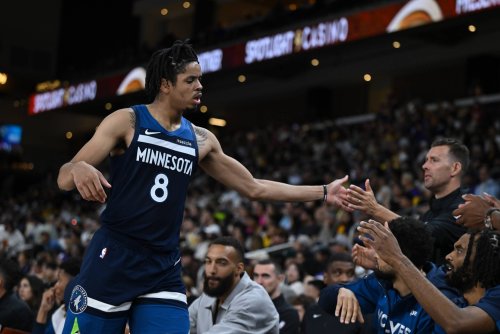
The Minnesota Timberwolves are pretty good. The past three seasons represent arguably the second-best stretch of Wolves basketball behind only 2001 to 2004. It may even be better when factoring in last season’s playoff success. They’ve ascended into the top tier of the NBA with a loaded roster, equipped with a budding superstar, Defensive Player of the Year, and several ascending role players and secondary players.
Nobody knows this more than Josh Minott.
The Wolves didn’t draft the springy, energetic wing to play immediately when they took him 45th overall in 2022. Still, he hasn’t gotten much playing time in his first two seasons. Minott’s production in his first two seasons doesn’t put him on track to be among the league’s best young players. He’s played in just 47 games, averaging 2.0 points, 0.9 rebounds, 0.3 assists, 0.2 blocks, and 0.2 steals in 4.0 minutes per game.
Minnesota has Minott, 21, slotted behind wings and power forwards like Jaden McDaniels, Naz Reid, Kyle Anderson, Karl-Anthony Towns, and Taurean Prince. Almost no amount of success with the Iowa Wolves would earn Minott minutes.
That may not change this year, with Donte DiVincenzo, Joe Ingles, Nickeil Alexander-Walker, Rob Dillingham, and even Leonard Miller clogging up the rotation. Still, improving his three-point shooting could help him secure more playing time and pay dividends for his career.
He might already be ahead of the curve. Minott recently
Over the past two years, Minott made 32.4% of his threes in the G League Showcase and regular season. While his 37.5% career NBA three-point shooting percentage is high (just 6 of 16 total shots), that isn’t enough volume to label him a shooter.
Though he hasn’t attempted many threes, Minott’s stat lines of the past two years can offer a peek into the future.
Using Euclidean distance, which measures the distance between two points as a line segment, I found how similar (or dissimilar) the 1,484 players drafted since 1998 who played consecutive seasons to begin their careers were to Minott’s.
*Data sourced from BasketballReference. Method built using Eduardo Tocco’s code.
I used his entire stat line, from games played and started to field goals attempted and made to points and steals per game. I then added the distance of all these stats to create one more representative distance.
Each player had two distances: One from their first season to Minott’s first season and another from their second season to Minott’s second season. Averaging these two distances results in one final distance that quantifies how similar they are to Minott.
The result: Alondes Williams has had the most similar career to Minott – at least by this method. LeBron James was the least similar. Furkan Korkmaz, Derrick Jones Jr., and DeAndre Liggins were also somewhat similar to Minott. There are hundreds of players who had relatively similar career beginnings to Minott.
The density plot below, an effectively smoothed histogram, shows the frequency of distances from Minott. It shows an intuitive fact about NBA life: rookies and sophomores usually don’t amaze immediately (if ever).

From here on out, the top 33 percent of similar players may be called the “similar players” to Minott. This figure is arbitrary, though it ensures enough players to work with and not too many so that the Minott-like target group is lost.
There are 490 total players. Their average third-year stat line? 4.2 points, 1.0 assists, 2.0 rebounds, 0.2 blocks, 0.4 steals, and 12.1 minutes per game in 26.6 games played. Nothing special. But some players excel.
Furkan Korkmaz, who averaged 5.8 points per game as a sophomore, scored 9.8 points per game in 72 games in his third season.
Although he’s a center while Minott is a small forward/power forward, Nick Richards jumped from 0.8 points per game in his rookie season to 8.2 per game in his third season.
Wolves favorite Jake Layman showed minimal signs of improvement in his second season but jumped from 1 point per game that year to 7.6 per game the following year. He also played over double as many games and nearly 14 more minutes per game.
Christian Wood played his third year in Greece. Flawed as though he may be, he eventually developed into a 20-point-per-game scorer despite sharing a similar first two seasons to Minott.
Players like Minott can find more playing time. While each player’s situation is anecdotally more important, there’s an underlying trend in most successful year three players.
Of the 271 Minott-like players that played a third season (and some didn’t), the 98 that played in 27 or more games shot 31.1% from three.
The other 173 that played 26 games or fewer shot just 25.9%.
Using the median games played of 18 instead of the mean, 131 players who played 19 or more games shot 30.6%, while the other 140 who played 18 or fewer shot just 25.8%.
It’s not that these better players necessarily play more “shooter-friendly” positions, either. The position distribution of these two groups is similar. The worst group had a higher percentage of shooting guards.


Better shooters do better things for their teams. For players like Minott, who may not have been drafted to be superstars nor excelled early in their careers, shooting well is a way to ensure you can contribute to the team’s offense in a simple, plug-and-play way.
A better analysis would contextualize each player’s three-point percentage to the league’s average in their respective years. That will have to come another day.
The league changes. Threes weren’t as important in 2005 as they were in 2015, nor as important as they will be in 2025. However, since then, shooting well has seemingly ensured that many NBA players can enjoy long, fruitful careers.
Once again, this is something Minott may exemplify.
Among those 490 similar players, only 178 played at least five seasons in the NBA.
The 312 who played four or fewer seasons shot just 28.1% from three in their first two seasons (3,248 for 11,577). Though they improved up to 30.7% in their third and (maybe) fourth seasons (5,067 for 16,491), it wasn’t enough for many players as they didn’t play five or more years.
The 178 more tenured players, however, fared differently.
They started higher – 32.3% from three (2,556 for 7,919) – but developed into even more respectable shooters. They shot 35.5% in all ensuing years, starting with their third season (31,298 for 88,249).
Once again, it doesn’t appear the positions of these short and longer-career players are playing a role:


This may be intuitive. Better shooters make more shots, earn more money, and play beyond Year 4 and into a second contract.
It’s the universal language for role players, too.
There are only so many touches available to a team. If there’s one or two bonafide stars on that team, there’s even fewer.
Minott is not a bad basketball player. However, he’s not on the same career trajectory as Anthony Edwards or Naz Reid or even McDaniels.
Perhaps Minott enjoys delayed success. But for now, showing the coaching staff he can make threes and coexist with more ball-dominant players could be what it takes to earn the playing time to realize his potential.
Think you could write a story like this? Hockey Wilderness wants you to develop your voice, find an audience, and we'll pay you to do it. Just fill out this form.
Recommended Comments
There are no comments to display.