

Imagine, if you will:
It was a tough night for Kevin O’Connell to sleep. A decision on Aaron Rodgers was pending. The Minnesota Vikings upgraded their roster significantly during the first week of free agency. A 14-3 team has raised expectations significantly, and the security of a contract extension could help him get some rest.
Eventually, his eyes got heavy, and he dozed off. Suddenly, he was at Ford Field. Fourth-and-goal from the one-yard line. The NFC Championship is on the line. The Vikings had just been stuffed on their first three carries, and Dan Campbell was about to tell O’Connell, “Get ready to head to Cancun, buddy.”
But just as the Lions were about to taste victory, in came the ringer: a 5’11”, 223 lb. running back ready to make a defense pay. He took the ball and burst through the line like the Kool-Aid Man through a brick wall, and the Vikings were on their way to the Super Bowl.
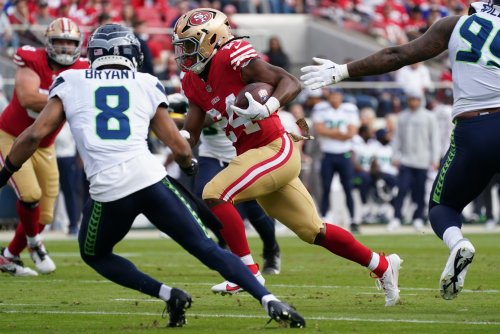
For once, O’Connell slept like a baby, perhaps muttering, “You know how I feel about Jordan,” in his sleep. But Jordan Mason isn’t just the running back of O’Connell’s dreams. He’s the one the Vikings have been searching for over the past three seasons.
Minnesota’s running game has been a concern since O’Connell took over for Mike Zimmer in 2022. While O’Connell flipped the script to a pass-first offense, he wanted an efficient ground game to marry the pass and attack defenses downfield.
While he got the latter part correct with Kirk Cousins and Sam Darnold, the running game hasn’t helped Minnesota out much. In O’Connell’s first three seasons, the Vikings rank 27th in rushing yards and 29th with four yards per attempt. Finding the end zone has also been difficult for the Vikings, who rank 26th with 34 touchdowns during that span.
The first step to beef up the running game was to add Ryan Kelly and Will Fries in free agency last week. But the next step was acquiring Mason in a trade with the San Francisco 49ers.
Mason is not your typical that guy was on my fantasy team player. Still, many Vikings fans will know him as the handcuff to Christian McCaffrey. They may also remember him as the running back who gored Minnesota’s defense for 100 yards and a touchdown in a Week 2 loss at U.S. Bank Stadium.
However, outside of stats and traditional numbers, Mason is a running back who defenses hate to tackle. According to Pro Football Focus, Mason ranked 10th among qualifying running backs with 3.35 yards after contact. He also forced 37 missed tackles on 153 carries. For context, Mason had more missed tackles than Breece Hall (36), Jonathan Taylor (36), and Brian Robinson (34) as a part-time player, meaning it takes more than one guy to bring him down.
It's something that has been missing throughout the Kevin O’Connell era. Aaron Jones averaged 2.97 yards after contact and had 46 missed tackles forced last season, but he ran for minus-two yards and scored only three times on 13 carries inside the five-yard line.
Cam Akers also had solid numbers with 2.83 yards after contact and 22 missed tackles forced on 104 carries. But he also struggled inside the five, with three yards and a touchdown on one carry.
Ty Chandler was supposed to be the “1B” to Jones’ “1A” and had 2.86 yards after contact, generating 14 missed tackles in 2023. But they couldn't trust him because of his inconsistency. That forced the front office to trade for Akers, who has torn both Achilles since entering the league in 2020.
Vikings fans thought Alexander Mattison was the guy before that, thanks to 2.76 yards after contact and 23 missed tackles on 74 carries in 2022. But things got historically bad as he failed to score a rushing touchdown on 180 carries the following year.
Then there was Dalvin Cook, who put up a solid 3.16 yards after contact and forced 52 tackles on 264 carries. Still, his all-or-nothing approach led the Vikings to move on after the 2022 season.
Minnesota's running back carousel has hindered its rushing attack. But so has their effectiveness inside the five-yard line. Dating back to 2022, the Vikings have run the ball 64 times inside their opponent’s five-yard line but have only scored on 21 attempts. The 32.8% clip ranks 31st, only ahead of the Houston Texans during that time frame, and the Vikings capped it off with a 6 for 20 (30%) performance on these runs last season.
It might have been part of why the Vikings threw money around to fix the problem in free agency. But they also extended Mason on a two-year, $12 million contract with $7 million guaranteed to add some muscle on these runs. It didn’t translate into massive success last season, with Mason scoring three touchdowns on 12 carries inside the opponent’s five-yard line. Still, his metrics suggest he could succeed running behind Minnesota’s offensive line.
While the move doesn’t eliminate the possibility of adding another back in the draft – especially a younger, faster version of Jones – it adds a new dynamic that lets O’Connell rest easier in the running game.
Think you could write a story like this? Hockey Wilderness wants you to develop your voice, find an audience, and we'll pay you to do it. Just fill out this form.
Recommended Comments
There are no comments to display.