


Most sports injuries are hard to contextualize. Most people haven’t experienced a torn ACL because fewer than 200,000 people suffer this injury in a year in the United States. That accounts for just 0.6% of the US population annually suffering an ACL tear. However, everyone can relate to ankle sprains.
Who hasn’t tripped over a scurrying dog while clearing a kitchen table or slipped on the grass while mowing the lawn? Athletes experience them all the time. Basketball players experience them coming down from a jump shot, and football players can have their cleats get stuck in the turf and roll an ankle.
Ankle sprains are one of the rare things in life where mere mortals with no athletic gifts can experience what a prime athlete can have happen to them. Because they are so common, they are often overlooked and underexplained.
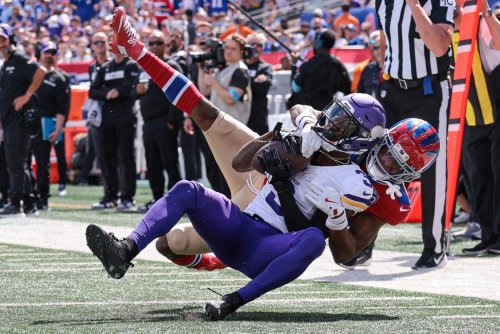
That can cause confusion about outcomes and timetables for recovery. The Minnesota Vikings’ second-year receiver Jordan Addison sprained his left ankle in preseason and then his right ankle in their 28-6 Week 1 win over the New York Giants. Therefore, it’s time for a refresher to understand an ankle sprain.
An ankle sprain is any stretching or tearing of the ligaments or cartilage in an ankle. It’s a common injury because of how the human body is constructed. Picture an old tree. The tree’s base is round and thick and gets increasingly tinner as you follow the tree's trunk up.
The tree withstands winds and storms due to its thick base. Its roots are connected to the base, preventing it from turning over or snapping from left to right. Now, look down at your leg. Notice how the opposite happens on the human body. The base of the leg, or the ankle, is likely the narrowest part of the leg. It’s connected to the foot, or the roots, and supports the entire body's weight.
That’s why the ankle is so easy to sprain. The weight congregating at such a small point causes it to twist and bend over. That’s an imperfect comparison because the ankle allows humans to walk, and trees are immobile.
However, the physics remain the same. The ankle is one of the weak points in the human body. It’s an amalgamation of connective tissues and ligaments connecting the foot to the lower leg. When someone overstretches or tears any of the 11 main ligaments concentrated in three separate bands of ligaments, it creates a sprain, usually due to hyperextension or abnormal twisting of the ankle joint.
Everyone knows the symptoms of an ankle sprain: pain, swelling, bruising, limited mobility, and more pain when weight bearing on the affected leg. Treatment is a simple acronym: RICE: Rest, Ice, Compression, and Elevation. The acronym is easy enough to remember, and the order of the letters indicates its importance to recovery. Rest is the key factor in ankle sprain recovery. It’s best to limit walking and to limit stress on the ankle.
The last three letters of the acronym ICE relate to symptom and pain management. Ice helps to lower inflammation and swelling and provides pain relief to the affected ankle. Compression adds support and forces fluid and inflammation away from the sprained area, which can cause pain relief. Elevating the leg allows gravity to assist in bringing fluid from swelling back to the core of the body and can help with throbbing pain by lessening the compression from the fluid.
Unfortunately, long-term recovery can be frustrating and arduous. Until a ligament fully heals, it is always at an increased risk of re-spraining, which is why players often re-aggravate the injury.
There’s also a chance that repeated sprains can cause early arthritis in the ankle joint. Arthritis is a chronic inflammation of a joint, and the chronic inflammation can put increased pressure on the ankle and lead to easier ankle sprains as mobility decreases. If the sprain is less severe, it can last a few weeks. However, some complications will last a lifetime because nagging injuries and arthritis prevent them from ever truly healing.
Fortunately, physical and occupational therapists are well-equipped to treat ankle sprains. They can help strengthen the muscles surrounding the ankle and lower leg, while practices like yoga and Pilates can improve joint flexibility. The combination of these approaches can aid in healing and prevent future sprains. Braces, wraps, and devices can provide stability and support, which you can often see on athletes after the game.
However, Jordan Addison’s medical reports since Sunday’s game say the ankle sprain is not as severe as it looked when he headed to the locker room with a towel over his head. Hopefully, he gets the rest he needs to fully recover and put the injury behind him for the season. A season that looks a lot more interesting after Minnesota’s win over the Giants.
Think you could write a story like this? Hockey Wilderness wants you to develop your voice, find an audience, and we'll pay you to do it. Just fill out this form.
Recommended Comments
There are no comments to display.