


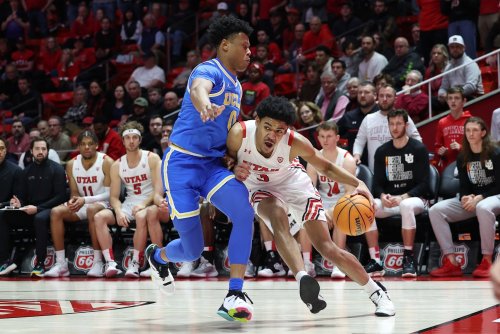
Jaylen Clark is as much of an unknown to Minnesota Timberwolves fans as the new rookie class. He ruptured his left Achilles on March 4, 2023, during his junior season at UCLA. That caused him to fall in the 2023 draft until the Wolves selected him with the 53rd pick.
Clark missed the entire last season recovering from the injury but was officially cleared to return to play on July 7. At a recent practice, a reporter asked what Clark is trying to prove in Summer League. “Reestablishing myself as the best defender out of my class age-wise,” he responded, “try to go out there and break a steals record.”
I followed up by asking Clark about defense being his path to the rotation, “1000%,” Clark replied.
Having the ability to look into what the team needed from him all of last season, Clark has settled in on his best skill to crack the rotation: “defense.”
At UCLA, Clark was known as a defensive hound, averaging a Pac-12-leading 2.6 steals per game in the 30 games he played last season. His 6.0 rebounds as a 6’5” guard were nothing to scoff at either. Just from his counting stats, it’s obvious why Clark was awarded the Pac-12 Defensive Player of the Year and the NABC Defensive Player of the Year awards.
His 5.1 steal percentage, the percentage of possessions he obtained a steal, ranked ninth in the NCAA and led to an 85.9 defensive rating that ranked fourth in the NCAA. His 2.7 defensive win shares ranked 13th in the country. That all led to a 6.7 per-game defensive box plus/minus, which ranked second in the NCAA behind only Dereck Lively when he was at Duke.
The statistics speak for themselves, but Clark's film shows how devastating he can be as a defender. He has an innate ability to crowd offensive ball handlers and force them into mistakes. Clark has excellent speed to keep up with his opponents, especially when guarding smaller defenders. Then, he uses his entire body to force ball handlers into taking looping routes to the basket because they don’t want to risk dribbling into Clark.
In the clip below, Clark bodies the offensive guard and forces the turnover:
They assigned Clark to the opponent’s best player during most of his time at UCLA. As a result, Clark has developed the ability to play against all positions. “In Summer League, for sure, I can guard 1-5,” Clark said at practice on Monday. In college, he used his frame to bang into taller defenders and maintained pressure on the ball against less competent ball-handling bigger players. Clark showed an innate ability to stand up to the contact from those bigger players and timing his steal attempt to poke at the ball. His other superpower when guarding smaller players was his ability to stay low, jump passing lanes, and cause a steal, as he does in the clip below.
Clark’s defense in pick-and-roll plays might be his best ability. It’s also the best way he can break through on the Wolves roster, similar to how Nickeil Alexander-Walker broke into Minnesota's rotation last year with his energy and hustle around screens. Clark has an instinctual ability to dodge screens, sliding above them to maintain contact with the offensive ball handler.
His speed helps him reset his feet and stay in front of defenders despite squeezing through small windows of space. It looks identical to how Conley and Alexander-Walker can make themselves small during the screen to avoid contact with the screener before making themselves big and taking away passing lanes. Similarly, Clark can shrink around screens off the ball and use his length to tip passes into steals.
However, Clark can use his heavier frame to switch on defense more efficiently, creating a contrast between Clark, Conley, and Alexander-Walker. That’s not to say that Conley and Alexander-Walker were poor on switches, but they are both more slender guards who can be picked on in mismatches off of the switch. On the other hand, Clark has the size and footwork to stand up better with bigs in post-backdowns and displayed this ability in college.
Perhaps the most encouraging sign for Clark is his ability to improve every year. During his three seasons at UCLA, his defensive rating improved every season, as did his steals per game, defensive win shares, blocks, and rebounds. If he can stay healthy, it’s safe to assume the improvement will carry into his professional career.
“It’s been probably 14, 15 months, so it feels great to be back out there,” Clark said regarding his training camp expectations. “When you get something taken from you, it leaves you questioning a whole bunch of stuff, so to be able to be out there playing how I played prior, it feels great.”
If Clark truly is playing how he played at UCLA, the Wolves should expect him to break into the roster with his defensive ability.
Think you could write a story like this? Hockey Wilderness wants you to develop your voice, find an audience, and we'll pay you to do it. Just fill out this form.
Recommended Comments
There are no comments to display.