


In the Futurama episode Attack of the Killer App, a new version of the eyePhone is released. As Phillip Fry attempts to purchase one, the store clerk begins to list potential issues with the new eyePhone, to which Fry interrupts, waving a fistful of cash.
“Shut up,” he says, “and take my money.”
https://twitter.com/originsofmemes/status/1788690690546815479?s=46
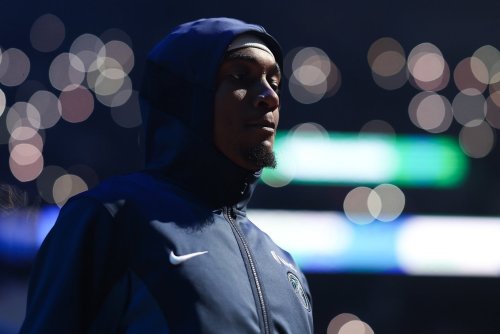
Much in the same way, Minnesota Timberwolves forward Jaden McDaniels entered his fourth NBA season in 2023-24 as a promising player with some flaws. His shooting was inconsistent, he was foul-prone, and he broke his hand in frustration the season before. Still, we can assume that the Wolves had a shut up and take my money moment when they signed McDaniels to a five-year, $126 million contract, ensuring he’d continue to develop in Minnesota.
McDaniels is now entering the first year of that contract, which will pay him $23 million. The pay increase will likely come with higher expectations because he had mixed results in 2023-24. However, he capped it off with a playoff surge that should give hope that McDaniels will exceed his new contract's expectations. Still, it’s difficult to determine the reasons behind that surge and his regular-season regression.
Looking back at McDaniels’ season and his traditional counting statistics suggests he regressed. Averaging his statistics to 36 minutes to level out playing time differences, McDaniels averaged fewer points, rebounds, assists, and steals than he did in 2022-23. His field goal percentages also dipped, going from 51.7 percent from the field to 48.9% and 39.8% from three to 33.7%. That would suggest that McDaniels could be a reason for concern as his extension kicks in next year.
Digging a little deeper offers hope, though. Despite having all of the regressions in traditional statistics, McDaniels posted career bests in offensive rating (114.2) and per-game plus-minus (+2.7). He also had a 1.2-point improvement in defensive rating, going from 111.6 to 110.4. That all resulted in McDaniels posting a career-best 3.8 net rating. His underlying stats would seem to suggest that despite his downturn in traditional statistics, McDaniels had a really impressive season.
But, like most things in life, it’s not that black and white. The uptick in his underlying metrics requires context. McDaniels offensive rating last season was 0.4 points lower than the team's average (114.6), and his defensive rating was 2.0 points lower than the team's top-ranked rating (108.4). His career-best 3.8 net rating was also 2.5 lower than the team's 6.3 per-game net rating. That would all suggest that McDaniels ratings could have been improved based on the team's overall play and that he took a step backward last season.
To add even more ambiguity, McDaniels performed with aplomb in the playoffs and arguably single-handedly won them games. For example, it’s hard to see Minnesota returning to vanquish the Denver Nuggets without his 32 points on 8 of 10 shooting or his 23 points on 7 of 10 shooting in Game 7. His offensive rating skyrocketed to 117.9 in Minnesota’s 16 playoff games, and his defensive rating remained elite at 111.5. That resulted in his net rating improving to 6.4. Comparing McDaniels to Minnesota’s team totals, his offensive rating in the playoffs was 3.1 points better (114.8), and his defensive was only 0.6 points fewer than the Wolves’ team total (110.9). That leads to his net rating being 2.5 points better than the Timberwolves’ average (3.9).
To summarize, McDaniels had a down season statistically but had the best regular-season ratings in his career because of Minnesota’s success. However, that dynamic switched in the playoffs. McDaniels's play likely increased the team's ratings.
So what changed?
After examining the differences in his percentages, a few things stand out. His usage rate decreased, his three-point percentage surged, and he took considerably better care of the ball.
2023-24 regular season
Usage 15.6%
Three-point 33.7%
Turnover ratio 10.2
2023-24 playoffs
Usage 14.3%
Three-point 42.9%
Turnover ratio 8.9
While it could be obvious that basketball is a make-or-miss league, and he hit threes, he improved drastically shooting the ball, making him a better player. It’s important to understand why he shot so much better and how it could relate to the playoffs.
McDaniels’ usage rate was the biggest change outside of his three-point percentage. His 1.3% dip in usage amounts to about two fewer possessions ending in his hands per game. The fewer possessions reflect the change in how the Wolves used McDaniels, meaning they tasked him with fewer on-ball creation and put him in more of a spot-up shooting role.
While his dip in usage isn’t large, it coincided with a decrease in his turnover ratio, suggesting that this less on-ball role caused him to make less costly decisions. That coincided with the eye test. Mike Conley and Anthony Edwards handled almost all the on-ball offensive responsibilities from the guards and wings. By guarding guards and wings on the ball, Conley and Edwards took all the pressure off McDaniels, which could be attributed to the 9.2% better three-point shooting. He was now tasked with swinging the ball to open shooters or taking the shot himself.
Some advanced statistics indicate that McDaniels played more of a catch-and-shoot role. For example, every three-point make that McDaniels had during the playoffs came off of an assist. The NBA labeled 94.3% of McDaniels three-point attempts as either open (closest defender within 4-6 feet) or wide open (closest defender 6+ feet away). 97.1% of McDaniels’ three-point attempts came with him touching the ball for under two seconds, and 91.4% came without a dribble. As a catch-and-shoot player, McDaniels was playing his offensive role.
As a result, the NBA labeled 37.9% of McDaniels’ total attempted shots as catch-and-shoot threes, and he converted 43.4% of his catch-and-shoot threes. However, 36.6% of McDaniels’ shots during the regular season come from catch-and-shoot threes, a 1.3% difference. That means that approximately one of McDaniels 56 total three-point attempts in the playoffs was likely a better percentage shot than he got in the regular season.
That raises questions. For example, why did McDaniels' percentage increase so dramatically when he only slightly changed his play style?
Let’s look at the location of his three-point attempts to find out. McDaniels shot 67.8% of his total threes in the playoffs from the corners, compared to only 62.8% during the regular season. Alas, this is a 5% change, meaning he shot roughly one more corner three every 20 shots. More importantly, he shot one less above the break three.
That’s important because McDaniels shot 29.8% above the break during the season, which is 6.7% worse than he shot from the corners during the regular season (36.5%). In the playoffs, McDaniels shot 47.3% from corner threes, which were likely more open, and there’s less pressure to make a play or pass. Like the regular season, the 47.3% from the corners was significantly better than his 38.9% from above the break. So the increase in corner volume and the decrease in above-the-break volume, coupled with the less pressure to be a playmaker and more open shots, resulted in his postseason shooting success across the 16 games.
The change in role took the pressure off McDaniels and placed him in a position to succeed as a catch-and-shoot player. Therefore, it’s likely the best place for McDaniels within Minnesota’s offense moving forward. In the playoffs, he has proven that he can drive winning when he is placed in locations and situations to succeed. Despite this, teams must put young players in situations that make them uncomfortable for their development, which is likely what happened with McDaniels in the 2023-24 season.
The Wolves can have the best of both worlds. Their team is good enough to allow McDaniels to struggle, work through his development as a creator, and expand his offensive game. Ultimately, they said shut up and take my money because he can play a valuable role in the playoffs and positively impact the team when they need it most.
Think you could write a story like this? Hockey Wilderness wants you to develop your voice, find an audience, and we'll pay you to do it. Just fill out this form.
Recommended Comments
There are no comments to display.