


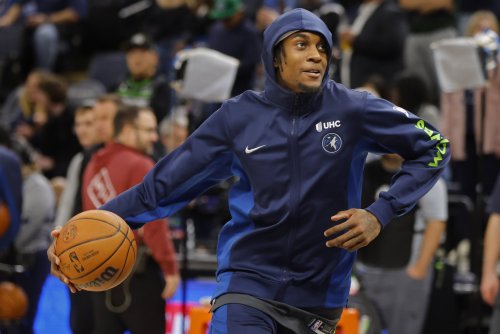
Anthony Edwards was sitting in a white tank at his locker, answering questions following an overtime win over the Boston Celtics. “He’s one of the best players on the team!” he exclaimed, referring to fellow 2020 draft pick Jaden McDaniels. Two weeks later, McDaniels suffered a right ankle sprain that kept him out of action for eight games. McDaniels is back, seemingly at full strength. Now with an adequate sample size of 11 games played since his return, it is time to ask the question, is McDaniels one of the best players on the team?
In some ways, McDaniels is one of the best players on the team. However, McDaniels seems to follow Newton’s first law of motion, which states, “For every action, there is an equal and opposite reaction.” McDaniels is phenomenal on defense, but he leads the league in fouls per game, which often hampers his abilities. McDaniels is shooting a career-high from the field, but his rebounds and assist percentages are at career lows.
We can discover why by looking at McDaniels’ recent game logs. McDaniels’ lack of consistency appears to create drastic positives and negatives in his game. The negatives are always there. McDaniels’ fouling has been a problem for years, and the career lows in certain categories appear situational due to the team's makeup. But McDaniels’ positives seem incredibly positive in one game and almost non-existent in others.
Anthony Edwards has taken a leap and solidified himself as a generational talent. But his development path isn’t typical for most players. It’s easy to forget that most young players develop the way McDaniels is developing, with high highs and low lows.
McDaniels is shooting a career-high 52.6% from the field, and his 115.3 offense rating is also a career-high. That’s mainly due to the games when he played at his peak. Since returning from injury, McDaniels has had four games where he’s shooting over 55% from the field and averaging 14.5 points.
In contrast, McDaniels has had four games where he shot under 45% and averaged 8.5 points. With his performance in eight out of his 11 games since returning being in such stark contrast, McDaniels’ inconsistency on offense could be related to his usage percentage being nearly identical to his career average at 15.7% this season compared to his career average of 14.7%. With such a low usage rate, missing his first two shots in a game can often cause his field goal percentage to be low despite otherwise having an efficient game.
To McDaniels’ credit, he can quickly shake off a tough shooting night. McDaniels has only had one back-to-back sub-50% shooting night all season, meaning his slumps don’t last long. That could mean that McDaniels is suffering from a lack of opportunity to shoot himself out of a poor start due to his low usage rate and minimal shot attempts per game. His back-and-forth games on offense could be attributed more to a couple of bad bounces on the rim than anything McDaniels is doing wrong, especially because he’s the fourth or fifth option among the starters.
McDaniels’ defensive influence is clearer. He’s an elite defender with an elite foul problem. McDaniels is averaging 3.5 fouls per game this season, another career high. McDaniels lives his basketball life in foul trouble, but his 4.1 per 36 minutes fouls per game are a career low. That suggests improvement in McDaniels’ ability to defend without fouling.
Neither number is good; McDaniels ranks 4th in the NBA in fouls per game. But that number drops to 34th when using his per 36 minutes number. That suggests that McDaniels has improved the ugly side of his defensive game.
But McDaniels brings a lot of positives with his game. His traditional defensive statistics seem a little lackluster, averaging under one steal and one block per game. Looking closer, though, his advanced stats are truly remarkable, given he guards the opposing team's best player almost every minute he is on the floor.
When McDaniels is the closest defender, opponents are shooting a dismal 28.6% from three and 42.7% overall. For reference, 28.6% from three would rank 286th in the NBA if it were one player’s stat; 42.7% would rank 342nd. Considering that McDaniels often guards All-Stars at multiple positions, it’s remarkable how he uses his length and lateral speed to affect players' shooting. McDaniels turns All-Stars into below-average shooters.
Below is an example of McDaniels using his length to affect Jalen Brunson’s shot. Brunson steps back and creates space, but Jaden can still affect Brunson’s shot using his size and length alone. That McDaniels can keep up with the much faster and smaller Brunson is impressive, especially considering that the Wolves also tasked him with guarding LeBron James in the previous game.
The yin and yang of McDaniels’ game seems to be in a constant push and pull. His inconsistency on offense may be what prevents him from being one of Minnesota’s best players. However, if the Wolves gave McDaniels more opportunities, he might shoot himself out of bad percentage games.
On defense, his ability to affect shots is top-tier in the league, but he is constantly in foul trouble. Regardless of McDaniels’ pros and cons, Edwards has consistently stated that he is one of Minnesota’s best players. If McDaniels can reduce his weaknesses, we may hear “Edwards driving. He kicks it out. McDaniels. Boom” from Michael Grady, Minnesota’s play-by-play announcer, especially because McDaniels and Edwards have a chance to lead the Wolves to the playoffs annually for the foreseeable future.
Think you could write a story like this? Hockey Wilderness wants you to develop your voice, find an audience, and we'll pay you to do it. Just fill out this form.
Recommended Comments
There are no comments to display.