


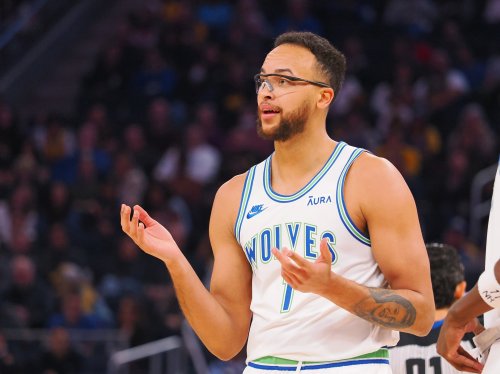
Last season, the Minnesota Timberwolves needed someone to fill the hole left behind in the starting lineup during Karl-Anthony Towns’ 52-game absence following his right calf injury. Kyle Anderson was the man Chris Finch turned to, hoping to receive consistent play from the forward they signed in the offseason. Anderson was a part of the starting lineup in 41 of the 52 games without Towns, filling a vital role for most of last year.
As a starter last season, Anderson averaged 10 points, six rebounds, and four assists while shooting a career-high 42% from three and 51% from the floor. Finch said the 6’9” forward “saved the season” multiple times last year.
That was a bold yet accurate statement from Minnesota’s head coach. Without SlowMo’s consistent offense and defense, the Timberwolves would not have snuck into the playoffs through the Play-In Tournament for the second year in a row.
Anderson has a bit of an “old man’s” game. He’s an incredibly unique player who excels at particular things. We’ve seen him be Minnesota’s most important player during stretches, but we’ve also seen him hold things back on offense. His positives usually outweigh the negatives, but things appear to be different this season.
During this year’s media day, a reporter
Before Towns went down on Nov. 28 last season, Anderson averaged six points, four rebounds, and three assists on 52% from the floor and 38% from deep. Those numbers aren’t bad, but it took him a while to settle into a groove and figure out his role going forward. It wasn’t until after KAT's injury that SlowMo truly looked comfortable.
Anderson played alongside Gobert for 1088 minutes throughout the regular season. Anderson and Gobert developed a great on-court connection, especially early in KAT’s absence when seemingly no one had the answers to playing with Gobert in pick-and-roll sets. SlowMo was a prominent fixture of the starting lineup for most of the year and didn’t very much burn with Minnesota’s bench mob.
Anderson’s unique play makes his skill set a double-edged sword. He has gotten the most out of a banged-up Stifle Tower while running with the starters and kept Minnesota’s season above water during season struggles. However, Finch has since shifted SlowMo back to the bench because Minnesota’s starting frontcourt has remained fully healthy through the first 19 games of this season. Anderson is no longer starting and playing a different role, highlighting some issues in his game.
Anderson’s passing, defense, and semi-reliable offense have always gotten him big minutes on winning teams in the NBA. Last year, Anderson could play his game while operating with the starters. However, now that he is back on the bench, the Wolves need him to be able to hit open shots to avoid becoming a liability in the rotation. Unfortunately, shooting has been his Achilles heel this year.
SlowMo has connected on only two of his 12 attempted triples, averaging 16.7% from beyond the arc. Last year, he shot 41% on 1.5 threes per game. Anderson’s low number of threes attempted isn’t concerning. Instead, it’s his unwillingness to pull from range that is making him a liability.
The Wolves have made a concerted effort to move the ball this year. When they swing the ball around the perimeter, Anderson often receives it with a wide-open look. In that situation, Anderson often pump-fakes and attacks the paint, hoping to create an open shot for one of his teammates and kick it out. Otherwise, he’ll take a heavily-contested look in the paint.
[video width=1280" height="720" mp4="https://zonecoverage.com/wp-content/uploads/2023/12/SlowMopassingupopen3.mp4]
Teams know Anderson is less willing to take threes this year and aren’t rotating out to him. Therefore, the only way for him to be effective on offense is to have the ball in his hands. Because Anderson can’t consistently create his own offense off the dribble, drawing up an isolation play for him is almost useless.
Much of the clunky play generated with Anderson on the floor isn’t his fault. Minnesota’s bench ranks 23rd in offensive rating (52.7) this season. From inconsistent play from Shake Milton to Nickeil Alexander-Walker having to fill in for Jaden McDaniels in the starting lineup, Finch and his staff haven’t been able to rely on their bench to produce consistent offense outside of the Naz Reid. When SlowMo was playing with the starters, the Wolves rarely called upon him to shoulder any heavy offensive load, and asking him to do so now wouldn’t be fair.
After Minnesota’s home opener against the Miami Heat, a reporter asked Finch about Anderson’s performance after he accounted for 20 points as a scorer and playmaker.
A lot of what SloMo does goes unnoticed. He plays with an incredible defensive edge, makes the right passes repeatedly, and can singlehandedly break down the opposing team's zone coverage. Without his under-the-radar impact, the Timberwolves could be sitting closer to .500 instead of owning a Western Conference-best 15-4 record.
However, with the February 8th trade deadline slowly creeping closer, Tim Connelly and his staff will take a look at the team as a whole. The starting lineup has looked incredible on both ends, but the same can’t be said for the bench. If the collective play from Finch’s first fleet off the bench doesn't improve, the front office must make some difficult decisions. Given that he’s in a contract year, Anderson could be in the mix to be moved.
Think you could write a story like this? Hockey Wilderness wants you to develop your voice, find an audience, and we'll pay you to do it. Just fill out this form.
Recommended Comments
There are no comments to display.