

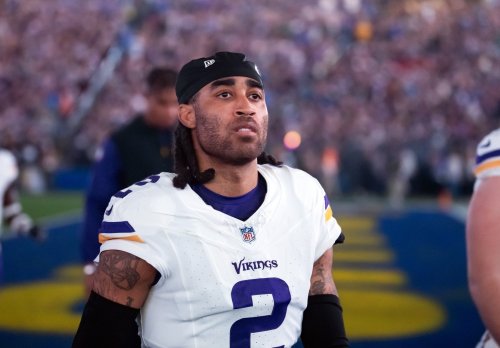
On Monday, the Minnesota Vikings allowed Sam Darnold and Stephon Gilmore's contracts to void automatically, meaning they will become unrestricted free agents (UFAs) at the start of the new league year. Byron Murphy and Aaron Jones agreed with the team to push their contract void dates back.
Void years are an arcane tool that NFL teams frequently use for salary cap accounting purposes. Still, they also have a real impact on a team's ability to negotiate with impending UFAs, so it's important to understand where they come from and how they function.
Let's dive into how void years work and what that means for the four players listed above.
Why do teams sign deals with void years?
The New Orleans Saints were the first team to consistently use void years, but the 2021 NFL season left the entire league with a problem. Due to league revenue declining in the 2020 season, the salary cap shrunk. Teams signed contracts with an understanding that the salary cap would increase, so the decrease led to a crunch where teams needed to find space to pay their players.
Typically, if a team wanted to lower a player's cap hit for a given year, they could either approach him and ask him to take a pay cut, or they would have to offer an extension with a high signing bonus, guaranteeing the player more money in the process. For a front office, the first option is a good way to upset your players, and the second can easily get you into trouble with your owner if the player starts to decline.
Void years became the middle ground of those two issues. More on the specifics of how they function in a minute. However, adding void years to contracts allowed teams to push cap hits into future years, just like with signing bonuses, but didn't practically increase the length of the player's contract.
After being somewhat forced into it by cap constraints, NFL teams realized another benefit to void years: They can function as negative-interest loans. Because the salary cap consistently increases, having charges in future years is always better.
Take Darnold's contract as an example. The Vikings paid him $10 million in cash in 2024, but they only owed him $5 million against the cap because of void years. The remaining $5 million from his deal will count as dead money against Minnesota's 2025 cap, but it will take up a lower percentage because the cap will increase.
That isn't exactly intuitive because it's the opposite of how borrowing money works in our everyday lives. When you spend on a credit card, take out a car loan, or sign a mortgage for a house, you will pay interest on the money you borrow, meaning you will pay the bank more money than you borrowed.
However, in borrowing against the salary cap, NFL teams don't pay interest. That means they will always end up paying less than what they borrowed. Because the NFL salary cap is projected to increase from $255.4 million in 2024 to $272.5 million in 2025, $5 million in 2025 has the same cap impact as $4.7 million did in 2024. The Vikings paid Sam Darnold $10 million in cash in 2024, but they'll functionally pay only $9.7 million against the cap for his services.
Once teams understood that benefit, we saw widespread adoption of void years in contracts. The Philadelphia Eagles, San Francisco 49ers, Cleveland Browns, and Saints lead the way, but almost every team uses them. There are still some holdouts, but NFL teams have a whopping $1.74 billion of cap charges in void years, an average of about $54.4 million per team.
Void years are here, and they're not going away.
Salary Cap magic
To understand why void years are useful, you need a little background on how salary cap charges are calculated. Any money a team pays a player either gets treated as* salary (Base Salary, Roster Bonuses, Workout Bonuses, Per Game Roster Bonuses, and Incentives**) or a prorated bonus (Signing Bonuses and Option Bonuses) against the salary cap.
*Note: I'm using Over the Cap's terminology for these payments, so it's easy to understand when looking at their site, which is the best public source for NFL salary cap data.
**Note 2: Likely-To-Be-Earned incentives that are missed will result in a cap credit the next year, and Not-Likely-To-Be-Earned incentives that are achieved will count against the cap in the next year, so they're not technically the same as salary, but that's outside the scope of this piece. If you read that and started to say "Well, actually..." you have the same brain as me, which is why I'm writing this note.
Salary paid to a player counts against the cap in the same year it's paid. What we're really interested in is bonus proration. When a player is paid a signing bonus, the cap hit for that money gets spread equally over the length of the contract, up to five years. So if a player gets a $100 million signing bonus on a five-year deal, the signing bonus portion of his deal will have a $20 million cap hit in each of the five years of the deal from that bonus. If the deal were only two years, then the cap hit would be $50 million each year. If the deal were for six years, it would cost $20 million against the cap for the first five years and nothing in the sixth year.
That's important because the NFL doesn't have guaranteed contracts, so it allows teams to pay players large sums of money up front without crippling their cap flexibility. Let's say a team signs a player for five years, $100 million, and gives half of that to him as a $50 million signing bonus, with $10 million in salary for five years. They would pay him $60 million in cash in Year 1 but only $20 million against the cap. They would pay him $10 million in cash each year in future years but owe $20 million against the cap.
Cap-hit acceleration is another concept that must be understood to explain void years. In the example above, the cap hit from a $50 million signing bonus was spread out to $10 million over five seasons. However, if the team were to move on from a player in any year of that contract, whether they trade him, cut him, or the player retires, then the money in future years accelerates into the year that transaction is made.
So, if the team decides to trade the player after two years, they would have paid him $70 million total -- the $50 million signing bonus and $20 million in salary -- but he would have only counted for $40 million against the cap in those two years. Because the player was traded, his future team will take on the $30 million in remaining salary on the deal, but the original team still hasn't paid back its cap debt.
The collective bargaining agreement decrees that the money in future years accelerates into the year the transaction was made. So, rather than owing $10 million per year over the next three years, the team that traded away the player will owe $30 million in the year of the trade.
That's not quite everything, though, because the June 1 rule exists. If the transaction described above happens after June 1, the cap accelerates into the next season. So, in the example, the team would have $10 million in dead cap in the year they traded the player and $20 million in the next year, for $30 million total.
Ok, but you still haven't explained what void years are
I'm sorry it's taken this long, but the background above is essential to understanding how void years function. "Void years" are years in a contract set to be eliminated at a certain date automatically. For Darnold, that date was February 17, 2025.
When the Vikings signed Darnold last year, the contract they signed described five years, all with designated salary numbers. Darnold was due a $6.25 million signing bonus, $2.5 million base salary, $1 million in per-game roster bonuses, and a $250,000 roster bonus in 2024.
From 2025 to 2028, he was assigned base salaries and maybe even other forms of compensation (only NFL teams, the NFLPA, and agents have access to the text of player contracts, so we can't know what those salaries are, and they are not generally reported by NFL insiders***). The void years in Darnold's contract were the years from 2025 to 2028 because they were set to void automatically.
***Note: The only solid salary numbers I've seen reported for the void years of deals are on Kirk Cousins' last Vikings contract, which had $42.5 million base salaries from 2024 to 2027.
On paper, it would look like Darnold was under contract for five years if you missed the clause that declared the final four years void automatically on February 17, 2025. Because the deal says five years, even though it was guaranteed to expire after one year, the signing bonus got prorated throughout those five years for $1.25 million per year. However, now that the void clause has been triggered, the final four years of the deal have been voided. The team has turned from five years into one year, and Darnold will become a free agent in March.
The elimination of the final four years of the contract also triggers a cap acceleration of the prorated bonus money. Because the future years were eliminated before June 1, 2025, or more accurately, after June 1, 2024 (we are technically still in the 2024 NFL league year), the remaining $5 million of prorated money will hit Minnesota's cap in 2025, rather than costing $1.25 million per year from 2025 to 2028.
Void years aren't just tools teams use on restructures or one-year deals. For example, when Justin Jefferson signed his extension last offseason, the Vikings added a void year in 2029, which was intended to help contain $6 million of his $30 million option bonus in 2025. Minnesota can also convert future salary on Jefferson's contract into bonuses to push money into the future.
The Eagles use void years more aggressively than any other team. Jalen Hurts’ contract, which functionally runs through 2028, has void years into 2035. Every year of the deal, he has an option bonus instead of a high base salary, so they constantly push the money into the future and void years throughout the deal.
this all has many implications I still have questions about
Now I'm going to try a little FAQ of questions I have had myself about void years, hopefully answering anything you might still be wondering.
The tweet above said Darnold's contract voided, does that mean he's a free agent immediately?
No, Darnold is not a free agent immediately. Technically, the years in his contract from 2025 to 2028 were voided. Gilmore had three void years, so his contract voided from 2025 to 2027. Both contracts now expire simultaneously with every other player who has 2024 as the last year of their deal.
If you want to get really technical, saying a player's "contract voided" is incorrect, although saying "The final X years of his contract voided" is a lot wordier and unwieldy for character-limited social media (or bored readers), so abbreviating it is fine.
Are players on voided contracts still eligible for compensatory picks?
Yes, the players in the tweet above are comp-pick eligible, pending what happens in free agency. That's because the void clause was included in the original language of their contracts. You can also receive comp picks for players who have had void years added to the back end of their deals or on extensions, as was the case for Kirk Cousins last year.
However, there are examples like Anthony Barr in 2022, where he was not eligible for a comp pick because the Vikings had renegotiated his contract to void years that had previously been on the books. Harrison Smith's potential contract void is another example where the Vikings would not receive a comp pick.
Why did the contracts void on February 17?
The franchise tag window opens on February 18. You can only apply the franchise tag to a player on an expiring contract. Before the future years voided, Darnold's contract (and the other players’) technically wasn't an expiring contract. To be eligible for the franchise tag (or other tags like the transition tag), the void date must be before the franchise tag window opened.
Okay, then why push back void dates for Aaron Jones and Byron Murphy?
Assuming you don't want to tag a player -- which the Vikings obviously don't want to do for Jones or Murphy -- the benefit of pushing the date back is it allows you more time to come to an extension, which would prevent the prorated bonus money from accelerating into 2025.
If the Vikings extend Jones before his contract voids, they will only owe him $800,000, plus whatever cap hit the new contract provides in 2025. If they had let the contract void and still re-sign him, they would owe $3.2 million plus that new cap hit, a significant difference.
The same logic applies to Murphy, who would have a $4.2 million dead cap hit if his contract voids but would only have a $1.4 million cap hit from prorated bonus money if the Vikings can extend him.
So does the Vikings letting Darnold, Murphy, and Gilmore's contracts void mean they plan to let them walk?
Not necessarily. It makes it more difficult because of a larger cap hit, but it's a matter of scale.
Darnold's contract needed to void when it did because it means the franchise tag is still in play. But I also don't expect the Vikings to offer Darnold a long-term deal. So, unless they franchise him, he will almost certainly leave for the highest bidder in free agency. It's also possible for the Vikings to extend Darnold because $5 million is small potatoes compared to the $40+ million starting QBs get.
For Gilmore, I think this signals that he is likely gone in 2025, but he was supposed to be a one-year stopgap anyway. When Barr's deal voided, Kwesi Adofo-Mensah mentioned that it was harder to make bringing Barr back work with the dead cap hit he had.
Gilmore (and Jones above) won't command nearly the value that Murphy will, so having a dead cap hit between half and a third of what you're paying the player in salary is more difficult to swallow. Still, the dead money is a sunk cost, so no matter who you bring in to replace Gilmore, you're still paying the dead money. Therefore, there's definitely a world where Gilmore is still Minnesota’s best option.
I read in the piece you linked above that the Vikings couldn't give Cousins a raise within a year of signing a deal. Doesn't that apply to Darnold, Gilmore, and Jones?
A very astute observation. The wording in that article needs to be more precise. The rule is that a salary increase cannot be negotiated within 12 months if a contract is renegotiated. Any salary-to-bonus conversion or addition of void years counts as a renegotiation, so the rule applied to Cousins.
However, it doesn't apply to any of the players Minnesota signed last year because they have not yet renegotiated their contracts. If the Vikings had wanted to, they could have eliminated the void on Cousins’ contract and paid him $42.5 million per year until 2027. Obviously, they did not, and he chose to sign with the Atlanta Falcons for $45 million per year.
Here is the exact CBA language, in case you're still curious:

You got all that, right?
Think you could write a story like this? Hockey Wilderness wants you to develop your voice, find an audience, and we'll pay you to do it. Just fill out this form.
Recommended Comments
There are no comments to display.