

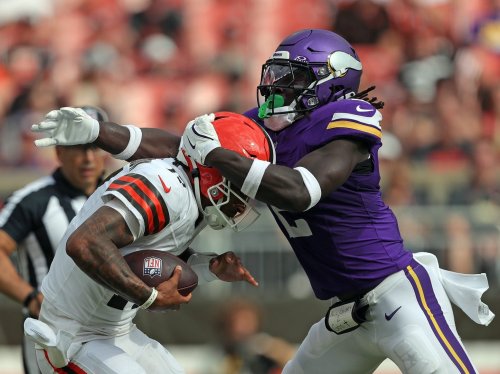
Yards were at a premium when the Minnesota Vikings and the Las Vegas Raiders battled in Sin City last December. The excitement from a legion of purple-clad fans departed along with Justin Jefferson in an ambulance. The game was scoreless heading into the fourth quarter. Efficient quarterback play was an afterthought.
Those 60 minutes were just as exhausting as the red-eye flight back to Minneapolis. Still, Nick Mullens set up a Greg Joseph field goal with 1:57 left, giving the Vikings a 3-0 victory.
No Vikings fan will recall this game when speaking to their grandchildren, but it still has significance. In an NFL where the offense is king, Minnesota adapted and used a stout defense to carry the wounded offense to victory. It’s not the way anyone drew this up, but if the Vikings want to compete in 2024, the Raiders game may be their blueprint.
Still, this isn’t how it was supposed to be. When the Vikings hired Kevin O’Connell in February 2022, he came with a way of thinking. Mike Zimmer was the old-school defensive coach who wanted his offense to control the time of possession and run the football. O’Connell promised a more modern approach, the fruit of the Sean McVay coaching tree.
With catchphrases like “marrying the run and the pass” and “the illusion of complexity,” O'Connell was going to turn the Vikings into an offensive team, and Minnesota had the weapons to do it.
Kirk Cousins served as the ultimate security blanket. Long considered a stabilizer with Washington and the Vikings, O'Connell asked Cousins to take more risk but ultimately play within the offense.
The task was easier for Cousins due to his supporting cast. Justin Jefferson and Adam Thielen at receiver. Dalvin Cook at running back. He had two book-end tackles in Brian O’Neill and Christian Darrisaw. The Vikings added T.J. Hockenson at tight end midway through the 2022 season.
Minnesota took off when Cousins mastered the offense. The Vikings averaged 27.8 points over their final seven games and carried one of the league’s worst defenses under defensive coordinator Ed Donatell.
That wasn’t how things were done under Zimmer, but it had an optimistic feel. The Vikings were 13-4 and on top of the NFC North. However, Daniel Jones had an out-of-body performance in the Wild Card game, ending Minnesota's season early. Still, this was how an O’Connell team was supposed to look.
Then 2023 happened. A hamstring injury limited Jefferson to 10 games. Cousins suffered a torn Achilles just before Halloween. Alexander Mattison didn’t have a rushing touchdown after the Vikings released Cook. Minnesota’s offense ranked 22nd with just over 20.2 points per game.
Offensively, the 2023 season was a disaster for O’Connell, but it signaled a shift in philosophy. While the offense wasn’t the same without its key components, the defense jumped from 28th (427) to 13th (362) in points allowed. That elevated the Vikings to a seven-win season.
That isn’t the type of football that O’Connell wants to play. In his final season with the Los Angeles Rams, he watched as the defense ranked in the middle of the pack (21.9 ppg) in points allowed while the offense did the heavy lifting, ranking seventh with 27.1 points per game.
Coming out of the 2023 season, it wouldn’t have been a surprise if O’Connell led an offensive spending spree, putting financial resources in draft capital to fix his unit like Zimmer did in 2021. But that would have ignored the fact that the offense is no longer Minnesota's strength.
Cousins’ departure over the offseason left O’Connell with a big hole. Signing Sam Darnold was supposed to be the bridge for J.J. McCarthy, but a torn meniscus means Darnold is the starter for the entire season.
That may have been the plan all along, but it’s an obvious downgrade from the homemade mac-and-cheese comfort you got from Cousins.
And we haven't accounted for the weapons at Darnold’s disposal. A healthy Jefferson will make a big difference, but the rest of the receiver room is filled with uncertainty. Jordan Addison's potential suspension clouded his availability before he suffered an ankle injury during a joint practice with the Cleveland Browns. Jalen Nailor, Trishton Jackson, and Brandon Powell are all question marks until they provide reliable play on the field.
Hockenson could have helped if not for a multi-ligament knee injury that could keep him out until mid-October or early November. Minnesota's leaky interior offensive line isn’t ideal for a QB who logged a 7.9 percent turnover-worthy play (TWP) rate in 2021 and a 4.4 TWP rate in 2022 when pressured, according to Pro Football Focus.
Maybe the Vikings could lean on the run to salvage their offense, but they don’t have the personnel to do it. While Zimmer benefitted from having Cook in his workhorse prime, O’Connell got the scraps before his release in the summer of 2023. Swapping Mattison for Aaron Jones is an upgrade. Still, a 30-year-old running back could be the type of bomb James Bond can’t diffuse.
Put it all together, and this is an offense that is more like a top-20 unit than a top-10. But it’s also an area where O’Connell can shift his philosophy.
When you look at Minnesota's defense, it feels like the stronger unit. The interior of the D-line still feels like a lunchpail group with Harrison Phillips and Jerry Tillery leading the way. Still, the Vikings were wise to invest in pass rushers.
Losing Danielle Hunter to the Houston Texans is a big blow, but they replaced him with a committee of players who better fit what Brian Flores wants to do. With Jonathan Greenard, Andrew Van Ginkel, and Dallas Turner, Flores has multiple pieces to move around, create packages, and use pass-rushers in situations he couldn’t use with Hunter and D.J. Wonnum as his primary rushers.
The Vikings linebackers also have some pass-rushing chops. Ivan Pace Jr. ranked 11th with a PFF pass-rushing grade of 78 last season, and they added Blake Cashman, who ranked 20th with a 73.5 grade.
A revamped front seven should do wonders for the secondary, even if the cornerback room differs drastically from where it stood at the beginning of the month. Stephon Gilmore was a nice addition, and Shaquill Griffin and Byron Murphy Jr. are good enough to contain opposing receivers if they can stay on the field.
At the least, they should be able to hit a high enough bar to help the Vikings contend. At their best? They could rank somewhere in the top 10 to 15 defenses that can help Minnesota reach its goal of being “super competitive.”
The Raiders game last December was an extreme example, but it’s the brand of football the Vikings will need to play to contend in 2024.
Think you could write a story like this? Hockey Wilderness wants you to develop your voice, find an audience, and we'll pay you to do it. Just fill out this form.
Recommended Comments
There are no comments to display.