


There are countless questions fans should be asking as the Minnesota Vikings and New Orleans Saints prepare to clash at U.S. Bank Stadium on Monday Night Football.
Can a Vikings secondary that struggled in the preseason stop last season's leading passer in Drew Brees?
Can a Vikings offensive line that has yet to play together protect Sam Bradford and block for Dalvin Cook?
How will the Vikings split carries between their three running backs?
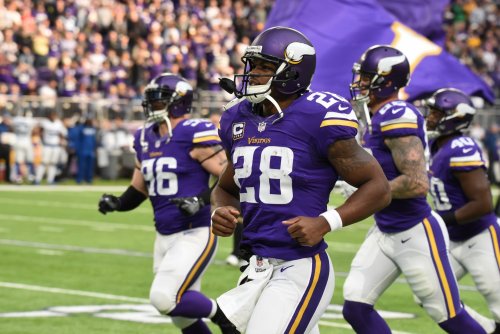
But, to the disdain of Mike Zimmer, the only question people want to ask is: Is Adrian Peterson really going to return to Minnesota and, as he says, 'stick it' to the Vikings?
"They’ve got a lot of great offensive weapons and he’s a great player," said Zimmer, "but this game isn’t about Adrian Peterson."
Zimmer's right. From an Xs and Os standpoint, it most certainly is not about Peterson. There are greater concerns than a 32-year-old running back who happens to be a former Viking.
But let's go down that path for a moment.
Let's pretend, for a moment, that intangibles do not play a role in Peterson's first trip back to compete against his former team; that the weight of the circumstance doesn't play a role in how Peterson runs, nor how Saints coach Sean Payton gameplans. In other words, we'll stay pragmatic about this and see, realistically, what we might see from No. 28.
Week 1 struggles
It's undeniable that Peterson has been a slow Week 1 starter in the later years of his career. That could very well correlate to his lack of reps in preseason games, which all but ceased after his torn ACL late in the 2011 season.
In his first five seasons, Peterson ran the ball at least 17 times in the preseason. He followed those preseasons up by emerging in Week 1 with two 103-yard games (2007 and 2008), a 180-yard game (2009), an 87-yard game (2010) and a 98-yard game (2011). His yards per carry in those five Week 1 performances: 5.8.
Peterson did not participate in the 2012 preseason as he put the finishing touches on his knee rehabilitation, but it began a trend of Peterson-less preseasons in Minnesota. It wasn't all that controversial, frankly. The coaches understood his value, and Peterson -- perhaps more alert to the danger of crippling knee injuries -- didn't fight the decision too hard.
Unfortunately, it seemed to slow Peterson's annual charge out of the starting blocks, as his Week 1 play declined. Over the next five years, Peterson carried the ball 85 times in five Week 1 games for 314 yards, an average of 3.7 yards per carry. Even in 2012 and 2015, years when Peterson eventually won rushing titles, his first game of the season was substandard.
As for the current season, Peterson broke the status quo and participated in the third preseason game for the Saints, carrying the ball six times for 15 yards.
This is the more than he's done any of the past five years, but Peterson also has the task of learning a new offense that is quite different from the run-first offenses in which he was featured in Minnesota. Getting just six live carries in a new offense may not be enough to get Peterson fully comfortable by Week 1.
A timeshare of running backs
Some may think the Saints have changed offensive philosophies based on the acquisition of Peterson. After all, a quarterback who is closer to age 39 than age 38 that led the league in pass attempts last year needs to start dialing it back eventually, right?
Zimmer doesn't see it that way.
"They’ve been running the same offense for a long time," he said. "They get in the I (formation), they get in base personnel, run the ball then play-action, and then they’ll spread you out. They’re not going to change too much."
Over the past four seasons, the Saints have been eerily consistent in the amount they've rushed the ball. Their total attempts since 2013: 391, 406, 397, 404. For reference, the Vikings carried it 474 times in 2015, the year Peterson won the rushing title and the offense was largely based around him. He's unlikely to get the same catered treatment in New Orleans.
Based on those yearly totals, the Saints will run the ball approximately 25 times per game. And Peterson isn't the only show in town.
Mark Ingram is 27 years old, rushed for over 1,000 yards last year and gained 5.1 yards per carry. He is earning over $5 million this year and isn't going to be phased out.
Last year he split carries with Tim Hightower, who averaged around eight carries per game. This season that work will likely go to rookie Alvin Kamara, who, according to Saints scribes, is on track to get plenty of work in the offense.
Even in a gameplan in which Payton chooses to emphasize Peterson, it's tough to envision the former Viking getting more than a dozen carries if all three backs are going to remained involved.
The Vikings defense
We've established that Peterson may have his workload reduced and that he's had a history of Week 1 rust. The final question: Will the Vikings do enough defensively to stop Peterson when he does carry the ball?
(Note: If we're not going to consider the intangible of Peterson running harder against his old mates, then we won't include the likelihood of his ex-teammates gunning harder to tackle him in this analysis.)
Minnesota's run defense has been a wart on an otherwise strong defense under Zimmer. It has allowed 4.3, 4.3 and 4.2 yards per carry, respectively, in Zimmer's three seasons, which has ranked in the middle to lower half of the league.
Over the past four years, Peterson has seen his consistency wane, gaining just 4.36 yards per carry since his ludicrous 2012 campaign. Much of his success has been predicated on explosive plays with eight touchdowns of 10 or more yards in the past four seasons.
As exhibited with his 1.9-yard average in Minnesota last year, Peterson may be losing his knack for powering through tight spaces and escaping from impossible positions, but if the Vikings allow Peterson to get free in the open field just once for a big gain, it could offset any good they do on the remainder of his carries.
The Vikings have actually been decent about restricting big rushing plays, according to SportingCharts.com, which tracks rushes of 10 yards or more. Last year they tied for 14th best in the league, permitting 43 carries of 10-plus yards. The previous year they tied for eighth best with 41 such plays allowed.
Of course, as Vikings fans know, it only takes one small seam for Peterson to explode, but a healthy Minnesota defense should have a smaller likelihood of letting this happen.
Conclusion
There is a lot working against Peterson: Week 1 rust, a new offense, a shared workload and a stout Vikings defense.
A vintage Peterson performance may not be in the cards Monday night, but it seems like the 11-year veteran is OK with that.
"I’m sure I’ll have my opportunities to get in there as well," Peterson told reporters, "but when you have that many playmakers, you have to put them in the game."
Secretly, the Vikings might be breathing a sigh of relief.
Think you could write a story like this? Hockey Wilderness wants you to develop your voice, find an audience, and we'll pay you to do it. Just fill out this form.
Recommended Comments