
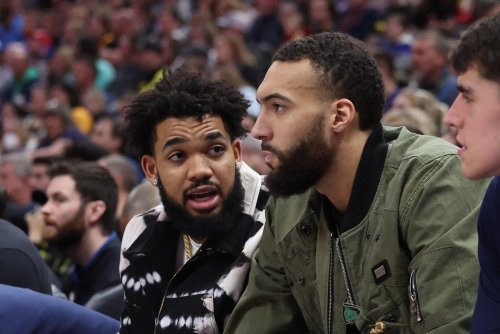
Coming into the season, Karl-Anthony Towns and Rudy Gobert were the focal point of the Minnesota Timberwolves' off-season discourse. And rightfully so. As you’ve probably heard, the Wolves paid a king's ransom for the three-time DPOY. No matter what you thought about the pairing, Connelly gave up a lot of assets to make it happen. Jarred Vanderbilt, Patrick Beverley, and Malik Beasley all played valuable minutes for Minnesota last season, not to mention Walker Kessler and the four first-round picks the Wolves parted ways with.
Timberwolves fans only saw 19 games of their team’s full potential until Karl-Anthony Towns went down with a right calf strain. The Wolves and Towns were lucky to dodge an Achilles tear, but this injury has still derailed much of his season.
The Wolves were nothing short of a disaster in those 19 games, though. After being handed what was thought to be an easy schedule, the Wolves found themselves sitting at 9-10 nineteen games into the season. A myriad of questions surrounded the Wolves. Had they gone all-in on the wrong guy? Can two bigs work in today’s NBA? Was Anthony Edwards ready?
Of course, all those questions were overshadowed by one:
How would the Wolves survive without Karl-Anthony Towns?
Now we have the answer. Edwards took complete control of the team, willing them to a 19-17 record since Towns went down. Edwards has given fans optimism for now, but the rough first stint of the Gobert and Towns experiment has left a sour taste in fans’ mouths. However, there is plenty of reason to be optimistic about Gobert and Towns.
Admittedly, it is hard to be optimistic about the fit after watching the team seemingly play better without Towns. But many of Minnesota’s early-season ailments were not due to Towns and Gobert being a poor fit but rather things that were out of the duo's control.
Case in point, Minnesota’s three-point shooting. The Wolves were shooting 32.9% during Towns’ time on the court this season. If extended over an entire season, they would be the worst three-point shooting team since the 2015-16 Lakers. In today’s NBA, you can’t expect anyone to be able to win with that kind of shooting support around them, especially a roster built around Rudy Gobert.
In those first 19 games, the Wolves only shot above league average (35%) 6 times, finishing 4-2 in those games. Since Towns' injury, Minnesota has hit that mark 23 times and has a 15-8 record in those games. The team's talent potential is clear when the Wolves shoot even at an average clip.
Minnesota also turned the ball over a ton during the early stages of the season, and while they still turn it over today, they’ve been steadily decreasing the number of turnovers per game. Through their first 19 games, the Wolves turned it over 16.1 times per outing. Since Towns went down, the Wolves have made a minor improvement to just under 15 turnovers per game.
The Towns-Gobert pairing was not the reason behind the problems the Wolves had early into the season, but they were treated as the scapegoats. Minnesota has fixed many of those issues, so the offense should only improve with Towns in the fold.
Although the first 19 games typically had negative takeaways, some really efficient games showed just how dangerous this offense could be when everyone is healthy. For example, Minnesota’s 115-101 win over the Indiana Pacers on November 23rd, where their Core 4 all finished positive after four efficient individual performances.

Many people forget how well Towns was able to pass to Gobert during their time together. The two big-man pick-and-roll may be unconventional, but it has worked well for the Wolves this season.
[video width=1280" height="720" mp4="https://zonecoverage.com/wp-content/uploads/2023/02/Wolves_Spurs_10-30-22_2Q_01꞉18_AdobeExpress.mp4]
If any offense suits the Wolves, it’s the spread pick-and-roll, especially since adding Mike Conley. Conley successfully ran the spread pick-and-roll with Gobert for years in Utah. Although the Wolves struggled with it early on, it’s become a staple in recent weeks. The combination of Towns’ returning to the court and acquiring a point guard with years of experience running that same system should bolster the offense into a new stratosphere.
To beat the spread pick-and-roll, teams must force the kick out to a poor shooter or stifle the play at the screen. But teams may find that easier said than done once they look at Minnesota’s depth chart.
Gobert is one of the best screeners in the league and gave Donovan Mitchell easy paths downhill for many years. In Minnesota, he’ll provide that same service for Anthony Edwards. Edwards, like Mitchell, is one of the most dominant downhill attackers in the league. Ideally, defenses will want to force Ant to kick out to a shooter. But as Edwards becomes a better playmaker, that may not be an option much longer. Because once Ant finds that touch, Karl-Anthony Towns (39%), Jaden McDaniels (37%), and Mike Conley (36%) aren’t slouches from beyond the arc.
A move that will have ramifications until 2029 was not decided in 19 games. Sure, that firsts stretch of games was ugly. But as the Wolves develop chemistry with one another, they’ll be able to settle into the offense they are best equipped to run. With plenty of reasons to stay optimistic about the duo, it’s important to remember the real reasons the Wolves were losing early on, alongside the talent both players possess.
Think you could write a story like this? Hockey Wilderness wants you to develop your voice, find an audience, and we'll pay you to do it. Just fill out this form.
Recommended Comments
There are no comments to display.