


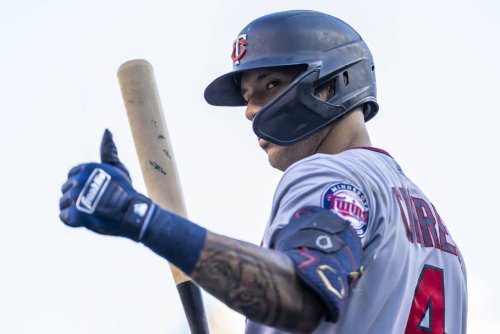
Carlos Correa says he likes to write down his goals. He says he always wants to aim high enough that accomplishing them is satisfactory. He feels setting goals is vital to his and his team’s success.
“Once the season hits and I’m in Spring Training, I’m like, all right, it’s game time, it’s time to get to work with these guys,” he said upon arriving in Fort Myers. “Just focus and go out there and set some really high goals.
“Winning the division is the first thing that comes, but when we’re talking about building a team that’s going to win, it’s all about winning championships. Winning the division is not going to be enough. We’ve got to set goals that are really high. That way, when you accomplish them, you’ll be really satisfied. That’s the plan here, man, we want to win. We want to win big.”
Correa started writing his goals on his flight to Fort Myers. He wouldn’t share all of his goals, but he said that his teammates were at the top of his mind.
“The first one was make my teammates better, and that's my main goal in Spring Training,” he said. “I'm obviously gonna work on myself, I'm getting my timing as soon as possible, yada, yada -- same thing we always go through in Spring Training.
“Helping my teammates get better, that's the main goal for me. Because if I can accomplish that, we're gonna be in a great spot come October. So, for me, that's No. 1 on my list.”
Last year, Correa insisted that the Minnesota Twins were Byron Buxton’s team and that he was just here to help. Still, he embraced his teammates last year, knowing he might opt out of his contract and leave at the end of the season. Correa also invested in Minnesota’s minor league system. He studied the minor league reports and got familiar with many of the prospects individually, asking Derek Falvey and the Twins brain trust pointed questions.
“Emmanuel Rodriguez, right?” Falvey asked rhetorically, referring to a 20-year-old A-ball player the Twins signed out of the Dominican Republic. “Emma's a few years away and has dealt with an injury at the end of the year. He didn't know everything about Emma, but he knew that he was good player, and then I showed him the stats, and then you see his stats in the Florida State league last year, and, 'My goodness, that's different.'
“He understands what that means, right? Where just looking at the stat line sometimes, it's like, 'It's A ball, whatever.' He's like, 'In the Florida State League, with those numbers, at that age, that performance, that's pretty interesting.' So those are the types of things he understands a little more the average player you're talking to because he cares about that.”
Correa opted out of the final two years of his initial three-year, $105 million contract last offseason. The Twins offered him $285 million to stay, but he took the San Francisco Giants’ 13-year, $350 million offer. However, San Francisco’s doctors found an issue with his surgically-repaired ankle and reneged. The New York Mets offered him $315 million but used the same doctor, who found similar results. Ultimately, Correa signed a $200 million contract with vesting options to stay in Minnesota.
Still, Correa remained in contact with Minnesota’s players, including prospects.
“He's invested with all the guys, that's pretty neat,” said Falvey. “He is, genuinely, this is the part that through the offseason, talking about how we felt he wanted to be here, how many times he was still contacting the players who were still on the roster, even when he was still a free agent.”
Falvey knows that he’s signed one of the best shortstops in the game, and easily Minnesota’s best shortstop since Cristian Guzman. However, Correa is also an asset to the front office.
“He understands so much of the front office,” says Falvey. “I mean, the running joke, we let him be the new assistant GM. He understands the game at a really deep level. He understands how value gets created on the field, what, it's focused on statistics that matter, but even just beyond that, I think he understands the interplay of a lot of the positions and defense and how it all works.
“And so, having someone that can actually articulate that in a way that you would to a player, I can sit there and tell any player (something), it won't land as well as if Carlos tells a player that.”
Correa isn’t only invested in Minnesota’s minor leaguers, of course. Once the Twins head north from Florida, he wants to be locked in with his teammates. It starts with Buxton. Correa felt Minnesota was Buxton’s team last year, but they’re both under contract for the next six seasons, so they’ll have shared leadership responsibilities. Correa said he established a rapport with Buxton early last year, bonding during a team dinner.
Buxton appreciated the respect Correa showed him, but he’s more than willing to share the leadership spotlight with Correa.
“It means a lot,” he said. “But like I told him, he’s won a World Series, he’s been to a lot of playoff games so for me, it was me learning from him how to go about my business and get the Twins to the playoffs and getting us to win that ring that we preach about every year. For me, it’s more of a learning curve. Now it’s more of just me and him coming together to make sure that we stay positive in here and everybody be themselves.”
Correa says he will lead verbally and by example. He greeted everyone in the clubhouse individually when he arrived at Spring Training and frequently has one-on-one conversations with players. Correa also sticks to a routine. It depends on the day, but does an hour workout every day, which includes something for the chest, shoulders, back, hamstrings, and quads. He focuses on staying healthy during the season and adding weight in the offseason.
“I do the same thing every single day of the week for 181 days, counting the off days and all that,” he said. “My goal is to stay strong, to stay mobile, to stay consistent with how my body feels on a daily basis. If I start adding more weight, I just start getting more sore, and the last thing I want is to be sore. Because the season for me is not to get stronger, it’s to maintain what I worked on in the offseason.”
Correa has maintained his routine since his mid-20s, but he said he wished he had started it when he was younger.
“I wish it was always there,” Correa admits. “But obviously you’re young, I would say naive, you don’t ask as many questions as you should, and that’s a problem. People are afraid to sound stupid or make stupid questions, and when you’re young, that’s a big problem that a lot of young players have. I tell the players all the time, ask as many questions as you can.”
Correa said he used to show up at the cage and “start swinging like crazy.” Now every swing has a purpose.
Correa says he learned a lot from Carlos Beltrán and Brian McCann when he first joined the Houston Astros. Correa debuted at age 20 in 2015 and played in Houston until 2021. Beltrán played the final season of his 20-year career with the Astros; McCann spent his age-33 and 34 (2017 and 2018) seasons in Houston. Beltrán and McCann were seasoned veterans when Correa met them, and he made his first All-Star team in 2017.
Rocco Baldelli said the season’s outlook changed “a lot” when Correa signed in Minnesota. He was still optimistic about the team at that point in the offseason, but he knows how much Correa means to the team. It’s not just his play on the field but how he influences the entire roster.
Spring Training is the only time of year when Baldelli gets to spend significant time with Double- and Triple-A players who are close to the majors. He will manage some of them periodically when the Twins call them up, but there are many players in camp who won’t spend much time in the big leagues. Still, Baldelli can see the impact Correa has on Minnesota’s prospects and how he can help with player development once they reach the majors.
“He does it all,” says Baldelli. “He does every aspect of the game that you can really look towards. Normally you don’t get someone that leads by example really in an elite kind of way at the highest level and someone that also knows how to message things directly correctly and consistently. You don’t generally get all of that in one player, but we get that with him.”
I asked Correa if he prefers to lead verbally or by example. I was curious because he mostly talked about how he observed players like Beltrán and McCann when he was in Houston, and because he thoroughly described his routine. However, he also emphasized that he wishes he’d have asked more questions when he was younger and wants Minnesota’s young players to ask him why he goes about his business the way he does.
He took a second to answer.
Correa is a two-time All-Star, a World Series champion, and a $200 million player. He wants to live up to his contract and make a positive impact on the field, but his No. 1 goal is to make the players around him better. Why does he take 25 to 30 swings in the cage? Why does he work out every day? How does he keep his mind and body sound?
Just ask.
Think you could write a story like this? Hockey Wilderness wants you to develop your voice, find an audience, and we'll pay you to do it. Just fill out this form.
Recommended Comments
There are no comments to display.