


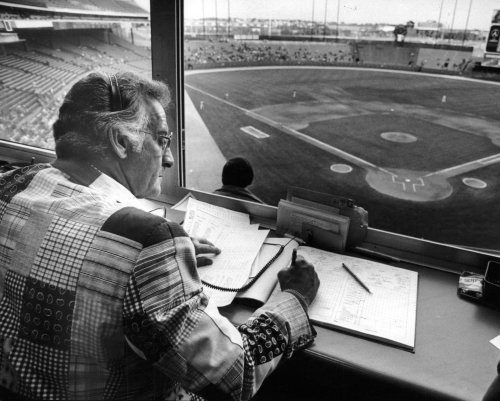
The baseball world lost one of the game's best ambassadors last week. On Thursday, Jan. 16, former catcher and longtime Milwaukee Brewers broadcaster Bob Uecker died from a battle with lung cancer at the age of 90.
People across baseball felt the gravity of Uecker’s death. Many have reflected publicly on his legendary impact on the game and throughout American pop culture. He was the most frequent guest on Johnny Carson’s Tonight Show, the star of Miller Lite
“He was a big leaguer,” said Twins Radio play-by-play man Kris Atteberry. “I know he was self-deprecating about it, but I think he was also proud because even while delivering those jokes, it was like, ‘Oh, I did play in the big leagues, by the way.’ Which is no small feat.”
The Minnesota Twins and Brewers broadcast crews have shared a fruitful relationship. If you’ve ever found yourself close enough to the Minnesota/Wisconsin border, you could pick up the faint AM radio stations broadcasting the Brewers games, which barely broadcasted into their neighboring state.
But no one has bridged the relationships closest to Uecker than Cory Provus, who worked alongside Uecker for three seasons from 2009 to 2011 on WTMJ-AM.
“I'll miss him, and I miss him now,” said Provus. “On my phone right now, I have 10, maybe 11, different voicemails that I've saved over the years [from Uecker], and I've listened to all of them. Just to hear his voice again, and I hear his voice now, I mean, the way that he spoke, his cadence that won't ever leave that will stay with me forever.”
Tim Grubbs and Sean Aronson are the play-by-play broadcasters for Minnesota's Double-A squad, the Wichita Wind Surge, and Triple-A St. Paul Saints, respectively. Both were born in the 1970s and were uniquely introduced to Uecker. Aronson and Grubbs grew up in National League markets – Los Angeles and Pittsburgh.
Instead, they grew up watching Uecker on his ABC sitcom, Mr. Belvedere.
“Part of the reason I watched it, I grew up outside of Pittsburgh and it was supposedly in Pittsburgh, that’s where it was filmed,” said Grubbs. “I don’t think they shot anything other than the opening credits, but when your hometown is being mentioned in and out of conversations was another touch to it.”
“I think I was a little too young to either appreciate the Tonight Show or to watch it when he was really on it,” Aronson said. “Like Mr. Belvedere was definitely where I saw him, and I’m not even sure I really knew who he was back then. But I loved the show, and I thought the show was great. That was my first taste with Bob Uecker.”
“For me, it was through his book Catcher in the Wry,” said Atteberry on his worldly introduction to the Ueck. “I was a kid who loved to read, and you’d scrabble together all the books you could, and that was one for me.”
Atteberry’s introduction to Ueck came when the Twins were still playing at the Metrodome. It was a story for a pre-game show about former Twins play-by-play man John Gordon, a friend of Uecker’s.
“I set this time and place up, and I was gonna meet Bob, I think it was at the Dome, and I came up to him at the time, and he was like, ‘Whoa, hey, nobody. You can't just talk to me.’ And I explained who I was, and it was about Gordo. Once he knew it was about John, he was like, ‘Oh my gosh, great.’ And then he couldn't have been nicer.”
Provus is one of the rare individuals in baseball over the last 25 years who didn’t need to go through others to speak with Uecker. When he arrived in Milwaukee, he had one of the more unique jobs any broadcaster could have. Over the 54 years that Uecker was in the booth, his broadcast partners would have to share the same scorebook with him for every game.
Sharing the same book meant learning how to keep score the same way as Uecker. It was a daunting task for Provus when he first joined the booth in 2009, but he quickly caught onto his cadence throughout the season.
“It was heavy, and my job was to carry it,” Provus said. “So, I'd fill it out every day, and I'd fill out the lineups, I'd fill out the pitching numbers, the batting numbers, and then I would slide it over, almost like the Cris Collinsworth slide.”
“I had to learn his way of scoring a game, and that was different because the way that my dad taught me is how I knew how to score a game. But Bob had his own way of scoring a baseball game. And to this day, I score that way.”
The one thing Uecker, directly or indirectly, has taught all of these broadcasters is one valuable lesson they all present in the booth: being themselves on and off the mic. They all said Uekcer will always be a one-of-one. Still, being your authentic self is an invaluable trait that has helped their careers and made Uecker such a loveable voice on the radio for 54 years.
“You got to be yourself,” said Atteberry. “If young broadcasters could learn anything from Ueck it’s be yourself. Be your own voice, it's not going to be his, because he is one of one. But remember this, you're one of one, there's only one of you, so just be you. And if you can do that, you got a shot because you've got something to share.”
“I think the fact that he knew that he was teaching people baseball, especially over the radio, you didn’t have the ability to watch all of the games over television,” said Grubbs. “You had to do pitch-by-pitch and all the different details. It’s a huge loss for all of us broadcasters and all of us baseball fans.”
“I’ve always been told that your personality in life should be who you are on the broadcast. What really stood out to me with Ueck was he was a guy that A, loved the game of baseball, but B, was himself on the broadcast,” Aronson said. “Who you saw in those movies, Major League, and who you saw in Mr. Belvedere, and who you saw in the commercials, him poking fun at himself, that’s who he was on the broadcast.”
Provus said being himself is also an invaluable lesson he took from Uecker. However, letting the game breathe over the radio airwaves was another one, even though broadcasting professors will say otherwise.
“He was a big believer in letting the game breathe,” said Provus. “It's radio, it's a medium I can't see, you have to be descriptive, and talk and describe what's going on. He's like, ‘You can tell people what's going on without talking.’ Just because you're not talking doesn't mean that a story isn't being told.”
In Provus’s case, he felt he best used Uecker’s wisdom of letting the crowd do the storytelling for his broadcast two Octobers ago when the Twins swept the Toronto Blue Jays in the 2023 AL Wild Card series.
“There were moments during that series where the sounds were so much better than what I could even say when the Twins fans were chanting ‘Gausman, Gausman,’” said Provus. “That's better than anything that I could put out there with my own voice. And those are moments that Bob was a big believer in.”
Provus has kept in touch with fellow broadcasters who worked alongside Uecker. But Uecker's legacy for broadcasters and anyone who loves baseball is to be yourself and remember that this game is all about having fun.
Think you could write a story like this? Hockey Wilderness wants you to develop your voice, find an audience, and we'll pay you to do it. Just fill out this form.
Recommended Comments
There are no comments to display.