

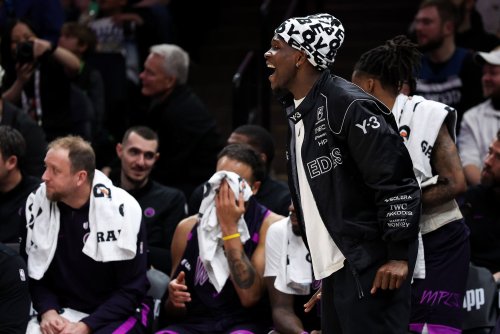
There is never a good time for the Minnesota Timberwolves to lose their best player.
But late in the season is the worst time to lose them. When the NBA calendar flips to April, and each game carries playoff implications, winning teams hope and pray that their best players stay healthy as the regular season wears them down.
So when the Timberwolves announced March 17 that Anthony Edwards would miss at least 1-2 weeks with a right knee injury, it was a gut-punch for a team struggling to find an identity while they jockey for seeding in the Western Conference.
However, Minnesota is 4-2 since Edwards went down, and he appears close to returning. The break without Edwards has actually done the Wolves — a disconnected, moody, and inconsistent team for most of this season — more good than harm.
Late in Wednesday’s game against the Houston Rockets, Minnesota had every opportunity to disconnect. They were without Edwards for the third straight game. Ayo Dosunmu, who had been starting in place of Edwards, was also out. Jaden McDaniels left late in the fourth quarter with a knee injury. Rudy Gobert fouled out. And crew chief Scott Foster ejected Naz Reid with 4:13 left in overtime.
Then, Houston went on a 13-0 run to take a 13-point lead with 3:01 remaining. The fans at Target Center began filing out.
But through that adversity, Minnesota grew closer out of necessity. The Timberolves finished Wednesday’s game on a 15-0 run, winning 110-108 and becoming the first team in the play-by-play era (since 2003) to come back from a 13-point hole in overtime.
“We’ve got real competitors in here,” Julius Randle, who finished with 24 points against Houston and hit the game-winner,
Shining through adversity was Minnesota’s calling card last season. They did it while figuring things out after the Karl-Anthony Towns trade, which shocked the organization. They also showed it against the Denver Nuggets on the road in a double overtime game. Or when they lost Randle for all of March with a groin injury. Minnesota banded together when its back was against the wall and fought to remain the scrappy, energetic, and defensive-oriented team it was in 2023-24 when the Wolves led the NBA in defensive rating.
Last season, Minnesota’s defense ranked sixth. Most nights, Chris Finch could count on his defense to keep him in games. But this season, his team’s defense has been far too inconsistent and declining in intensity since the All-Star break.
The Timberwolves will have prolonged stretches during games — or even entire games — when their energy on defense evaporates. That allows opponents to string together possessions with wide-open three-point shots and momentous rim attacks.
When the Wolves play hard, their defense usually tunes up exponentially.
Finch and his staff have struggled to get the team to do that, especially when they are missing shots on the other end. However, Edwards’ absence has been the wake-up call the Wolves have needed.
Minnesota has the NBA’s No. 1-ranked defense without Edwards. The Wolves have not given up more than 111 points in a game since he went down, while holding their opponents (Phoenix Suns, Utah Jazz, Portland Trail Blazers, Boston Celtics, Rockets, and Detroit Pistons) to an average of 43.6% shooting in that span.
“The defense is being led by our on-ball physicality, compete, and contain,” Finch
Two weeks ago, the fully healthy Wolves had the NBA’s 21st-ranked defense in the first 12 games after the All-Star break.
When he locks in, Edwards is a plus point-of-attack defender, especially in big moments. But the Wolves have navigated being without his ball-containment by collectively raising their intensity. They are playing hard, being physical with ball handlers as they bring the ball up, and rotating on a string much more frequently.
They’ve been defending like a team that realizes the importance of each moment by focusing on the smaller things. Finch
“Obviously, we can’t fill in Ant Man’s shoes,” Bones Hyland
Offensively, the Wolves have struggled without Edwards. According to Cleaning the Glass, Minnesota has the second-worst half-court offense over the last six games, averaging 86.8 points per play. The Wolves are also shooting 43.6% from the floor in that span and 34.7% from deep while averaging 15.7 turnovers.
Edwards is the offense for this team. We didn’t need a stretch of him not playing to realize that. But these last six games certainly cemented that notion. Minnesota faced formidable defenses and struggled to generate any offense other than off turnovers.
Saturday, the Wolves — also sans Dosunmu and McDaniels — delivered their worst offensive performance of the season. They scored 87 points in a loss to the Pistons on a season-low 31.8% shooting and 20.9% from three-point range.
Minnesota is navigating through more injury trouble now than it has for the last two years. But again, they are still in the middle of the playoff hunt because they’ve played with the level of contagious energy that they’ve struggled to ignite all year.
On Sunday afternoon, the Wolves announced that Edwards is questionable to play in Monday night’s game against the Dallas Mavericks. The Athletic also reported that “all signs point toward” him returning in Dallas.
Minnesota is gearing up for a grueling finish to the regular season, playing eight games over the final 14 days with two road-back-to-back sets. The Wolves are getting back Edwards — who hopefully is recharged and refocused on what the team needs from him to be at their best after watching from the sidelines — at a crucial time.
The question now is whether the Wolves can maintain their rediscovered identity over the final eight games of the season. What will their ulterior motive be? Over the last six, it was stepping up in Ant’s absence. Hopefully, moving forward, the playoffs being in clear focus will be enough for the Wolves to buy into the defensive game plan every night.
However, had the Timberwolves let their intensity and focus continue declining without Edwards, we would be having a much different conversation right now. They very well could be in the Play-In hunt right now. Instead, the team pulled together out of necessity.
“I always say that,” Randle
Think you could write a story like this? Hockey Wilderness wants you to develop your voice, find an audience, and we'll pay you to do it. Just fill out this form.
Recommended Comments
There are no comments to display.