


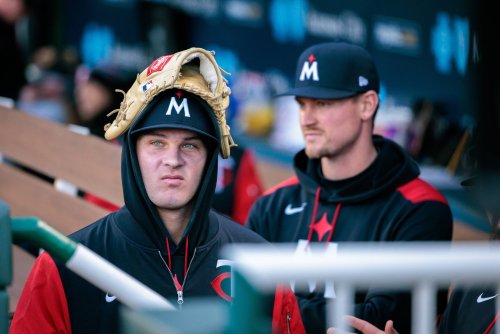
The Minnesota Twins started 3-6 for the second year in a row.
Vegas projects the St. Louis Cardinals to win 76.5 games this year, their lowest total in 17 years. They swept Minnesota to start the season. The Chicago White Sox lost 121 games last year; they beat the Twins 9-0 immediately after St. Louis swept them. According to ESPN, Minnesota had an 83.6% chance to beat the Houston Astros while leading 7-5 at the top of the ninth. Griffin Jax blew the save, and Houston won the series.
Minnesota finished last season 12-27 and missed the playoffs after a 70-53 start. They are 15-34 since last August 18, the second-worst record during that time. Only the White Sox (13-34) are worse. The Twins didn’t sell out Opening Day. 16,082 people saw their 6-1 win over the Astros; 14,638 saw them blow a 7-1 lead the next day.
Many statistics explain Minnesota’s slow start. However, one stands out above the rest.
The Twins are reportedly $425 million in debt.
How you see that number likely says more about your priors than your insight into Minnesota’s operations. Dislike Twins ownership? Then, they didn’t invest enough to create an engaging product. Fancy yourself a savvy businessperson? Gotta balance the books.
However, the answer lies somewhere in between.
On the surface, $425 million in debt seems straightforward. The Twins are losing money, so they cut payroll by $35 million after winning their first playoff series since 2002. Last year, reducing payroll hampered their depth, which cost them at the end of the season.
There are many ways teams make money, including tickets and concessions. However, season-ticket holders drive much of any team’s revenue because the teams get that money upfront, and season-ticket holders tend to be the biggest spenders.
Still, television revenue is a massive revenue source, and I will focus on that. A conflict between Comcast and Bally Sports resulted in Xfinity blacking out the Twins’ games last year, meaning much of the fanbase saw their 7-13 start and 12-27 collapse but little of the winning.
Sinclair Broadcast Group operates the Bally Sports Network, now FanDuel Sports Network. Sinclair paid $54 million to broadcast Twins games in 2023. However, Minnesota’s deal with Sinclair expired last year, and they extended on a smaller, one-year contract in 2024.
Instead of re-upping with Sinclair this year, the Twins struck a deal with MLB to broadcast their games. People who want to watch the team must either pay for a “sports package” through their cable provider or $99.99 per year ($19.99 per month) to watch them via Twins.TV.
To do some back-of-the-napkin math, the Twins must sell 540,000 yearly Twins.TV subscriptions to earn $54 million on their television rights. 5.8 million people live in Minnesota, 3.7 million of whom live in the Twin Cities metro. That means the Twins must capture 9.3% of Minnesota’s population or 14.6% of the metro.
That doesn’t seem impossible, except the Twins’ early attendance numbers indicate that fans have disengaged from this year’s team. Who’s to blame them? They cut payroll after winning in the playoffs and collapsed last year. People were excited about an ownership change, but Justin Ishbia pulled out at the last second and bought the White Sox. Royce Lewis and Brooks Lee got hurt. The Twins start 0-4, and people stay home on a sunny Minneapolis weekend.
So, how do the Twins engage fans while running a sound business?
Finding a solution requires second-level thinking. In 1984, Carl Pohlad bought the Twins for $44 million. The Twins are worth between $1.5 and $1.7 billion now. Any ownership group with the funds to support a yearly loss will do so if they can because sports franchises grow exponentially in value each year.
However, ownership groups must maximize their season-ticket holder base and broadcasting contract to mitigate operating costs.
Teams must win in consecutive years to build a season-ticket holder base. Attendance numbers reflect the previous year’s record because people often buy tickets, even for individual games, before the season starts. The Twins have a season-ticket base of about 12,000, and they couldn’t capitalize on the Bomba Squad’s success in 2019 because of COVID restrictions a year later. However, so did losing seasons in 2021 and 2022 and last year’s collapse.
We must also consider television revenue differently because people have stopped paying for cable. Television markets still matter but less than under the old cable model.
Before MLB teams started offering streaming services for individual teams, fans had three options. They could buy local cable or get MLB.TV to watch every out-of-market game if they were outside Minnesota. The Twin Cities are America’s 15th-largest TV market. Detroit (11), Phoenix (12), Tampa (13), and Seattle (14) are ahead of Minneapolis-St. Pau,. Miami (16), Cleveland (17), and Denver (18) are below. Most fans watched through their cable package and were subject to local blackouts, limiting the teams’ broadcast reach.
However, TV markets were always shorthand for revenue and matter less as broadcasting moves online. Not all markets are made equal. Detroit, Cleveland, and Minneapolis-St. Paul are full of die-hard sports fans. Phoenix, Tampa, and Miami have many displaced fans, including people from Minnesota. Seattle and Denver sit somewhere in between.
More pertinently, people throughout the nation can purchase an online broadcast. Restrictions apply; read the fine print. However, the next ownership group should tap into the entire Twins fanbase and build upon it. Capture as much of Minnesota as possible and get displaced Twins fans in New York, Los Angeles, and Des Moines to purchase Twins.TV broadcasts. Under this model, parts of Phoenix, Tampa, and Miami are also Twins Territory.
The next ownership group must focus on engaging Twins fans, no matter where they are, while giving people at home a reason to go to games. However, the current group is trying to keep its books clean to get an offer closer to $1.7 than $1.5 billion. Everything will be on hold until then.
Think you could write a story like this? Hockey Wilderness wants you to develop your voice, find an audience, and we'll pay you to do it. Just fill out this form.
Recommended Comments
There are no comments to display.