


As we prepare to head into the final month of the MLB regular season, it’s hardly too early to look to the offseason -- especially when considering the Minnesota Twins have lost 13 games in a row to fall headlong into the first overall slot as far as draft position is considered.
With a likely new GM/power structure in place, it’ll become evident pretty quickly who they like or don’t like among the holdovers from a flawed, but in a number of places talented roster. The impetus on the new GM -- even if it’s Rob Antony or a holdover, for what it’s worth -- will be to make their mark on the franchise, essentially putting the shovel into the ground to dig in and break ground on the future to come for this franchise.
And while that might mean a mass exodus of more than just fringy talent on the 40-man roster -- because some players will clearly be viewed differently than they were by Terry Ryan and company -- it also means that new executive will have to make some key decisions to allocate, or perhaps re-allocate talent in place to avoid not only logjams that have occurred, but also to set the team up for sustained success, hopefully in the near-ish term.
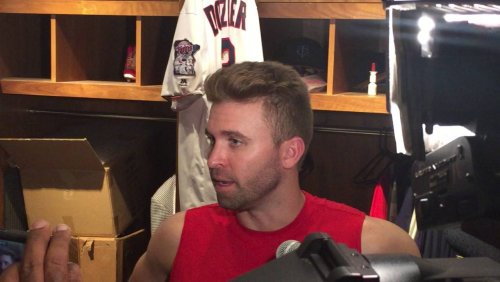
Essentially, what it boils down to is that one of the biggest keys, if not the biggest, is whatever happens with Brian Dozier. The facts are impossible to ignore; he’s on a pace for roughly 40 home runs should he continue his current pace to 700 plate appearances -- a mark he’s reached in each of the last two years. Keep in mind that pace also includes a rough patch to start the season, as he’s hitting .269/.343/.543 right now in spite of being under the Mendoza Line in late May.
Since manager Paul Molitor benched Dozier in late May, his OPS has gone from .606 to .886 -- a 280-point increase. In the meantime, Dozier has hit .300/.367/.640. That’s in just 88 games, as he’s hit 28 home runs, 25 doubles and five triples. According to Baseball Reference, Dozier’s 162-game paces for that stretch -- and this will blow your mind -- are as follows: 52 (!) home runs, 47 doubles and 10 triples.
That’s right; 109 extra-base hits. That 1.007 OPS is higher than every MLB hitter has put together this year except for one -- David Ortiz. That’s higher than Kris Bryant, Mike Trout, Josh Donaldson, Jose Altuve....you get the point. Yes, it’s not in a full season, but it does help gain some traction and context to just how good he’s been.
No Minnesota Twin has ever had 100 extra-base hits in a season.
No Minnesota Twin has ever had 90 extra-base hits in a season.
Just one Minnesota Twin has ever had more than 80 extra-base hits in a season -- Tony Oliva with 84 back in 1964.
So we get it; Dozier is great. And if this current run amounts to half a season of production, we do sort of have a blueprint for that with Dozier in the last two years. Instead of the second-half fade which plagued him in 2014 and 2015, he’s cut out a huge swath of the middle of the season and absolutely gone nuts. That doesn’t necessarily mean it’s true that he can only perform for half a season, but you can understand why people might think that way.
Dozier is also not a baby, and that isn’t meant as derisive or as a joke. He’ll be 30 very early next season, thanks in large part to coming on with the Twins as a senior sign out of Southern Miss in 2009, as well as a relatively long developmental path. All the more reason to give Dozier credit, of course, but as other outlets have noted, he’s also got old-man skills. That is, a lower batting average, with a good eye and lots of power to the pull side. Gambling on that gets more and more risky as a guy gets on the wrong side of 30.
That’s not to say the Twins don’t hold the cards here. Dozier is not only remarkably valuable in a trade, but also to the Twins, who have ample questions up the middle. But he’s signed for just two more years at $15 million total. Jason Kipnis -- a comparable player -- is owed somewhere along the lines of $40 million over the next three years if he takes a buyout of his $16.5 million team option in 2020, when he’ll be 33. There’s little doubt Kipnis is worth every penny, but that also means that Dozier’s deal is an incredible value to the Twins.
[caption id=attachment_6187" align="alignnone" width="617]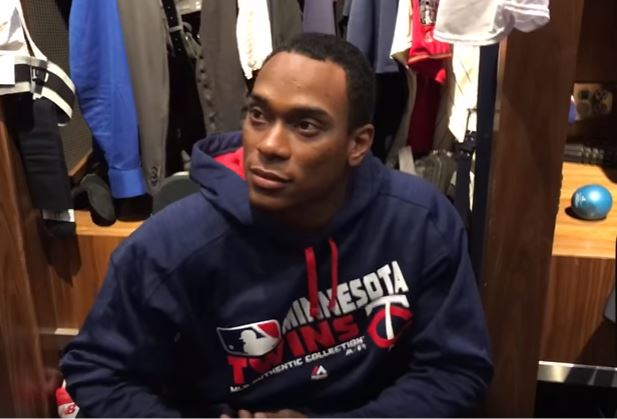 Jorge Polanco would be the primary benefactor of a Dozier move, as he'd almost certainly slide over to be the starter at second base.[/caption]
But that’s just it; he’s only signed for two more years. There’s no guarantee that he’ll be nearly this good in his age 32 season even if the Twins were to extend him further. Enter Jorge Polanco, who also clouds the picture a bit. Polanco is hitting .305/.340/.447, and is a ready-made replacement should the Twins decide to move Dozier. Second base is his best position, with third base a close-ish second and shortstop probably a somewhat distant third. Basically, it’s a sliding scale that Polanco is on the wrong side of, given the uncertainty in the near term at short for the Twins, with the certainty they have in Dozier and the supposed certainty they have in Miguel Sano, at least publicly.
Moving Dozier to clear room for a future middle infield of Polanco and Nick Gordon makes sense on some levels. Gordon shouldn’t be too terribly far away -- he’s headed to the Arizona Fall League to hone his skills against other close-to-ready prospects this October -- after posting a .291/.335/.387 line at High-A Fort Myers this year. As a consensus top-100 prospect, he has the sort of pedigree -- by the way, you’ve also heard of his dad (Flash) and brother (Dee) -- to jump from Double-A to the majors, with potential to be a very good defensive shortstop from the word go. Don’t put too much stock into minor league fielding percentage, as fields aren’t as neatly manicured as Target Field, among other reasons. For instance, Andrelton Simmons -- largely regarded as the best defensive shortstop in the game -- made 28 errors as a 21-year-old shortstop in High-A. Gordon isn’t Simmons by any stretch, but is only 20 and virtually every talent evaluator has said he’s a plus defender in the future.
There’s also capable help in the meantime, as Eduardo Escobar is a two-win player in the recent past despite not really getting going this year. Consistent playing time -- or lack thereof -- could be a huge issue here. Nevertheless, Escobar is a more than competent hitter and fielder as the Twins wait for Gordon to come along, and that would allow Polanco time to get comfortable playing second base moving forward.
Basically, it boils down to what the Twins can get for Dozier. He’s not truly in the most elite class of second basemen -- your Altuves and Canos, etc. -- and second base isn’t at the top of the position player pedestal like shortstop, center or catcher. But he’s still an uber-productive player at the top of his game with a lot to offer to a team who needs help to the right of second base. If the Twins could snag a really nice No. 2 starter -- Julio Teheran-level, perhaps -- is that enough for them to make a move?
It’s just a theory. A 1,200-word theory. Thoughts? Leave some in the comments below!
Think you could write a story like this? Hockey Wilderness wants you to develop your voice, find an audience, and we'll pay you to do it. Just fill out this form.
Recommended Comments