
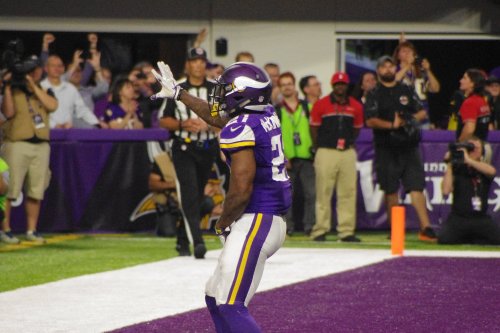
The Vikings are bad at running the ball.
It's an unusual state of affairs, and it's not something that we expected to see going into the season; the running back corps was known to be excellent, with future Hall of Famer Adrian Peterson backed up by the emerging young Jerick McKinnon. The offensive line was poor in pass protection, but had acquitted itself well in the running game last year.
This year, the rushing offense ranks dead last in Football Outsiders' DVOA, rush yards per attempt, and expected points gained on rushing plays. By any number of measures, this is the worst rushing offense in the NFL after a year where they ranked eighth, fourth and second in those respective metrics.
While I argued that the running failures were on both Peterson and the offensive line earlier in the year, I'm of the opinion that McKinnon shares much less responsibility for the performance of the running game when he has been in than Peterson did for those running plays.
I've received a little bit of pushback on this, though, and some have argued that McKinnon's vision is at fault for the low yardage and I've strongly disagreed. One of the people I've talked to about this has detailed examples from the game against the Houston Texans to outline his point.
https://twitter.com/GregTKaiser/status/787326105501904896
I have to admit this example is confusing to me. The play is below, slowed down.

I don't see how this could possibly be construed as McKinnon's fault. One could more easily make the argument if one isolated a still image:

But this still doesn't seem like a reasonable argument; McKinnon would lose on a cutback because his helmet read on Joel Heath would demand he continue to bounce it outside. It is also an absurd demand to make of a running back to cut as he's changing the ball.
This isn't a play whose design is meant to attack the bubble between the guard and tackle, and by the time McKinnon receives the ball, that bubble closes because D.J. Reader squeezes the lane before Berger pancakes him.
More importantly, by the time McKinnon's foot lands on the ground, the play is dead—if there was a cutback opening, it wasn't open long enough for him to do anything about it.
https://twitter.com/GregTKaiser/status/787327217067962370
This one makes much more sense to me as a locus for criticism, and in hindsight, McKinnon should have pushed upfield, but a winning block from Pruitt on the reach would have busted McKinnon for a big gain and the play design was clearly meant for the sweep back to bust up through the two tight ends:

There are definitely reasons to be sympathetic to McKinnon, too, as he couldn't have known with much forethought the result of Pruitt's block by the time he could have made a decision to cut underneath Pruitt, but I agree with Greg Kaiser that had McKinnon made the right helmet read and cut to the near hip of the tight end, it would have been a much better play.
I'm not so sure about the certainty of a big gain, as Brian Cushing would have turned downfield with McKinnon and with an angle, but following the play design here was not the correct decision.
https://twitter.com/GregTKaiser/status/787327799014993920
This is a play I actually thought demonstrated more good than bad from McKinnon, though I understand why it looks like a bad read initially. This showcases advanced running back skills and mature decision-making and should be used as an example that McKinnon creates yards instead of dropping them. But it won't look like that at first glance:

This is a draw play, so McKinnon has to delay before taking the ball, but the key here is not that there was this enormous lane McKinnon ignored before switching to it late; he pressed the lane in order to create the opening.
If you keep your eyes on Brian Cushing, the middle linebacker stacked over the nose tackle, it's clear that Cushing is reading the play and will attack whichever gap the running back chooses. If McKinnon doesn't take outside steps into the C gap, then Cushing never abandons the A gap that McKinnon eventually chose.
If McKinnon doesn't do that, Cushing meets him behind the line of scrimmage for a one-yard loss.
Incidentally, this play wouldn't have been a problem if the offense didn't bring another defender into the box while explicitly robbing themselves of the ability to block that defender. Sweeping Cordarrelle across the formation and snapping the ball before the defender chasing him ran out of the box meant that there was a free defender to take McKinnon on.
Regardless, this was a good play—not an average or a bad one—for McKinnon.
https://twitter.com/GregTKaiser/status/787329004126691328
McKinnon wasn't "pulled" as he had another carry on that same drive after Asiata ran it twice, it's true that Asiata had all the carries on the final drive of the game to run out the clock; a truth that I don't think tells us anything about how the coaching staff felt about McKinnon.
Regardless, Kaiser is correct that this is not a great run by McKinnon:

You can see him pressing the lane as he is forced to give up the designed run, but it would have been much smarter to press inside and attack outside. Still, I think it's a very understandable run and arguing that it's anything worse than a mistake by McKinnon would be going too far.
The slow motion is a lot more sympathetic to McKinnon than the original speed run, too, and I think it helps us understand the decision-making process that McKinnon undergoes here.
There are also times McKinnon showcased fantastic running ability and maturity. Below, he demonstrates adaptability, shiftiness, patience and explosion:

It looks even smarter in slow motion.

He wasn't perfect, and there were a few plays that McKinnon certainly left yards on the field, but throughout this game, I saw McKinnon add yards with vision, patience, agility and power. That's not something I saw with consistency from Peterson this year, and it's one reason I'm so high on the running back as a potential running back of the future.
Think you could write a story like this? Hockey Wilderness wants you to develop your voice, find an audience, and we'll pay you to do it. Just fill out this form.
Recommended Comments