


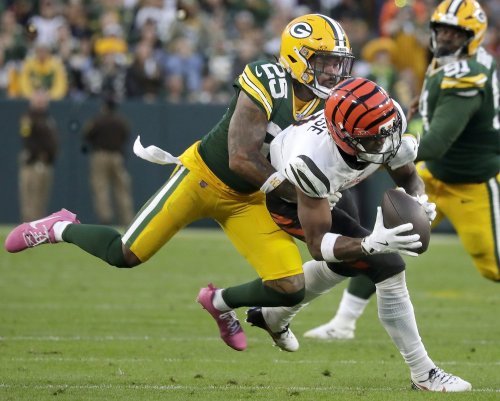
The Green Bay Packers' defense made history at the start of this season.
They were the first team in the Super Bowl era to open a season with four-plus sacks, 60 or fewer rushing yards, and 200 or fewer net passing yards allowed in consecutive games — and they did it against two of last year’s top-four offenses in EPA per play.
However, something shifted quickly over the last three games.
Green Bay got to face 40-year-old Joe Flacco twice in a three-week span. They generated 24 pressures against the Cleveland Browns in Week 3, but came away with just two sacks against a bottom-10 pass-blocking unit in efficiency. Then, they managed only one sack in Week 6 against the Cincinnati Bengals, who ranked last in pass-blocking efficiency.
In Week 4, the Packers faced a much more efficient offensive line against the Dallas Cowboys, though Dallas was missing two starters up front, including center Cooper Beebe. Green Bay generated 19 pressures but recorded just one sack, which came when Micah Parsons forced a game-saving tackle near the line of scrimmage in overtime.
So, what’s changed that’s making it difficult for Green Bay’s pass rush to finish off plays?
Even after their bye, Green Bay’s pass rush is elite: ninth in pressures, fifth in QB hits, fifth in PFF pass-rush grade. Quarterbacks know that if the ball doesn’t come out quickly, it won't come out at all.
In Week 3, Joe Flacco held the ball for 2.5 seconds or less on 40.5% of his dropbacks, completing 85.7% of his passes for one big-time throw and an 87.2 passer rating. On the other 59.5% of dropbacks, when he held the ball 2.5 seconds or longer, he completed just 42.9% of passes, with one interception and a 32.4 rating. Simply put, when he got the ball out quickly, his offense moved.
In Week 6, 54.5% of Flacco’s dropbacks came when he held the ball for 2.5 seconds or less, completing 20 of 23 passes for 160 yards. However, he completed just 45% of his throws when holding the ball for 2.5 seconds or more. Once again, he was far more efficient when he got the ball out quickly.
In Week 4, Dak Prescott completed 14 of 17 attempts when holding the ball for 2.5 seconds or less, throwing for three touchdowns and a 143.3 passer rating. Even when holding the ball for 2.5 seconds or more, he completed nearly 74% of his passes, making that game more of an outlier performance for him than anything the Packers did. Whatever Green Bay threw at him, he had an answer.
Jeff Hafley’s defensive scheme leans heavily on zone coverage. After Week 6, the Packers ran over 55% of their defensive snaps in Cover 2 and Cover 3, compared to just 19% in Cover 1. Overall, 77% of snaps came in zone and 19% in man.
The problem is that many of those zones have been soft, and Green Bay’s corners are naturally better in man coverage. As a result, Flacco and Prescott were able to pick them apart, knowing the Packers would struggle with the quick game – and spoiler alert, they did.
Teams have exploited what was known as Green Bay’s weakness heading into the season: the cornerback room. They’ve been successful when playing press, physical coverage at the line of scrimmage, but they struggle to hold their own for even two seconds if the pass rush doesn’t get home, which has hindered the defense’s ability to get stops, especially in the second half.
According to Sumer Sports, Green Bay’s defense ranks ninth in EPA/play in man coverage (60.53% success rate) and 18th in EPA/play in zone (51.59% success rate). The secondary is much better suited for man coverage, and considering how opponents have torn them apart in some soft zones, they may need to increase their man coverage rate.
Perhaps Hafley likes to run more zone to prevent the big play, but it doesn’t matter when the defense is getting gashed when running soft zone looks. Green Bay needs to mix things up and let its cornerbacks play to their strengths.
Think you could write a story like this? Hockey Wilderness wants you to develop your voice, find an audience, and we'll pay you to do it. Just fill out this form.
Recommended Comments
There are no comments to display.