

Quarterbacks on rookie contracts are a well-known competitive advantage in an era where tenured signal callers land mammoth, market-resetting deals each offseason. Eleven QBs account for over 20% of their team’s salary cap. When you have a high-caliber guy making rookie bank, his minor impact on the cap allows general managers to splurge on other positions and build a contending roster.
The most prominent current example is the San Francisco 49ers’ $800K man, Brock Purdy. After they took him with the last pick in the 2022 draft, Purdy’s first contract is uniquely cheap — relatively speaking, of course. Purdy's contract allowed John Lynch to retain star talent across the board, including Christian McCaffrey, Trent Williams, Deebo Samuel, George Kittle, Fred Warner, Nick Bosa, and Javon Hargrave. The Los Angeles Chargers had a similar window with Justin Herbert, the Kansas City Chiefs were more successful in Patrick Mahomes’ early years, and, tangentially, Tom Brady’s famous pay cuts were a crucial part of the New England Patriots’ ability to maintain a dynasty.
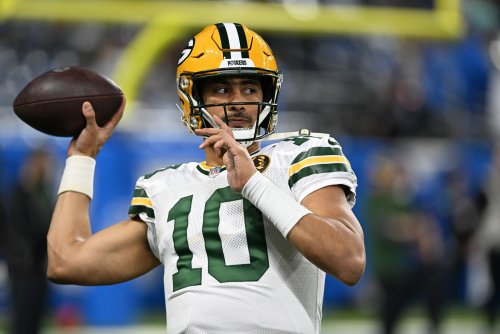
The Green Bay Packers have been the league’s most successful team in finding and developing talent at the game’s most important position. After going from Brett Favre to Aaron Rodgers to their new young phenom, Jordan Love, multiple generations of Packers fans are blissfully unaware of the plight of poor quarterback play. Green Bay’s strategy, at least in its past two iterations, has been to draft a quarterback with a premium pick before they need one. Then, after years of development within the organization, they take the reins when the time comes.
However, the economic drawback is sacrificing the years when your star player is at his cheapest. Love burst onto the scene down the stretch of the 2023 season, his first at the helm. In the subsequent offseason, he will receive a market-resetting deal because his initial four-year contract expended while he learned behind Rodgers. With enormous deals rolling in for Jared Goff and Trevor Lawrence, bearing average annual values of $53 million and $55 million, respectively, Love will take a massive bite out of Brian Gutekunst’s salary cap.
However, those years of development were essential to Love’s ascent. In particular, draft pundits touted him as a somewhat raw, albeit high-ceiling prospect coming out of Utah State. Therefore, that rendered the loss of his initial years a necessary concession. Still, that doesn’t mean Gutekunst isn’t finding ways to take advantage of the cap reprieve that rookie contracts provide.
As positional value at the running back and safety positions has suffered, the market for the best players at premium positions has soared. Nowhere has this been more apparent than in the wide receiver market. When the Jacksonville Jaguars handed Christian Kirk a four-year, $84 million deal after a few years of modest production in Arizona, an already-uphill battle to retain superstar Davante Adams became impossible. After Gutekunst traded him to the Las Vegas Raiders, he resisted fan and media clamor to replace him with an E-ticket pass-catcher, opting to rebuild the receiver room via the draft instead.
Gutekunst selected Christian Watson, Romeo Doubs, Jayden Reed, Dontayvion Wicks, Luke Musgrave, and Tucker Kraft in the two drafts following Adams’ departure. None have emerged as a true WR1. However, all of them have flashed in their roles, each contributing to a cohesive weaponry at Love’s disposal.
As Arizona Cardinals receiver Marquise Brown put it, when asked to name receivers typically underrated by fans, “The Packers receiving corps, because I be messing up they names but they be cooking.”
It’s fair to say that Gutekunst wouldn’t change a thing about that. Those around the league whose names aren’t being messed up are landing mega-deals. In the NFC North, Justin Jefferson signed a $35 million per year deal, and the Detroit Lions locked up Amon-Ra St. Brown with $30 million. A.J. Brown got $32 million annually in Philadelphia, and even less-proven guys like Jaylen Waddle, Nico Collins, and DeVonta Smith landed over $25 million themselves.
Watson, Doubs, Reed, Wicks, Musgrave, and Kraft's combined cap hits are approximately $11.1 million. We have already seen how that pales in comparison to the salary of just one star on the outside. However, for further context, Allen Lazard will count for $13.2 million against the New York Jets’ cap. Lazard was signed on the open market from Green Bay just one year ago. His contract is a hallmark example of the inflated receiver market, his poor 2023 performance notwithstanding.
Therefore, the Packers have done the hard part. They’ve gone out and found mid to late-round guys who can flat-out play. Now, they’ll reap the benefits at a significant discount for at least the next couple of seasons. It’s essentially the inverse of the dominant strategy in today’s NFL — and that perfectly inverted logic may have them a step ahead of the rest of the league.
Think you could write a story like this? Hockey Wilderness wants you to develop your voice, find an audience, and we'll pay you to do it. Just fill out this form.
Recommended Comments
There are no comments to display.