
If there's one thing I've learned in covering the NFL, it's that you'll end up wrong more often than right.
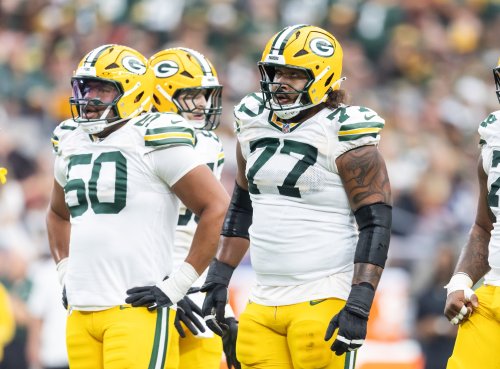
In the offseason, PFF ranked the Green Bay Packers’ offensive line 14th heading into the 2025 season, a stark contrast after finishing sixth in their 2024 rankings. I disagreed with their assessment.
The Packers replaced their weakest link, center Josh Myers, spent significant capital to bring in guard Aaron Banks, and drafted Anthony Belton in the second round. These moves, and the idea of 2024 first-round pick Jordan Morgan taking a step forward, suggested the unit would regroup, not regress.
Well, Green Bay's offensive line was even worse than 14th, and I look like a big dummy.
Even with some sympathy toward injuries, the offensive line was collectively one of the weakest groups on the roster. And with the Packers not exactly flush with cash, there isn't a mythical free agent who can immediately come in and anchor the group. Offensive line growth will need to come from within, through coaching and further development from the players already on the roster. The newly re-signed Matt LaFleur needs to find a way to squeeze every last drop of talent from the line to end the postseason disappointment streak.
As mentioned, the concept of replacing Myers with Banks and making the corresponding moves should have created a better offensive line than the 2024 group. Why did what looked on paper work out so poorly in practice?
Well, Banks technically did grade out better than Myers, in the sense that Banks' 53 PFF grade is legally higher than Myers' 52.9.
Banks dealt with injuries for much of the season and took time to find a groove. While even at his best, he somewhat elevated the run blocking, he was never a true difference-maker. What should have been a player upgrade, even considering he and Myers play different spots, was essentially a wash.
The real fallout of that swap was at the center. Again, on paper, Elgton Jenkins at center should have been a massive upgrade over Myers. For years, many analysts believed the center could be his spot. In practice, he didn't adjust well to the move and would have been better off staying at guard. Once Jenkins' season ended, the offensive line improved with Sean Rhyan moving to center.
At left tackle, Rasheed Walker massively regressed after a solid 2024 season and was consistently one of the worst-graded Packers. Between his penalties and how often opponents beat him, he was a liability by the end of the season. It wasn't a great look for a player in the last year of his deal. Still, he'll get a big payday this spring from another team.
At right tackle, you'll find no complaints here about Zach Tom, who continues to elevate the group as its top contributor. Unfortunately, Tom missed six games, including the Wild Card loss, and played just a snap in Cleveland. Injuries kept their best lineman from playing his best, which hurt the entire group.
However, the biggest issue came from the coaching staff. Belton and Morgan ended up playing a lot of snaps, but the coaching staff didn't properly prepare them. They praised both players for their versatility. Still, it became clear that the spots where they received the most training weren't their best.
It's easy to say with hindsight, but it's clear that Morgan is a tackle and Belton is a guard. Sure, they can play other spots. Still, the Packers should have prioritized training Morgan at tackle -- especially after a solid preseason at LT -- and Belton at guard, rather than letting Morgan flounder at guard.
Eventually, both young players settled into their best spots. Still, it shouldn't have taken so long to put these players in the most favorable positions.
All of the above led to Green Bay ranking second-worst in offensive line heading into the Wild Card Round. PFF ranked Green Bay's run blocking 21st and its pass protection 25th. Of the teams that reached the postseason, only the injury-devastated Los Angeles Chargers ranked lower. Chicago's front seven bullied that offensive line in the second half of the Wild Card loss and played a major role in the loss.
Green Bay has traditionally built extraordinary offensive lines. While many teams can't find five quality starters, the Packers usually have depth to spare.
With no first-round pick and limited cap space, the Packers need the players they have to play much better. LaFleur is sticking around as head coach, so it'll fall on him to find a way to generate internal improvement.
Data suggests Green Bay's offensive coaching staff has less experience than other teams', and bringing in more veteran coaches might be one answer. If Adam Stenavich isn't in Green Bay next season, it becomes even more pressing. LaFleur needs some tough self-scouting and a deep look at his coaching staff. I've long claimed that LaFleur needs more outside voices on his offensive staff, and a new offensive line coach might be the place to start.
There's certainly plenty of talent on the offensive line. Morgan looked good at tackle and should start next season on the left side. Belton looked well on his way to settling in at guard. Tom is fantastic, and Banks might improve once consistently healthy.
The team needs an answer at center and could use more depth, but the core group is clearly set. To ensure the 2025 version of the offensive line is an outlier rather than a pattern, Matt LaFleur needs to take a deep look at how his coaching staff can maximize the talent. There's a very good chance he needs to look outside his current staff to find those answers.
Think you could write a story like this? Hockey Wilderness wants you to develop your voice, find an audience, and we'll pay you to do it. Just fill out this form.
Recommended Comments
There are no comments to display.