


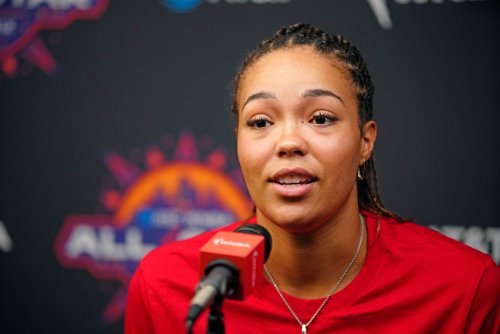
Following the Minnesota Lynx's 101-88 series-ending victory over the Phoenix Mercury, Cheryl Reeve discussed a conversation she had with Napheesa Collier before her historic night.
“I told the team before the game, 'Look, Phee's not gonna get 38 tonight,'” Reeve told the press. “After (the game), she said, 'Coach, you were right,' and she got 42.'”
Collier's 42 points set a new Lynx record for points in a playoff game. It broke fellow UConn star Maya Moore's record of 40, which she set against the Mercury on September 27, 2015. Collier's 42 points also tied the WNBA record for points scored in a playoff game. Collier's 80 combined points also set a new record for most points scored in consecutive playoff games. Perhaps the most impressive statistic is she scored those 80 points while playing 77 minutes and 58 seconds out of a possible 80.
Still, Collier was critical of herself after the game.
“I should have made my free throws,” Collier said, smiling. “I mean, I was just taking what the defense gave me and what my teammates were giving me.”
However, Collier might be oversimplifying her performance in the series. Mercury head coach Nate Tibbets explained the conundrum Collier presents for teams.
“Are you going to try and guard her one-on-one and take the twos? Or double, and they’re making threes?" he said. "She’s playing at such a high level.”
In the Mercury series, Collier fully displayed the problem she creates for defenses. She's one of the best post players in the game. Her footwork is flawless: Collier can back down players, drop her hips, and slide under bigger defenders like Mercury star Brittney Griner. She also possesses the ball-handling ability to take the ball back out of the post and isolate against those bigger defenders.
These two skills allow her to read the help defender and evaluate if she has time to work in the post or needs to step back and drive to the rim. When the Mercury puts a smaller defender on her like Natasha Cloud, Collier changes her mindset. She can utilize her size when she gets the ball at the perimeter and drives straight through Cloud. If Collier noticed Griner lurking in the paint to help defend, Collier posted up and used her footwork to get to a spot on the floor she was comfortable in, then turned around into a leaning jump shot that Collier made with deadly efficiency.
When all of these options fail, Collier can make threes as a stretch four. That ability seems to improve depending on the game's importance, as evidenced by her shooting 5 for 8 in the series.
In this series, Tibbets appears to have chosen to allow Collier to score based on her historic statistics. However, Tibbets threw just about every look at her. He doubled, they played zone, and he attempted to have Griner lurk to stop drives. Tibbetts had just about every Mercury player matched up against Collier at some point -- it just didn’t matter. Collier would decipher the new coverage within one play and continue to score at will.
When Collier didn’t score, she drew fouls. She shot 28 free throws in total in the two games. When she got double- or even triple-teamed, she passed out for threes. Collier read the defense and game so well that Collier only had four turnovers despite having a career-high 31.1% usage over the two playoff games. That means only 6.3% of Collier's total plays resulted in a turnover during the two-game series. To put that in perspective, that low of a turnover ratio would have ranked third in the WNBA during the regular season, while her usage would have ranked first.
Collier had eight assists through the two games. Most came from her recognizing the doubles and passing the ball out to whoever came off the double, resulting in the three. Basketball doesn't track who makes the assist before the assist or the "hockey assist." However, Collier was also setting up assists. She would pass the ball to the closest open player on the perimeter, who would rifle the pass to the open shooter, thus preventing a potential turnover by forcing a pass.
She does all of this offensively, and offense isn’t her best attribute. Collier was the Associated Press Defensive Player of the Year this year. Her excellence in rotation and individual greatness in isolation have gone unmatched all season.
Collier displayed historic greatness against the Mercury to guide the Lynx to the second round. Her greatness seems sustainable, given the talent around Collier and the bind she puts opposing teams in. The Lynx should be favored to win the next round against the Connecticut Sun and return to the finals. What might be the most encouraging, though, is Collier's self-criticism.
"I should have made my free throws," she said after the game.
Collier knows she's still ascending.
Think you could write a story like this? Hockey Wilderness wants you to develop your voice, find an audience, and we'll pay you to do it. Just fill out this form.
Recommended Comments
There are no comments to display.