


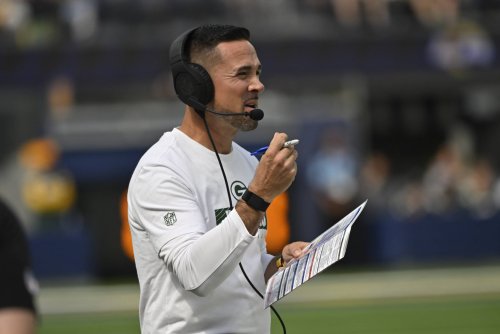
Matt LaFleur is one of the best offensive minds in the NFL, which was essential when the Green Bay Packers managed to go 2-0 following the MCL sprain that sidelined Jordan Love. LaFleur’s play calling has driven Green Bay to have the third-best rushing offense in average yards per game, trailing only the Baltimore Ravens and Washington Commanders. That savvy play calling has also put Love in a position to lead the NFL in touchdown passes entering Week 7 -- despite missing two games.
However, LaFleur gets overly clever in short-yardage situations. The Packers faced two crucial short-yardage plays against the Houston Texans on Sunday. Instead of running up the middle with Josh Jacobs, LaFleur called jet sweeps to Jayden Reed and Bo Melton. They combined for a loss of a yard on two rushing attempts, and Green Bay failed to convert on both downs.
There’s no reason for LaFleur to overcomplicate the game plan. The Packers were having success on the ground. Josh Jacobs averaged 6.7 yards per carry. His 27-yard run came when Green Bay attacked the line of scrimmage vertically.
Jacobs earns $12.5 million per year. Green Bay signed him to handle most of the carries on Sundays. He ranks in the top five in yards after contact, per Pro Football Focus, and is a top-eight running back in rush yards over expected, per Next Gen Stats. There's no reason he shouldn’t get the ball in those short-yardage situations.
It's not like the Packers must design jet sweeps and end-arounds to give Jacobs a breather. They have a productive second option in Emanuel Wilson. Among players in his draft class, Wilson ranks in the top 10 in rushing yards, yards per attempt, yards after contact, yards after contact per attempt, missed tackles forced, rushes of 10-plus yards, first downs, and rushing grade. He has proven a reliable option when Green Bay needs him to take a few snaps for Jacobs.
The idea of attacking the defense horizontally in short-yardage situations is borderline insanity. Why do anything but run vertically? Why risk losing yardage when the offensive line is blocking well? It's like running a toss with one yard to go. Don’t toss the ball five yards backward when you're inches from a first down. It just doesn't make sense.
Green Bay’s horizontal rushing game isn’t bad. Reed is the only wide receiver in the league with over 100 rushing yards, and he's a constant threat even when he doesn’t get the ball. Against the Indianapolis Colts, the Packers had Reed and Jacobs on the field. Malik Willis faked a handoff to Reed and gave it to Jacobs, who went up the middle, aided by Tucker Kraft coming inside to block.
Against the Tennessee Titans, Melton came in motion and lined up in the backfield, with Willis faking a handoff to him on an end around. Meanwhile, Wilson slipped into a backside screen, and Elgton Jenkins pulled to the right, effectively deceiving the defense. Wilson caught the pass and cruised into the end zone.
Entering Week 7, the Packers were tied with the Seattle Seahawks for the best rushing offense in the league despite ranking just 27th in run blocking. That speaks volumes about LaFleur's creativity in the run game. By having players shift inside and out, he has consistently put defenders out of position, contributing to a better flow in the running game.
On Sunday, Green Bay's two wasted possessions due to convoluted playcalling didn’t come back to haunt them, mainly because the defense bailed them out. However, that’s not sustainable. Sometimes, sticking to the basics should be enough to move the chains. LaFleur must internalize that to keep his team out of harm's way.
Think you could write a story like this? Hockey Wilderness wants you to develop your voice, find an audience, and we'll pay you to do it. Just fill out this form.
Recommended Comments
There are no comments to display.