

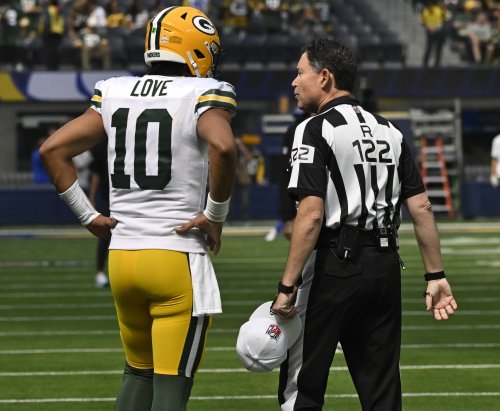
The bye week couldn't come at a better time for the Green Bay Packers.
Core players like Jordan Love and Jaire Alexander are dealing with injuries, and a week off might allow the team to address some season-long concerns.
Once again, the Packers were their own worst enemy -- plagued by drops, missed field goals, and a plethora of penalties. Against lesser teams, Matt LaFleur's squad could overcome these self-inflicted wounds and come out on top. It wasn't enough against the Detroit Lions, arguably the NFC's best team, and the Packers fell to 6-3.
Granted, 6-3 isn't a bad place to be halfway through the season. There's more to like about what the Packers have done than dislike. Still, Green Bay must stop hurting themselves weekly if they hope to make a deep playoff run. What's the answer to minimizing these momentum-killing penalties?
The Packers outplayed the Lions in every number except for the final score. Unfortunately, the final score is the king of numbers. Detroit executed better and left a rainy Lambeau Field with a victory and first place in the NFC North.
Four-hundred and eleven total yards of offense compared to 261 doesn't mean a whole lot when you have six drops, three botched snaps, a missed field goal, a pick-six, and 10 penalties. And it's not like the Lions game was a one-off anomaly.
The Packers have the fourth-most drops, second-most pre-snap penalties, and second-worst field goal percentage this season.
The Packers brought in a new kicker to solve the last problem (though he missed a field goal on Sunday), so they must solve the first two problems during the bye week.
"Some of them are lack of focus when you're talking about the pre-snap penalties,” LaFleur said on Monday. "We've had far too many of those. They got us yesterday in a critical situation where I don't think they were going to run a play, and we jumped offsides."
After a sloppy Week 1 loss in Brazil, I wrote that the penalties were a fixable issue that the Packers could resolve as the season went on. Yet, week after week, LaFleur has had to address the amount of penalties the team commits. Their three losses were to good teams they could have beaten, but the best teams don't make this many mistakes. It's part of the team's identity at this point in the season.
The “it's a young team” excuse doesn't hold weight when most of the team has at least a season and a half worth of playing time, and I'm sure LaFleur would agree.
Love correctly said that this team hasn't played their best football yet.
"We’re still a really good football team," the quarterback said after Sunday's loss. "I think a lot of the mistakes are self-inflicted."
That's not the worst thing in the world. The Packers are a good football team despite their mistakes. They have room for growth, and it's better to grow during the season than start strong and fizzle out (hi, New Orleans). But how can they take that sentiment and make the necessary changes to make it a reality?
I have never made a mistake or committed an error in my life, so I really had to ponder this.
It's hard to pivot and make significant, broader changes when preparing for a specific opponent every week. The bye week offers a chance to step back, look at the larger picture, and focus on core problems.
According to Tucker Kraft, the first step is to self-scout during time away from the team.
"Coming out of the bye, guys need to get rested up," Kraft
While the lack of discipline starts at the top, Kraft is correct that it's up to each player to examine their approach and how they address the pressure. It's a vague, unsexy answer. Still, every player has a different approach that works for them. Some time away should offer a chance for each individual to reflect.
LaFleur also agrees.
“When we get back and have practice next Monday," he said. "There's got to be an intentionality behind that needing to be cleaned up."
He plans to increase competition and challenge every player to find one area they can improve upon.
On the team level, LaFleur says the staff will take a deeper look at their tape from the second half of last season when they turned things around and became one of the league's hottest squads. That offers an opportunity to find lost nuggets of wisdom and reintroduce them into this year's process.
The Packers can also let the scheme work for them more efficiently. A back-to-fundamentals approach is a football cliché, but it's a cliché for a reason. Trusting that the play-calling can set the offense up for success eliminates some of the mental guesswork, allowing players to focus on their responsibilities without the overthinking that can lead to pre-snap penalties. Utilizing more of a hurry-up offense will enable the offense to play better ball, and it won't give players the time to overthink and risk committing penalties.
Even though it lingered for two months, Green Bay's penalty problem is still fixable. The coaching staff is aware of the problem and is challenging individual players to self-reflect during the bye week while they look to last year's tape for advice. Practice will likely be focused on cleaning up these messes by drilling the fundamentals and letting the scheme do more heavy lifting. If nothing else, the Packers can start bribing the refs like rival teams' fans seem to think they do anyway.
Think you could write a story like this? Hockey Wilderness wants you to develop your voice, find an audience, and we'll pay you to do it. Just fill out this form.
Recommended Comments
There are no comments to display.