


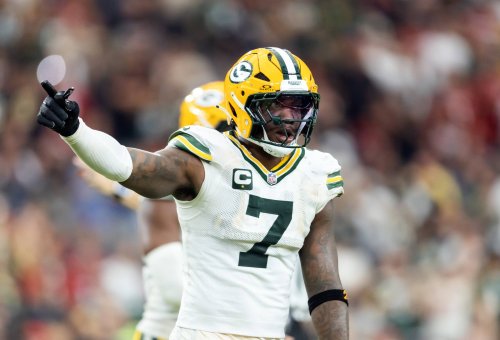
Reinventing the way they generate pressure will become one of the Green Bay Packers’ primary tasks under Jeff Hafley following Micah Parsons’ season-ending knee injury. When Parsons was on the field, Green Bay had the luxury of rushing with four and still affecting the quarterback, even without leaning heavily on coverage rotations or pressure disguises.
However, that margin for error no longer exists after his injury. Without a true game-wrecker up front, simply lining up and winning won’t be enough. The Packers are mostly relying on the same pass-rushers they had last season, a group that finished in the bottom 10 in pass-rush win rate, but without Kenny Clark after the Parsons trade and with Devonte Wyatt lost for the year.
As a result, creativity has to become the foundation of Jeff Hafley’s scheme. Fortunately for him, Green Bay’s defense still has two X-factors who could emerge as the front seven’s best allies in the pursuit of consistently bringing down quarterbacks: Edgerrin Cooper and Quay Walker.
Cooper and Walker have had issues in coverage this season. Per Pro Football Focus, they rank 25th and 81st, respectively, among 92 linebackers with at least 100 coverage snaps in passer rating when targeted. But with Parsons out, Green Bay must generate pressure differently — a shift that could allow both players to lean more heavily into the strengths they’ve shown throughout their time with the Packers.
In practical terms, that means giving both players more opportunities to rush the passer.
That hasn’t been a major part of the plan until Parsons’ injury. Walker has rushed the quarterback on just 13.3% of passing plays, while Cooper sits at 10.3%. For context, those rates rank 23rd and 36th, respectively, among 38 linebackers with at least 50 pass-rush attempts. Both marks also represent a dip from last season, when Walker and Cooper rushed the passer on 14.5% and 16.8% of their passing snaps, respectively.
Last year, Cooper finished the season as the second-highest-graded off-ball linebacker in pass-rush grade. He recorded more sacks than Lukas Van Ness and posted the second-highest pass-rush win rate on the roster among players with at least 30 pass-rush attempts, trailing only Brenton Cox Jr.
Cooper profiles as an effective gap shooter, enhancing his value under simulated pressure. His ability to trigger quickly and close space allows the Packers to threaten interior lanes without committing to high-risk blitz structures. That distinction matters because conventional pressure packages increase stress on the secondary if the rush doesn’t get home — an area Hafley has clear incentive to protect, given the volatility in Green Bay’s cornerback group.
Simulated pressures offer a more efficient alternative. By altering which defenders rush and which drop, the Packers can create pressure through disguise rather than volume. Regular rushers falling into coverage while second-level defenders attack the quarterback forces protection rules to adjust post-snap, increasing the likelihood of disruption without exposing the coverage unit. In that framework, Cooper’s downhill burst becomes a schematic asset rather than a coverage liability.
Much like Cooper, Quay Walker also profiles as a capable gap shooter. The key difference lies in how Green Bay can protect him on the back end when he’s incorporated into simulated pressure looks. In those packages, Walker isn’t asked to do one thing consistently — sometimes he’s attacking the quarterback, other times he’s dropping into coverage. When he drops, the quality of the coverage assignment matters.
According to Pro Football Focus, Walker ranks 114th among qualified linebackers in coverage grade and 16th in yards allowed in coverage. His struggles tend to surface when he’s isolated or tasked with handling complex responsibilities in space. Simulated pressures can mitigate that by creating more favorable coverage looks — shorter zones, defined landmarks, and throws forced underneath — allowing Walker’s athleticism to manifest without exposing his weaknesses.
Hafley should have some wrinkles to work with. There's still room for Green Bay’s defense to evolve — and that likely means getting Walker and Cooper more involved in the pass rush. Replacing Parsons was never going to come through a single adjustment. The Packers must be creative to cover for losing him.
One of those wrinkles can come from expanding the linebackers’ pass-rush roles, sending them through different gaps and from varied angles while rotating coverage responsibilities behind them. By blurring the line between who is rushing and who is dropping, the Packers can present quarterbacks with pressure looks that haven’t shown up on tape this season.
Think you could write a story like this? Hockey Wilderness wants you to develop your voice, find an audience, and we'll pay you to do it. Just fill out this form.
Recommended Comments
There are no comments to display.