


Brian Gutekunst stood at the podium for his annual season-ending
"There's times we kind of broke out, and then there's times we'd have these lulls where we just we just we weren't probably playing as well as we would like," Gutekunst said. “There was some transition to a new scheme, but I think we didn't grow into that consistent front like we had hoped. But there were times that we showed it, so I know it's capable. I think we've got the right guys."
A month later, Gutekunst spoke with reporters at the league’s annual meetings, where he emphasized that one of Green Bay’s core mandates was the ability to pressure the quarterback with four rushers. That focus was hardly accidental. Just two weeks earlier, Philadelphia had won the Super Bowl by overwhelming Patrick Mahomes without relying on extra blitzers.
Green Bay followed that mandate in the draft, selecting edge rushers Collin Oliver and Barryn Sorrell, along with interior defensive lineman Warren Brinson. The splash came in August with the blockbuster Micah Parsons trade, a move that instantly elevated Green Bay’s front seven.
Devonte Wyatt, Lukas Van Ness, and Rashan Gary all posted strong statistical starts to the season, reaching pressure totals in four games that had taken more than two months to achieve a year earlier. More importantly, the biggest improvement from what Green Bay’s defense had been a year earlier was its ability to generate pressure with four rushers without requiring Jeff Hafley to deploy overly aggressive pressure packages or complex coverage looks.
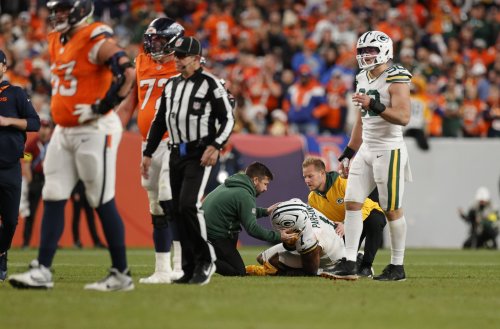
However, Parsons’ season-ending knee injury may force the Packers to fall back on many of the same creative tactics it relied on a year ago.
Entering Week 16, Parsons led the Packers with 79 total pressures. For context, Rashan Gary ranked second with 47. No other Green Bay pass rusher is near Parsons’ level. That gap helps explain why the Packers ranked 10th in pass-rush win rate this season despite sitting 29th in blitz rate. The ability to win with four rushers was not a schematic accident — it was the Micah Parsons factor.
The Packers may no longer have the luxury of generating consistent pressure with four rushers. Last season, they posted a 35% pass-rush win rate, a bottom-10 figure in the league. That was the reality of Green Bay’s pass rush without Parsons, and it closely resembles the group they now have again — with the exception of Kenny Clark and an injured Devonte Wyatt, who had been the Packers’ best interior defensive lineman this season.
Green Bay can no longer afford to be a defense that consistently drops seven into coverage. That privilege disappears when a generational edge rusher is lost for the season. Keisean Nixon and Carrington Valentine are not built to hold up if quarterbacks are given seven seconds to throw on every down, which is exactly what will happen if the Packers fail to adapt.
Hafley will need to diversify the game plan with more exotic pressure looks. Still, Edgerrin Cooper and Quay Walker are excellent blitzers, allowing double A-gap pressure looks and simulated pressures to be used more often. Creativity will be the defense’s best ally if Green Bay is going to remain an effective unit.
The Packers can still field a top defense despite losing Parsons. Just a year ago, they ranked in the top-10 in both EPA per play and total EPA without a true game-changing edge rusher. At the same time, there is no ignoring how much Parsons’ absence hurts Green Bay’s Super Bowl odds.
It is a difficult situation for everyone at 1265 Lombardi Avenue, but nothing is lost. This defense has already shown it can be disruptive without generational talent in its arsenal, and it will be asked to prove it again.
Think you could write a story like this? Hockey Wilderness wants you to develop your voice, find an audience, and we'll pay you to do it. Just fill out this form.
Recommended Comments
There are no comments to display.